GLP-1 medications — semaglutide, tirzepatide, and similar drugs — were added to Precision Nutrition's curriculum in 2026 because so many clients now arrive on them. These medications suppress appetite and slow gastric emptying, often causing clients to eat dramatically less without any coaching intervention at all. That's not automatically a problem — but it changes what a coach needs to watch for. The job shifts from encouraging consistency to protecting against the risks of rapid, medication-driven weight loss: inadequate protein, micronutrient gaps, and muscle loss, all while staying firmly within a nutrition coach's scope of practice around the medication itself.
Chapter 19 closed by naming GLP-1 coaching as one specific version of the special-scenario pattern it introduced. This chapter goes deeper into that single scenario, because Precision Nutrition added it as its own chapter for 2026 given how common these medications have become in real coaching practice.
How GLP-1 Medications Change the Coaching Picture
GLP-1 receptor agonists were originally developed to manage blood sugar in type 2 diabetes, and have since become widely used for weight management. The practical mechanism worth knowing as a coach: these drugs mimic a gut hormone that signals fullness to the brain, and they slow how quickly food moves through the stomach. The effect for a client is often dramatic — someone who previously struggled to eat consistently may suddenly find they barely want to eat at all, without having changed a single habit on purpose.
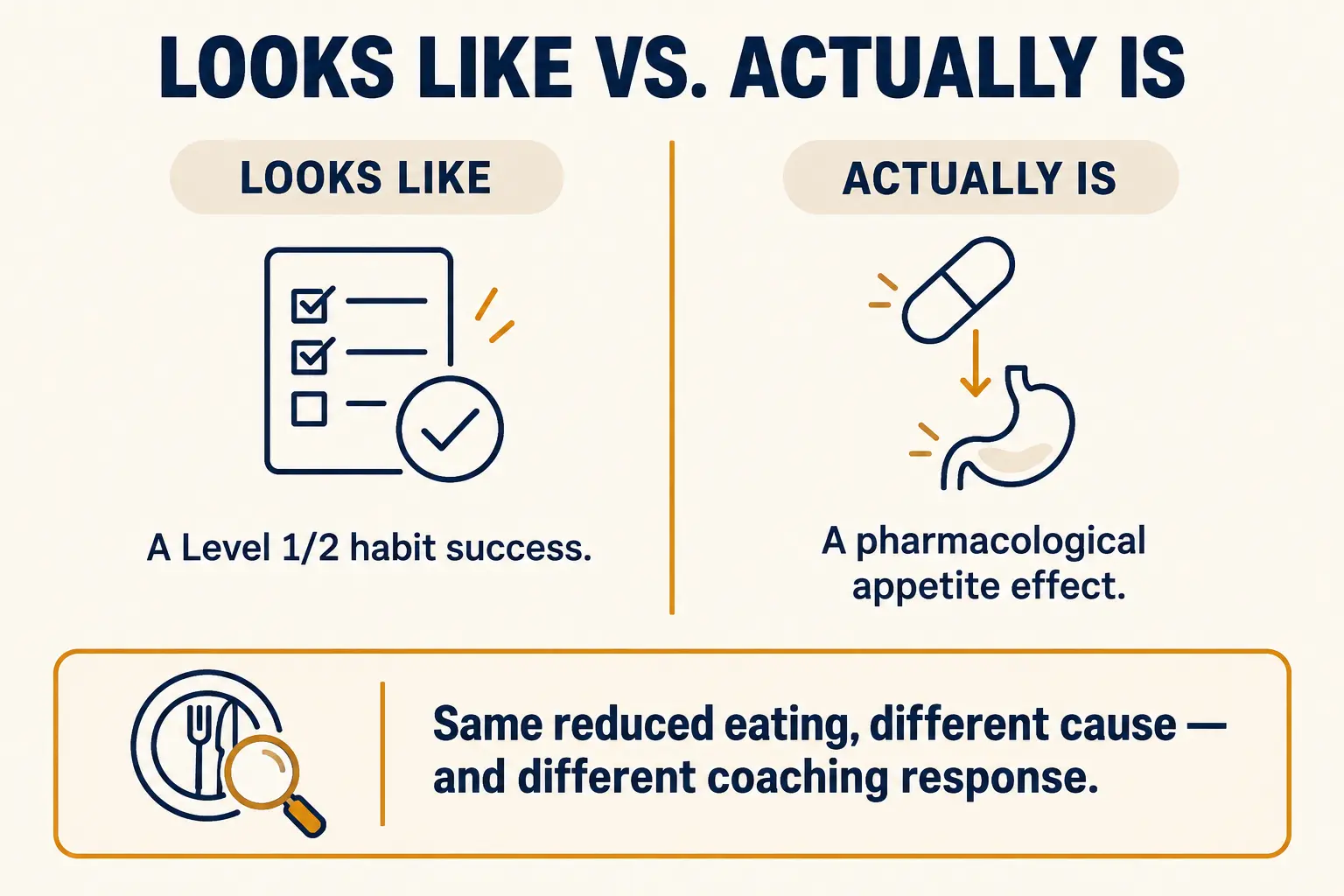
This is where the framework from earlier chapters can mislead a coach if applied too literally. A client eating far less than before can look, on the surface, like a Level 1 or Level 2 success story — the kind of behavior change Chapters 16 and 17 spent real time on. But a client who says "I just don't want to eat anymore" on a GLP-1 medication isn't describing a habit they built. They're describing a pharmacological effect, and that distinction matters enormously for what a coach should do next.
The stakes are worth making concrete. A client eating meaningfully less than their body needs — sometimes far below what would ever be recommended as an intentional target — is at real risk of inadequate protein and micronutrient intake, and of losing meaningful muscle mass alongside fat mass, even while the scale moves in what looks like the "right" direction. The risk here isn't inconsistency the way Chapter 16 describes it. It's under-fueling that's easy to miss precisely because the client isn't complaining about hunger the way an unmedicated client on a restrictive diet typically would.
Protecting Clients From the Risks of Rapid Weight Loss
None of this means a coach should discourage a client from using a medication their physician prescribed. It means the coaching conversation shifts toward protecting the parts of health that a suppressed appetite can quietly undermine.
- Protein prioritizationEven within a much smaller overall intake, protein should come first at each eating occasion — it's the single most protective lever against losing lean mass during rapid, appetite-suppressed weight loss.
- Micronutrient adequacyA much smaller volume of food makes it genuinely harder to hit key micronutrient targets, so nutrient-dense choices matter more here than they would for a client eating a typical volume.
- Hydration & GI side effectsNausea and slowed gastric emptying can reduce fluid intake alongside food intake, so hydration deserves its own explicit check-in rather than being assumed to be fine.
- Rate-of-loss monitoringUnusually fast weight loss is a signal to loop back to the prescribing physician, not something to quietly let ride just because the client is pleased with the number on the scale.
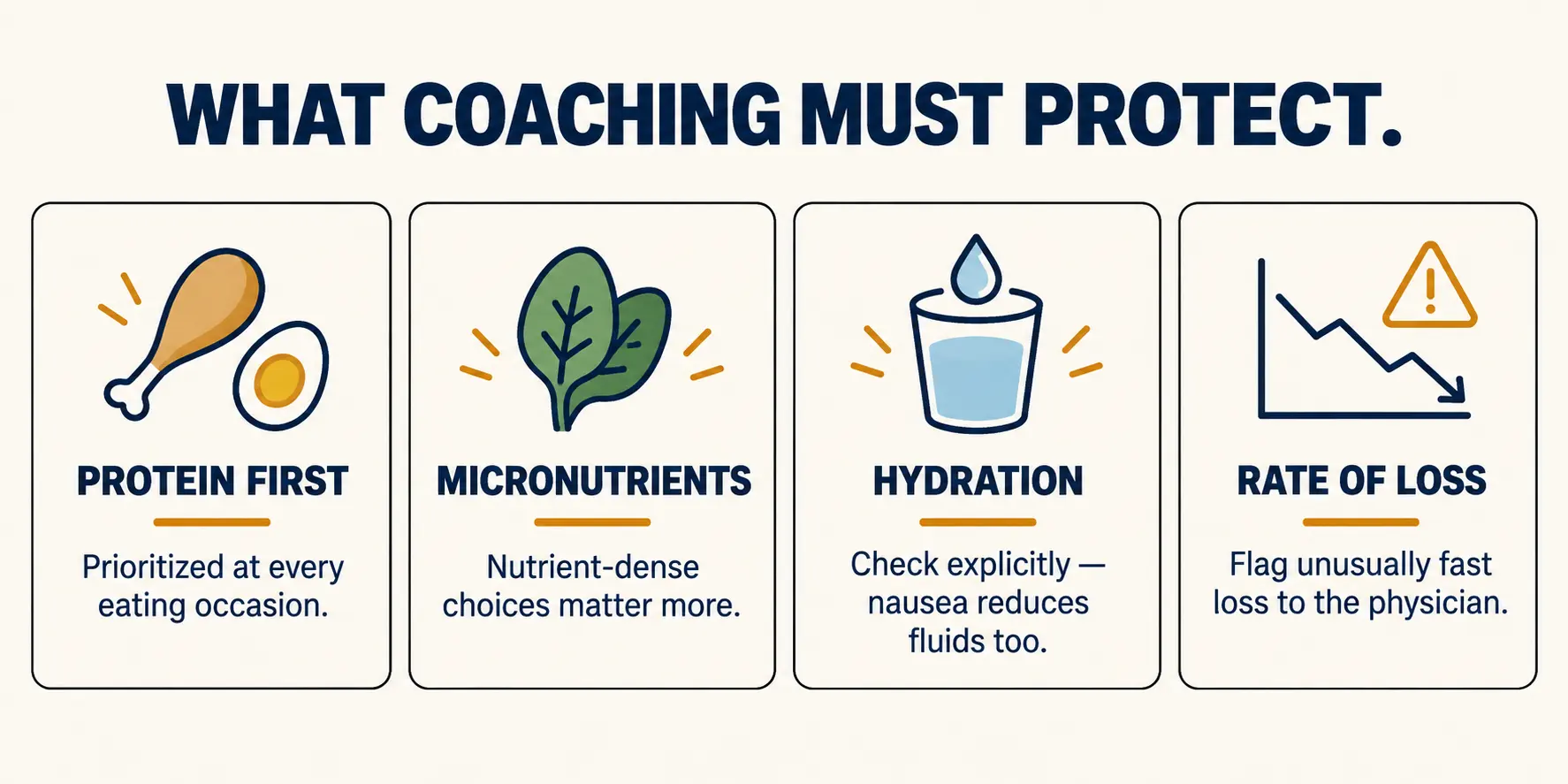
These four considerations aren't independent checkboxes any more than the special scenarios from Chapter 19 were. A client eating very little, absorbing food more slowly, and losing weight quickly is dealing with all four at once — a coach who only tracks protein while ignoring the rate of loss, or who focuses on hydration but never circles back to whether the client's physician knows how fast the number is moving, is missing the bigger picture that ties these together.
In practice, this often means rethinking meal structure rather than just meal content. A client who can only comfortably manage small amounts of food at a time may do better with several smaller, protein-forward eating occasions spread across the day than with the traditional three-meal structure this course has generally assumed. A palm-sized portion of a protein source at each of four or five small meals can add up to an adequate daily total even when a client would never manage that much protein in one or two sittings — the same total intake, reached through a structure that actually fits what the medication allows the client to do.
A client on semaglutide reports barely eating a full meal a day and feels genuinely proud of what they describe as newfound willpower. A coach applying this chapter recognizes this isn't discipline — it's the medication working as intended on appetite, and treating it as a habit success would miss what's actually happening. The right response is to reframe the conversation around nutrient density and protein within that smaller volume, not to praise the restriction or encourage eating even less.
Why This Matters for Coaching
Scope of practice takes on a very specific shape in this chapter. A nutrition coach has no role in prescribing a GLP-1 medication, adjusting its dosage, or managing side effects directly — all of that belongs to the client's prescribing physician. Where a coach adds real value is entirely on the nutrition side: making sure a client's smaller intake still delivers enough protein and key micronutrients, and staying alert to signals that something has moved beyond what nutrition coaching alone can address.
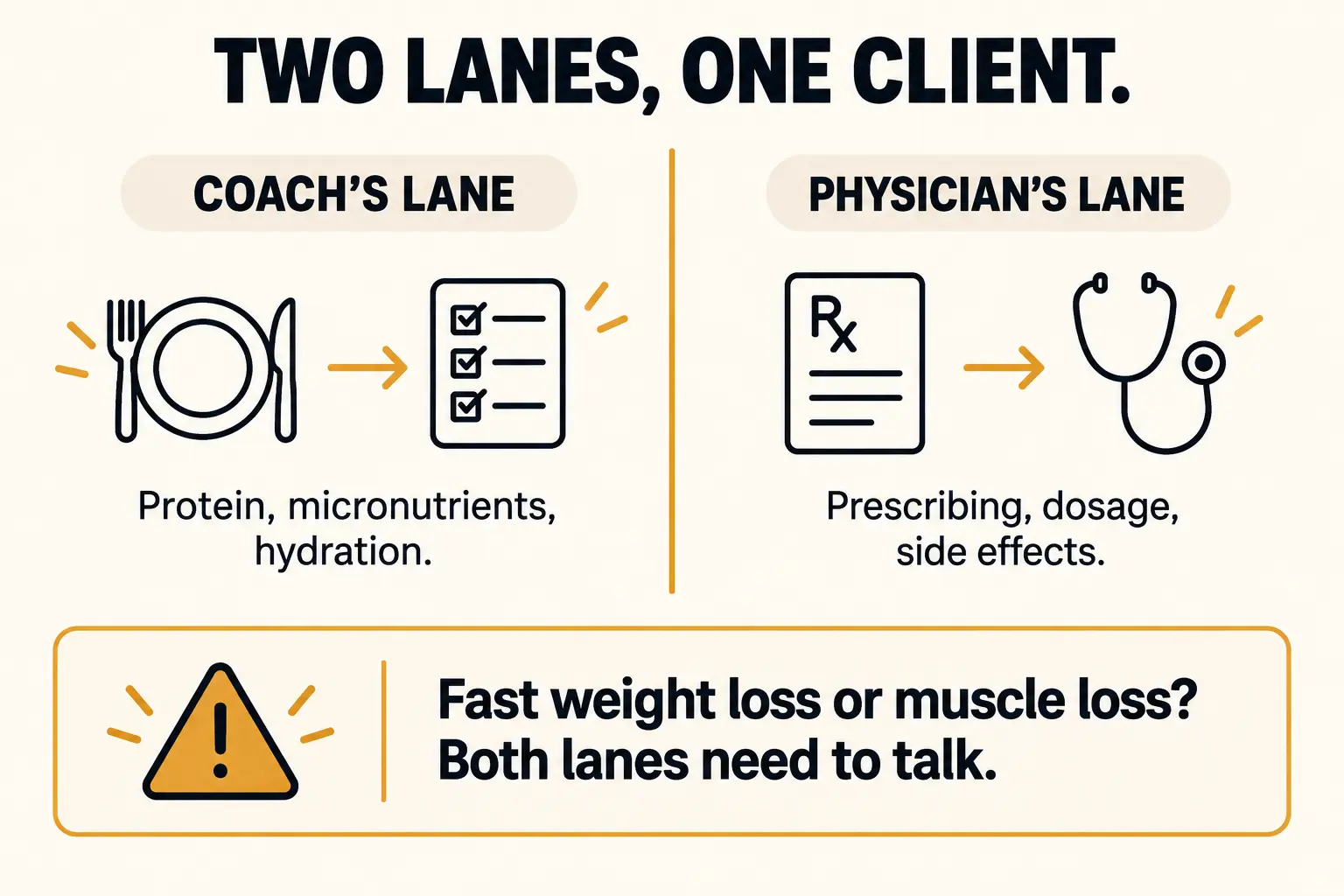
Those signals are worth naming directly, because they echo Chapter 19's special scenarios in a new, medically specific form: an unusually fast rate of weight loss, visible signs that muscle mass (not just fat) is dropping, or disordered eating patterns resurfacing under the cover of a medication that makes restriction easier to sustain than it would be otherwise. Any of these is a reason to coordinate with the client's medical team rather than working around them — the same referral instinct from Chapter 19, applied to a scenario that's becoming common enough to deserve its own chapter.
This closes out the content-specific stretch of Precision Nutrition Level 1 that began all the way back in Chapter 1. Chapter 21 shifts entirely to a different kind of material — the business fundamentals behind actually building a coaching practice — before the course's cumulative practice exam draws on everything covered across all three units.
8 questions, modeled on PN's real open-book exam style. Score 75%+ to mark this lesson complete.
- GLP-1 medications suppress appetite and slow gastric emptying, often causing clients to eat dramatically less without any behavioral effort of their own.
- Reduced intake from a GLP-1 medication is pharmacologically driven, not a habit success, even though it can look like one on the surface.
- Protein prioritization, micronutrient adequacy, hydration, and rate-of-loss monitoring are the four things coaching must protect during medication-driven weight loss.
- A coach has no role in prescribing, adjusting, or managing the medication itself — that stays entirely with the prescribing physician.
- Unusually fast weight loss, visible muscle loss, or resurfacing disordered patterns are signals to coordinate with a client's medical team, not to manage alone.
Before moving to Lesson 21:
- Write, in one sentence, why reduced appetite on a GLP-1 medication isn't the same as a Level 1 or 2 habit success.
- List the four things this chapter says coaching should protect during medication-driven weight loss.
- Think of one signal that would prompt you to loop back to a client's prescribing physician.
- Complete the knowledge check above and review any question you missed.