Exchange rates are set by four readable forces — interest rates, inflation, trade flows, and fear. A "weak" currency isn't a national tragedy or a trading opportunity; it's a specific set of price changes in your life, and you can calculate them.
"Rupee hits all-time low." "Dollar surges." "Lira in freefall." Currency headlines are written to alarm, and they succeed — while explaining almost nothing. What did the falling rupee actually change for a nurse in Kochi, a freelancer billing US clients, or a family paying an Australian tuition bill? Three very different answers, as it happens — one of them is quietly better off.
This lesson gives you the machinery to read any currency headline and immediately know what it means for you. No predictions — just the four forces that move rates, and the honest arithmetic of who pays and who benefits when they move.
The Four Forces That Move Exchange Rates
| Force | How It Works | Timescale |
|---|---|---|
| 🏦 Interest rates | Money flows toward currencies that pay more to hold. When the US raises rates while others hold, capital migrates into dollars, lifting them against everything. Expectations move markets before the decisions do. | The dominant force, months to years |
| 📈 Inflation | A currency losing purchasing power at home loses it abroad too. Persistently higher inflation than your trading partners means persistent depreciation — this is purchasing power parity, useless next month, remarkably reliable over decades. | The long-run anchor |
| 🚢 Trade & capital flows | Countries that export more than they import see constant demand for their currency; countries that attract foreign investment likewise. Big importers of oil (like India) see their currency pressured when oil spikes. | Steady background pressure |
| 😱 Sentiment & shocks | Elections, wars, banking scares. Fear sends global money sprinting into "safe havens" — US dollars, Swiss francs, yen, gold — and out of emerging-market currencies, regardless of local fundamentals. | Days to months, violently |
Notice what's not on the list: chart patterns, moon cycles, or the opinions of Telegram groups. Day-to-day moves are mostly noise around these forces — which is precisely why Lesson 3's traders, betting on the noise, fare as they do.
"Weak" Currency: Who Actually Pays, Who Actually Gains
Suppose your currency falls 10% against the dollar this year. The headline says catastrophe. The truth is a ledger:
| You lose if you… | You gain if you… |
|---|---|
| Buy imported goods — phones, laptops, cars, and anything with imported parts gets pricier | Receive remittances from abroad — the same dollars from your cousin in Dubai now convert to 10% more at home |
| Buy fuel — oil is priced in dollars, so a weak currency is a petrol-price rise in disguise (which then feeds general inflation) | Earn in foreign currency — freelancers and exporters billing in dollars just got a raise in local terms |
| Pay foreign tuition or travel abroad — your foreign-currency goals just moved 10% further away | Hold international investments — your global index funds are worth ~10% more in local currency (Lesson 4's whole subject) |
| Hold all savings in local cash — its global purchasing power just shrank, even though the number didn't change | Work in export industries or tourism — foreign customers find your country 10% cheaper |
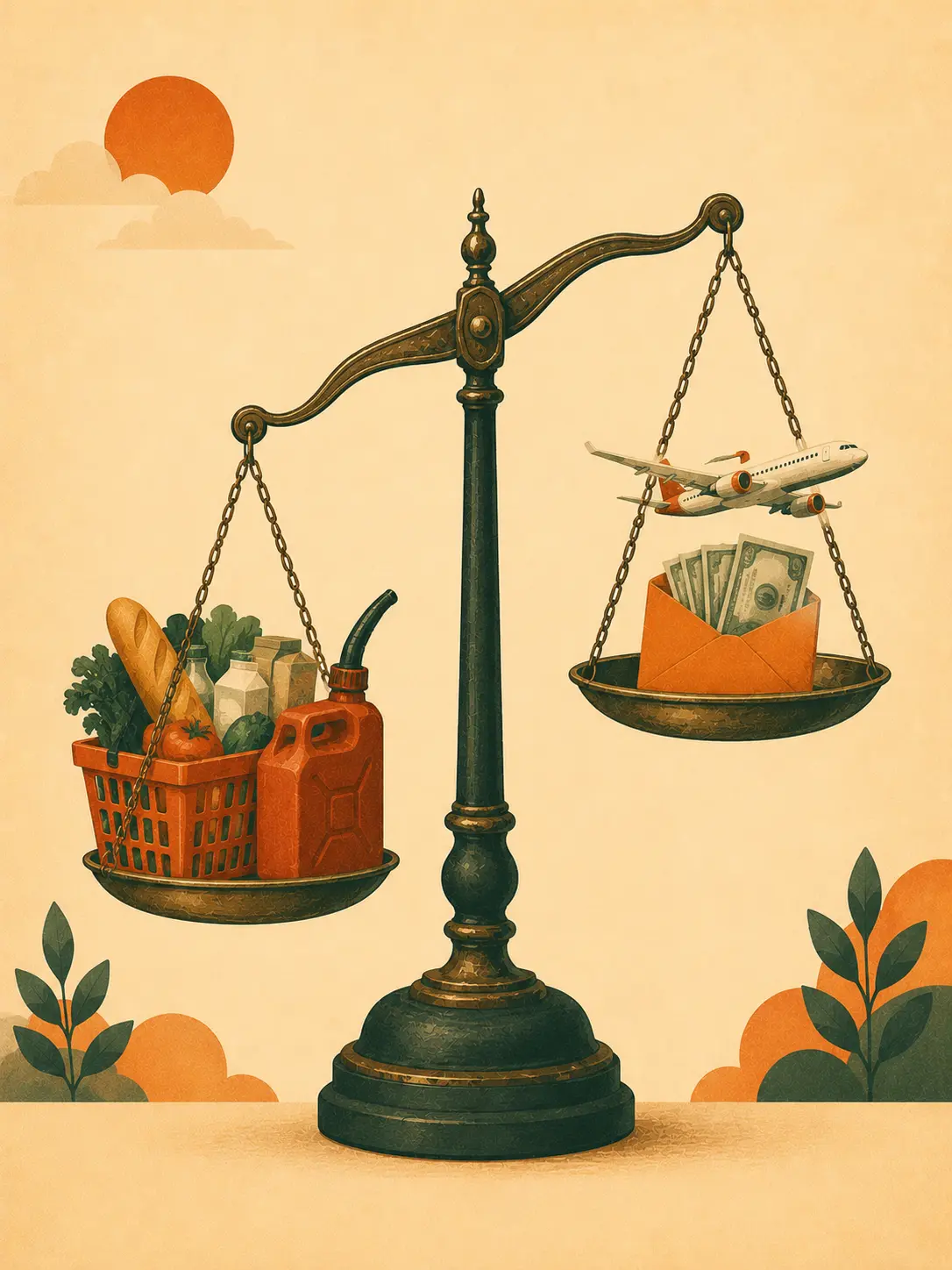
Same event, opposite outcomes. The nurse buying an imported phone lost; the freelancer billing US clients won; the family with the Australian tuition bill lost precisely 10% of a year's fees. "Weak" is a direction, not a verdict — your exposure list from Lesson 1 decides which side of the ledger you're on.
One-off moves make headlines, but the quiet pattern matters more: high-inflation currencies depreciate persistently. The Indian rupee traded around 45/USD in 2010 and around 85+/USD by the mid-2020s — a near-halving of its dollar value over 15 years, arriving a grinding 3–4% per year, exactly as the inflation gap predicts. Nobody panicked on any given Tuesday, but every foreign-priced goal — education, travel, global investing — drifted steadily more expensive. If your currency has a persistent inflation gap with the dollar or euro, this drift IS your financial planning weather. Lesson 4 shows what to do about it (calmly, without trading anything).
What This Means for Your Money (Preview of the Toolkit)
You can't control the four forces, but you can position around them — and none of it involves a trading app. If you have foreign-currency goals (education, migration, travel), their cost in local terms is drifting with the exchange rate — budget with depreciation included, not today's rate. If you receive or send remittances, the rate you get matters twice — the market rate (this lesson) and the markup you're charged on it (Lesson 5, where most people find 1–4% of free money). If you invest long-term, global diversification quietly converts some of your currency risk into currency balance — Lesson 4 runs the numbers. And if headlines still tempt you to bet on the moves directly — that's Lesson 3, where we watch the machine that eats those bets.
Price Your Own Exposure
The calculator below takes a depreciation scenario and prices it against your real life: your imported spending, your foreign goals, your remittance flows. It's the difference between reading a headline and knowing your number.
What a currency slide actually does to YOUR numbers — spending, goals, and remittances. Any currency; the arithmetic doesn't care.
Complete this before moving to Lesson 3.
- Run the calculator with your honest numbers and a 10% scenario. Note which side of the ledger you're on.
- Look up your currency's rate against the dollar 10 years ago vs today (search "[your currency] USD 10 year chart"). Compute the rough annual drift — that's your planning weather, not a crisis.
- If you have a foreign-currency goal, re-budget it with that annual drift applied to your timeline. That new number is the honest target.
- Next currency headline you see, name which of the four forces is driving it. (It's usually interest rates.)