Every cue, every exercise, every rep in this course ultimately comes down to nerves telling muscles what to do. This lesson covers the nervous system's role in movement, the two main muscle fiber types, and the three ways a muscle can act — vocabulary that shows up in almost every lesson that follows.
Terms like "reciprocal inhibition" and "rate of force production" will come up again in later lessons on flexibility and speed training — this lesson builds the nervous-system foundation those ideas rest on. Skim it too quickly and later lessons start to feel like memorization instead of application, because the underlying mechanism never actually clicked.
The Nervous System's Role in Movement
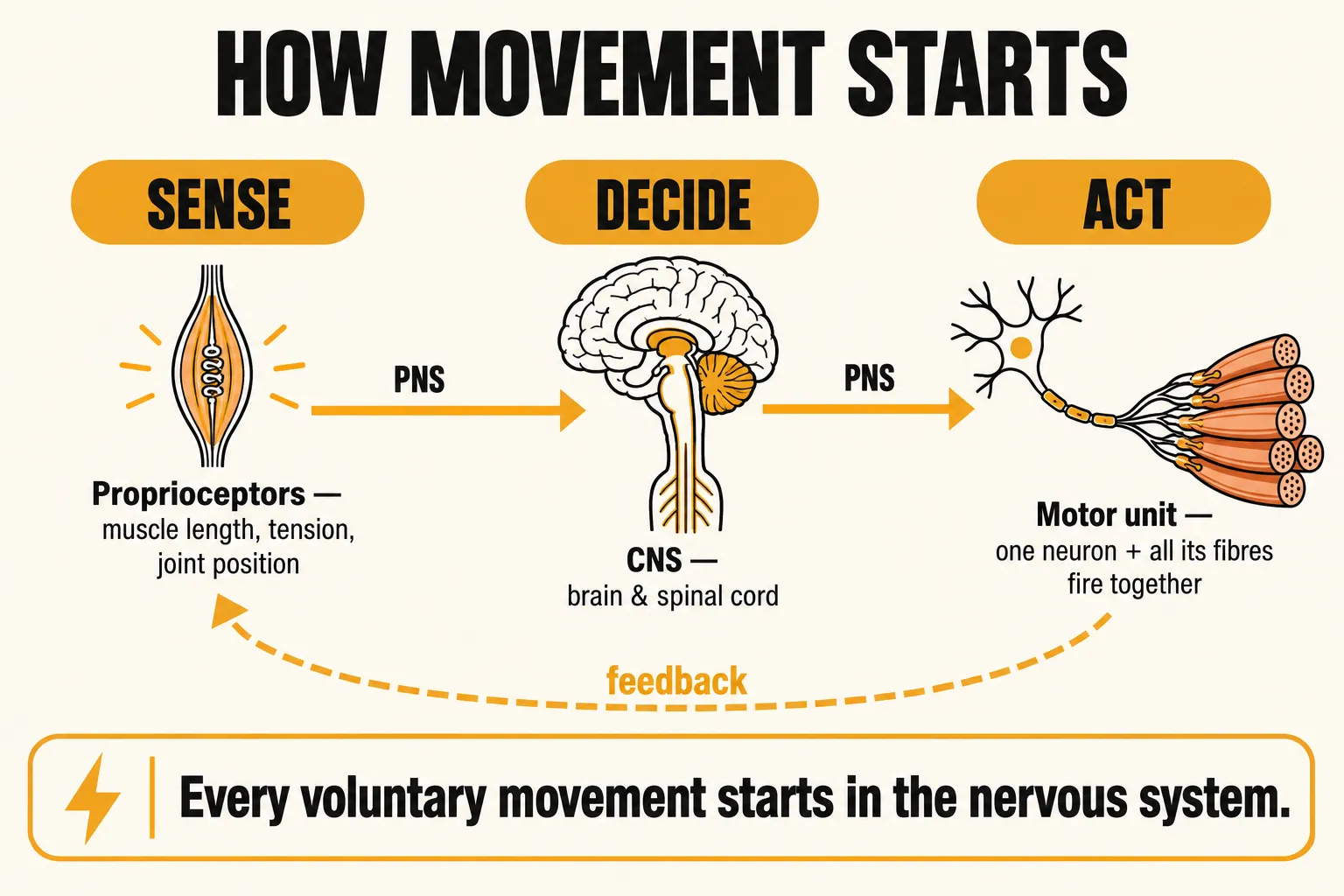
Every voluntary movement starts with the nervous system, which senses conditions, decides on a response, and signals muscles to act:
- Central nervous system (CNS)The brain and spinal cord — where movement decisions are made and coordinated.
- Peripheral nervous system (PNS)The network of nerves connecting the CNS to muscles and sensory receptors throughout the body.
- Motor unitA single motor neuron and all the muscle fibers it controls. When the neuron fires, every fiber in that unit contracts together.
- ProprioceptorsSensory receptors — including muscle spindles and Golgi tendon organs — that feed the nervous system information about muscle length, tension, and joint position. This same sensory input is what Lesson 10's balance training later relies on.
Reciprocal and Autogenic Inhibition
Two proprioceptor-driven reflexes are worth understanding now, because Lesson 7's flexibility training is built almost entirely around them.
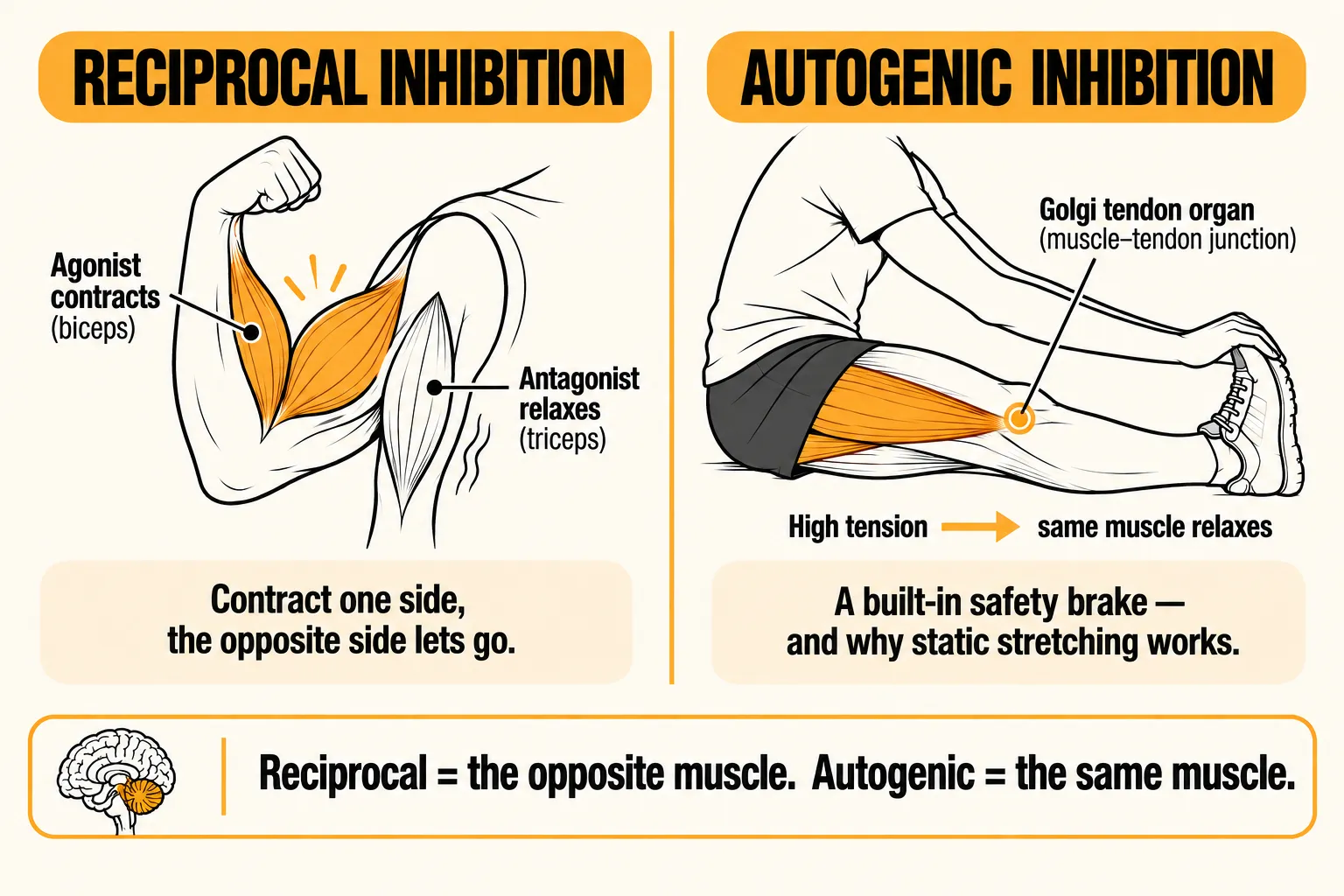
- Reciprocal inhibitionWhen one muscle (the agonist) contracts, its direct opposite (the antagonist) is neurologically told to relax — you can't fully contract your biceps and triceps at the same moment, because the nervous system inhibits one to let the other act.
- Autogenic inhibitionWhen tension in a muscle or tendon gets high enough, the Golgi tendon organ signals that same muscle to relax — a built-in safety brake against a muscle tearing itself or its tendon.
Static stretching relies on autogenic inhibition — holding a stretch long enough for the Golgi tendon organ to trigger relaxation in the muscle being stretched. Lesson 7's discussion of self-myofascial release and static stretching only makes sense once you know this reflex is the actual mechanism doing the work, not just "time under tension."
Muscle Fiber Types
| Fiber type | Characteristics | Best suited for |
|---|---|---|
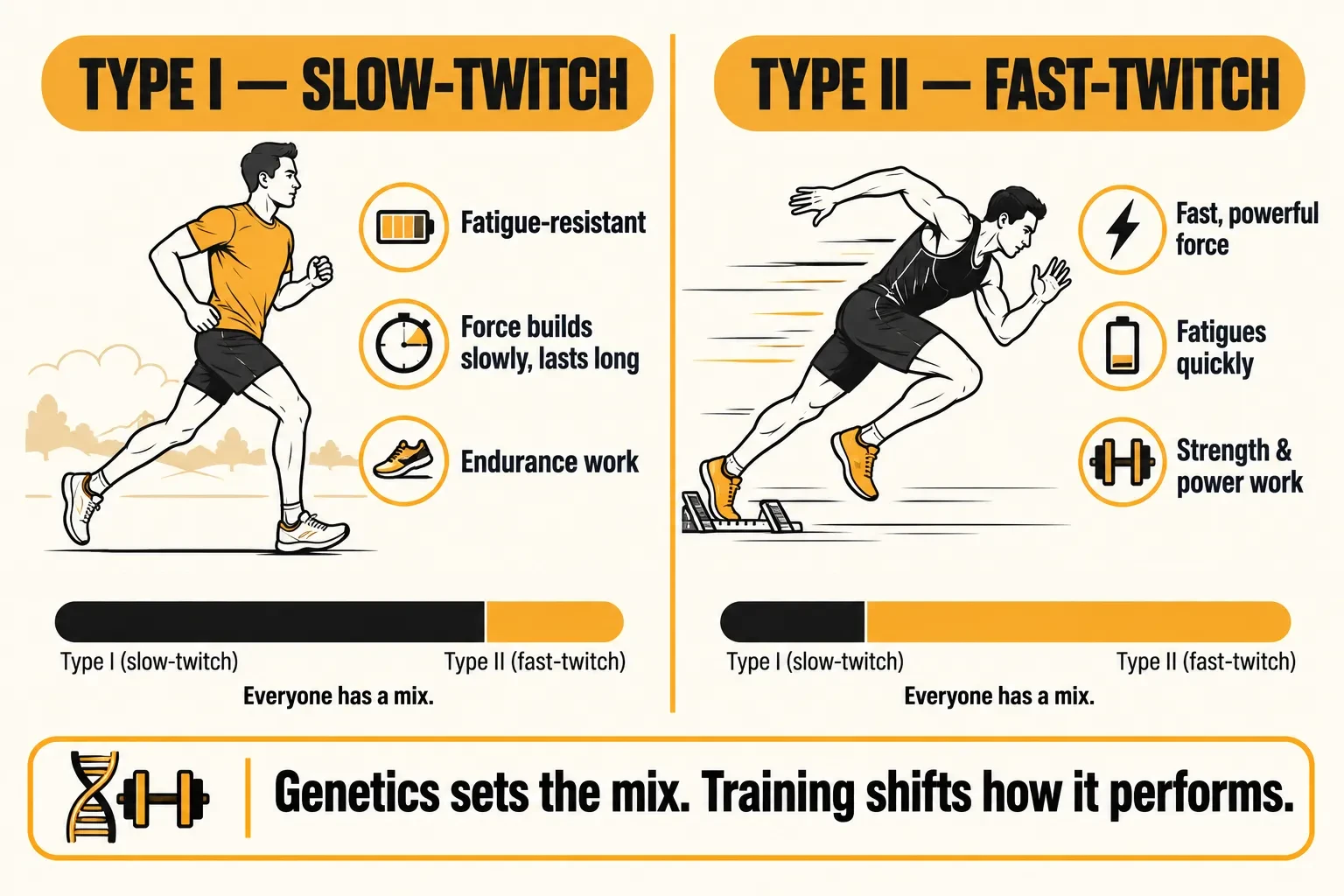
| Type I (slow-twitch) | Fatigue-resistant, produces force slowly but sustains it for a long time | Endurance activity — Lesson 8's steady-state cardio, Lesson 14's Phase 1 |
| Type II (fast-twitch) | Produces force quickly and powerfully, but fatigues faster | Strength and power activity — Lesson 14's Phases 4-5, Lesson 11's plyometrics |
Most people have a mix of both fiber types in any given muscle — the ratio varies by individual and by muscle, and training can shift how those fibers perform, even if it can't fully convert one type into the other.
A sprinter and a marathon runner make the contrast concrete: elite sprinters tend to have a higher proportion of Type II fibers in their leg muscles, while elite marathoners tend to have more Type I — some of this is genetic, but years of sport-specific training also shift how the existing fibers perform, which is part of why SAID (Lesson 1) and fiber type are really talking about the same underlying phenomenon from two different angles.
The Three Types of Muscle Actions
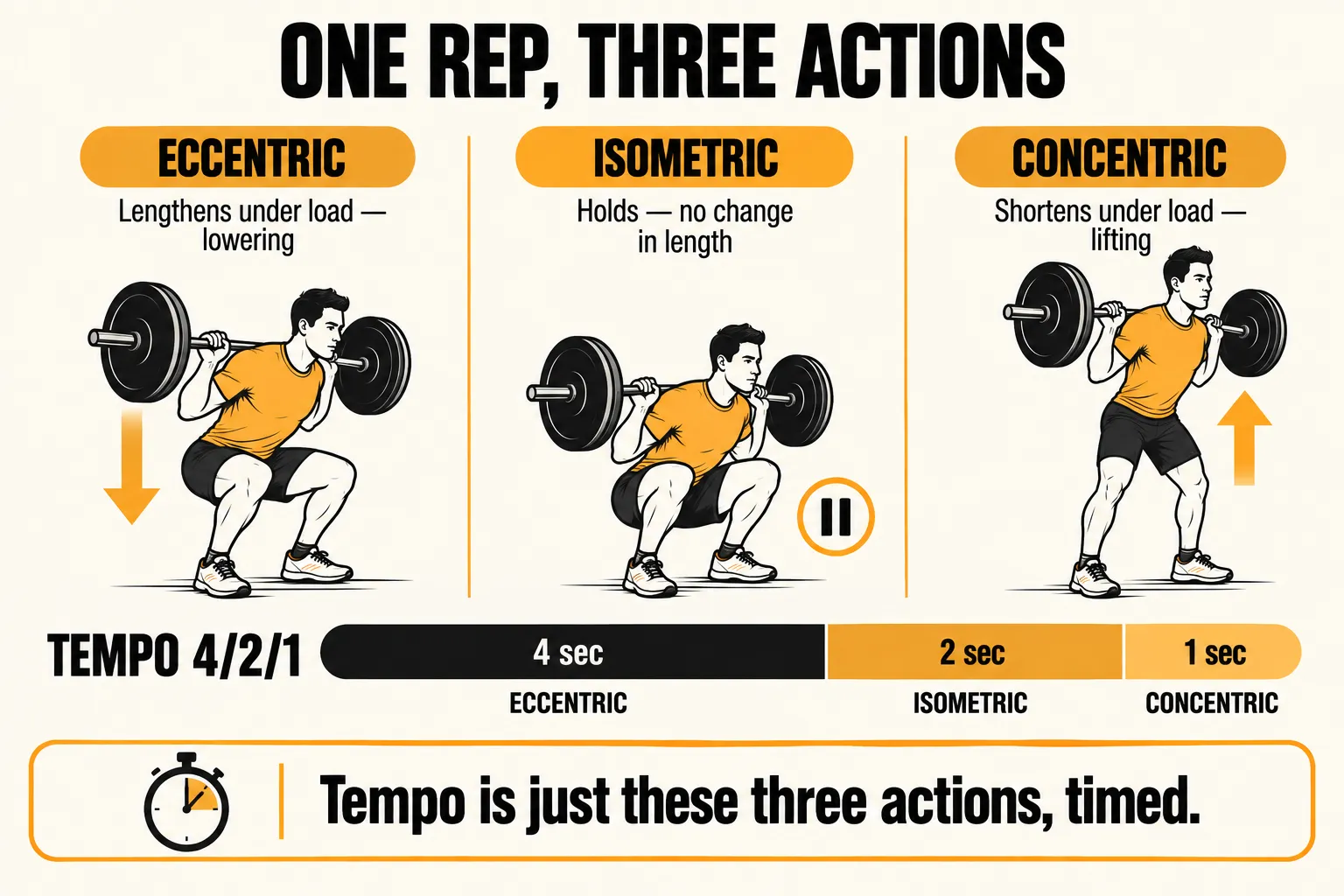
Every rep of every exercise is built from these three actions, usually in combination:
- ConcentricThe muscle shortens while producing force — the "lifting" portion of a rep, like the upward phase of a squat.
- EccentricThe muscle lengthens while producing force — the "lowering" portion of a rep, like the downward phase of a squat. This is also the loading phase of Lesson 11's stretch-shortening cycle.
- IsometricThe muscle produces force without changing length — a held position, like the pause at the bottom of a plank.
Most exercises actually cycle through all three in a single rep. A single squat is eccentric on the way down, briefly isometric at the bottom if there's a pause, and concentric on the way back up — three distinct muscle actions inside one movement most people would just call "a rep."
8 questions, modeled on NASM's real exam style. Score 70%+ to mark this lesson complete.
- The CNS (brain, spinal cord) makes movement decisions; the PNS carries signals to muscles and sensory receptors.
- A motor unit is one motor neuron plus every muscle fiber it controls — they all fire together.
- Proprioceptors (muscle spindles, Golgi tendon organs) feed the nervous system information about length, tension, and joint position.
- Type I fibers favor endurance; Type II fibers favor strength and power.
- Three muscle actions: concentric (shortening), eccentric (lengthening), isometric (no length change) — tempo is just these three, timed.
- Reciprocal inhibition relaxes the opposing muscle during a contraction; autogenic inhibition relaxes a muscle under high tension — static stretching relies on the latter.
Before moving to Lesson 3:
- Name the three muscle actions and give one exercise example of each.
- Explain, in your own words, why Type II fibers fatigue faster than Type I fibers.
- Write one sentence distinguishing reciprocal inhibition from autogenic inhibition.
- Complete the knowledge check above and review any question you missed before moving on.