You don't need to find the winning companies — you need to own all of them, for almost nothing, forever. The index fund is the rare product where the lazy, cheap option is also the one the evidence crowns.
Lesson 3 ended with a promise: the entire investment universe would collapse into a short menu. Here's the collapse. For the growth engine of a beginner's portfolio, the evidence points at one answer with almost embarrassing consistency: a broad, low-cost index fund. This lesson is the why — the contest, the protection, and the fee maths that will genuinely annoy you.
The Contest Nobody Wins (Reliably)
An active fund employs brilliant, credentialed professionals to pick winning stocks. An index fund employs nobody — it mechanically buys every company in an index (S&P 500, FTSE 100, Nifty 50, or the entire world) in proportion to size. It doesn't research, predict, or try. It just owns everything.
You'd bet on the professionals. Almost everyone does. And the scoreboard has been humiliating them for fifty years: the long-running SPIVA studies find that over 10–15 year windows, roughly 80–90% of active equity funds underperform their own benchmark index after fees — in the US, in Europe, in India, in emerging markets. Everywhere the study is run. Worse: the minority who win in one decade rarely repeat in the next, so you can't even identify them in advance.
Why do experts lose to a list? Because the market's price already contains millions of experts' information — outguessing it consistently is nearly impossible — and because active funds charge 1–2.5% a year for the attempt while the index charges 0.05–0.3%. The professionals aren't stupid; they're expensive. Which brings us to the number that decides your wealth.
The Fee Maths the Industry Hopes You Never Run
Every fund quotes an annual fee — the expense ratio (also labelled TER or ongoing charge). It's presented as a rounding error: "just 1.5%." Here's what the framing hides: the fee is charged on your whole balance every year forever, so it compounds against you with exactly the machinery Lesson 1 put on your side.
| Same investor: 500/month, 30 years, 8% market return | Index fund @ 0.2% | Active fund @ 1.5% |
|---|---|---|
| Final portfolio | ~700,000 | ~560,000 |
| Lost to fees (vs the 0.2% fund) | — | ~140,000 — about 20% of the outcome |
| Years of contributions consumed | — | ~23 years' worth of monthly deposits |
* Illustrative maths, any currency. And this table charitably assumes the active fund matches the market before fees — the evidence says most don't.
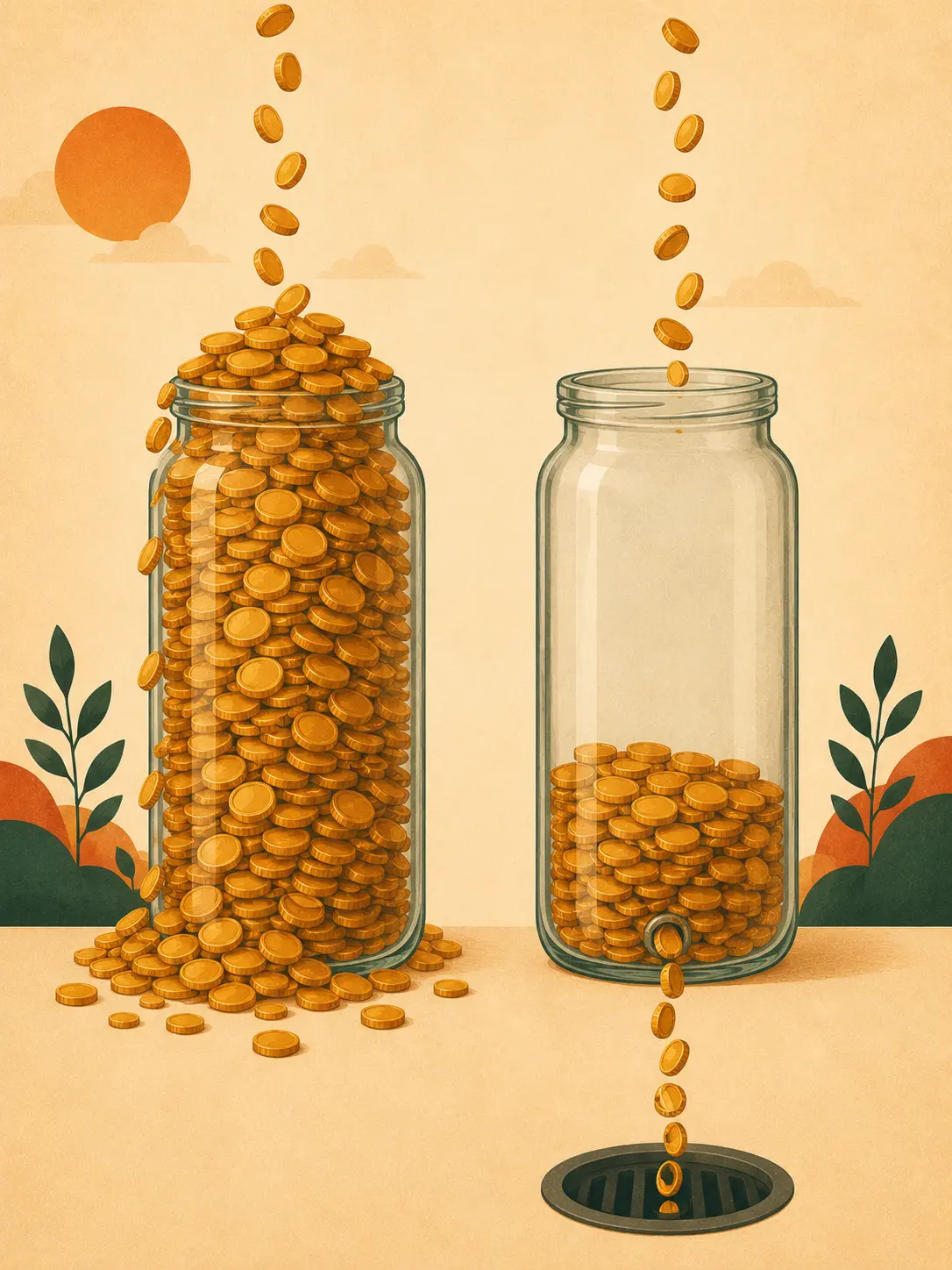
Read that middle row again. The "small" fee difference quietly consumed 140,000 — and statistically, the expensive fund underperformed on top of it. This is why fee-checking is the single highest-paid minute of research in all of personal finance, and why the calculator below is this lesson's tool.
Diversification: What It Does and Doesn't Do
The index fund's second superpower is that diversification comes built in — one purchase, thousands of companies, dozens of countries (if you pick a global index). Be precise about what that buys you:
| Diversification DOES protect you from | Diversification does NOT protect you from |
|---|---|
| One company collapsing (fraud, disruption, bankruptcy) — it's 0.01–2% of your fund, not 100% of your savings | Whole-market crashes — in 2008, essentially everything fell 30–50% together |
| One industry dying (any single sector is a sliver of a broad index) | Volatility itself — the ride is smoother, but it's still a ride |
| One country's lost decade (Japan 1990–2010 is the cautionary tale a world fund survives) | Your own behaviour — panic-selling a perfectly diversified fund locks losses just as well (Lesson 7) |
| Having picked the wrong stock — you own all of them, including every future winner | Inflation, if you retreat to cash inside the fund's bad years |
In one sentence: diversification converts "I could lose everything permanently" into "I will temporarily ride down and back up with the world economy." The first risk ruins lives; the second one pays for retirements — if you can sit through it, which is what Lessons 5 and 7 prepare you for.
Investors everywhere massively over-weight their home market — familiar names feel safer. But your salary, house, and pension already depend on your home economy; stacking your portfolio there too is concentration wearing a comfort blanket. A total-world index fund holds thousands of companies across every major market by default. Common practice: global core, modest home tilt if your country's tax rules or fund costs favour local funds — a one-evening research question for your country.
What "Good" Looks Like, Anywhere on Earth
Fund names differ by country; the checklist doesn't. A beginner-grade core fund is: broad (hundreds+ of companies — "total market," "all-world," or a major national index — not a theme, sector, or "AI opportunities" story); cheap (expense ratio under ~0.5%, ideally under 0.25%); passive (the word "index" in the name, no manager promising outperformance); and boring (no leverage, no "2x," no capital-guarantee structures hiding fees). Search "[your country] total market index fund expense ratio" and this checklist will filter the results in minutes.
Run the Fee Maths on Your Numbers
Compare any two annual fees over your timeline. Try 0.2% vs 1.5% first — then try whatever your bank's fund actually charges.
Complete this before moving to Lesson 5.
- Run the Fee Drag Calculator with your real monthly amount and timeline. Note the gap number — that's what fee-laziness costs you personally.
- Search "[your country] total market index fund" or "[your country] index fund lowest expense ratio" and write down 2–3 candidate funds with their fees. Don't buy anything yet — Lessons 5 and 6 finish the plan first.
- If you already own any fund, find its expense ratio (fund factsheet, first page) and run it through the calculator against a 0.2% alternative. Decide nothing today; just know the number.