Nutrition advice is everywhere, and much of it is wrong or overstated. Evidence-based coaches judge claims by the quality of the research behind them. Systematic reviews and randomized controlled trials generally carry more weight than single observational studies, animal studies, expert opinion or testimonials. Observational studies show association, not cause and effect. Headlines often report relative risk, which can sound far bigger than the absolute change. Good practice combines the best available evidence with coaching expertise and each client's values and circumstances.
Lessons 1 and 2 covered what a coach does and where the boundaries lie. This lesson covers how a coach decides what's true. Clients arrive with questions from headlines, social media and friends, so a coach needs to be able to judge the evidence quickly and calmly, then explain it in plain language. On the exam, expect questions on study types, the evidence hierarchy and how to interpret a claim.
Free on YouTube Subscribe to get every lesson video in this course SubscribeThe Scientific Method
Science is a process for testing ideas, not a collection of fixed facts. Conclusions can change as new evidence builds up — which is a strength, not a weakness.
- 1. Observe and askNotice something and ask a clear question.
- 2. HypothesisA testable prediction about what will happen.
- 3. TestDesign a study and collect data.
- 4. Analyse and concludeDoes the data support the hypothesis, and how strongly?
- 5. Peer review and replicationOther experts check the work before publication, and other teams repeat it. Findings that replicate are more trustworthy.
Types of Nutrition Research
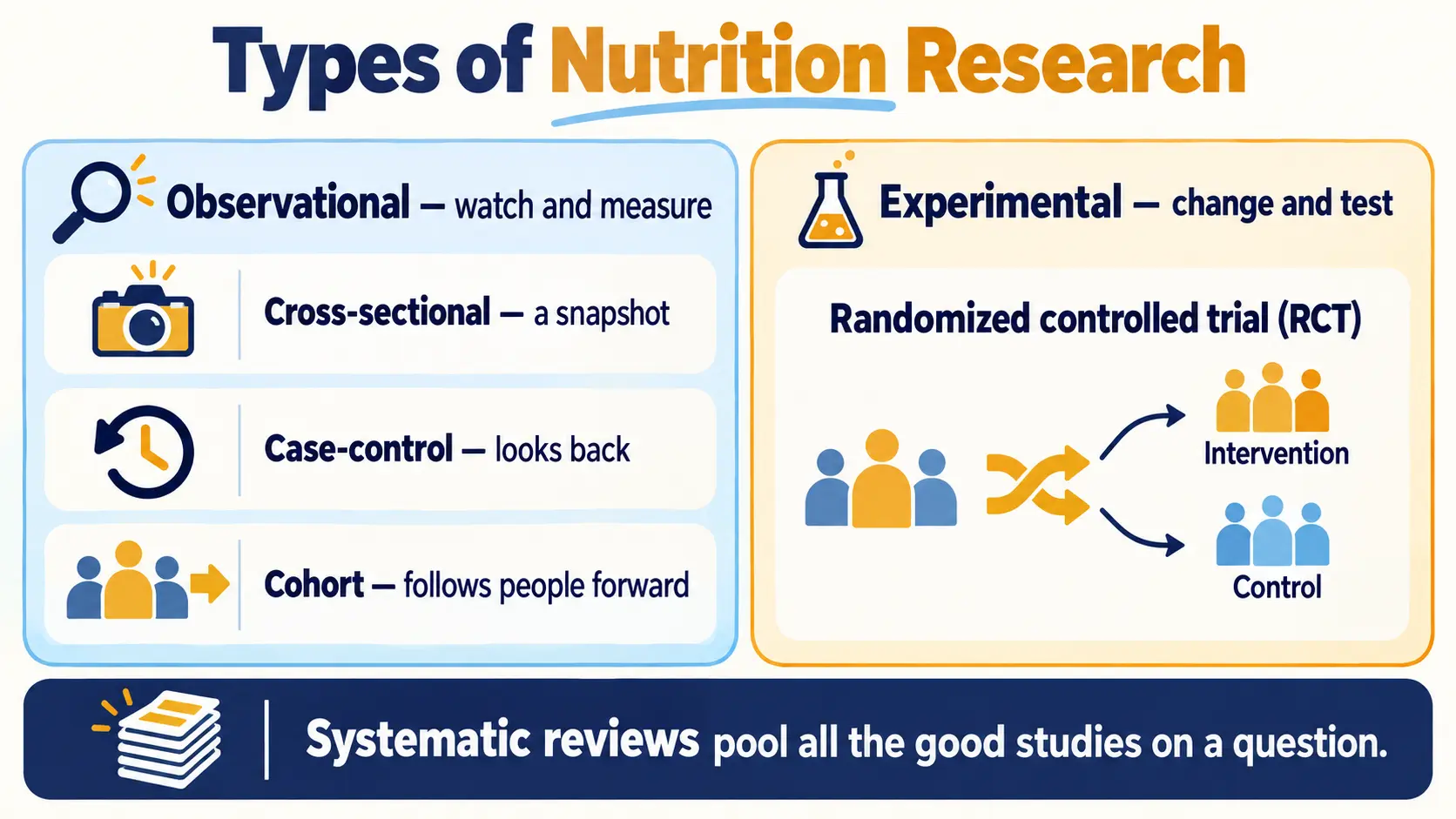
Most nutrition research falls into two broad groups. In observational studies, researchers watch and measure without changing anything. In experimental studies, researchers change something (such as a diet) and measure what happens.
| Study type | What it does | Strength | Limitation |
|---|---|---|---|
| Cross-sectional | A snapshot of a group at one point in time | Quick; spots patterns | Can't show which came first |
| Case-control | Compares people with a condition to people without, looking back at past habits | Good for rare conditions | Relies on memory (recall bias) |
| Cohort | Follows a large group forward over years | Shows what came first; large samples | Still association; confounders |
| Randomized controlled trial (RCT) | Randomly assigns people to an intervention or a control group | Best single design for cause and effect | Costly; often short; hard for whole diets |
| Systematic review and meta-analysis | Gathers all good studies on a question; a meta-analysis pools their data | The big picture | Only as good as the studies included |
Two other kinds of evidence sit to the side. Animal and laboratory (in vitro) studies explore mechanisms and generate ideas, but results often don't carry over to people. Anecdotes and testimonials — "it worked for me" — are the weakest form of evidence, because one person's experience can't separate the effect from everything else going on.
The Hierarchy of Evidence
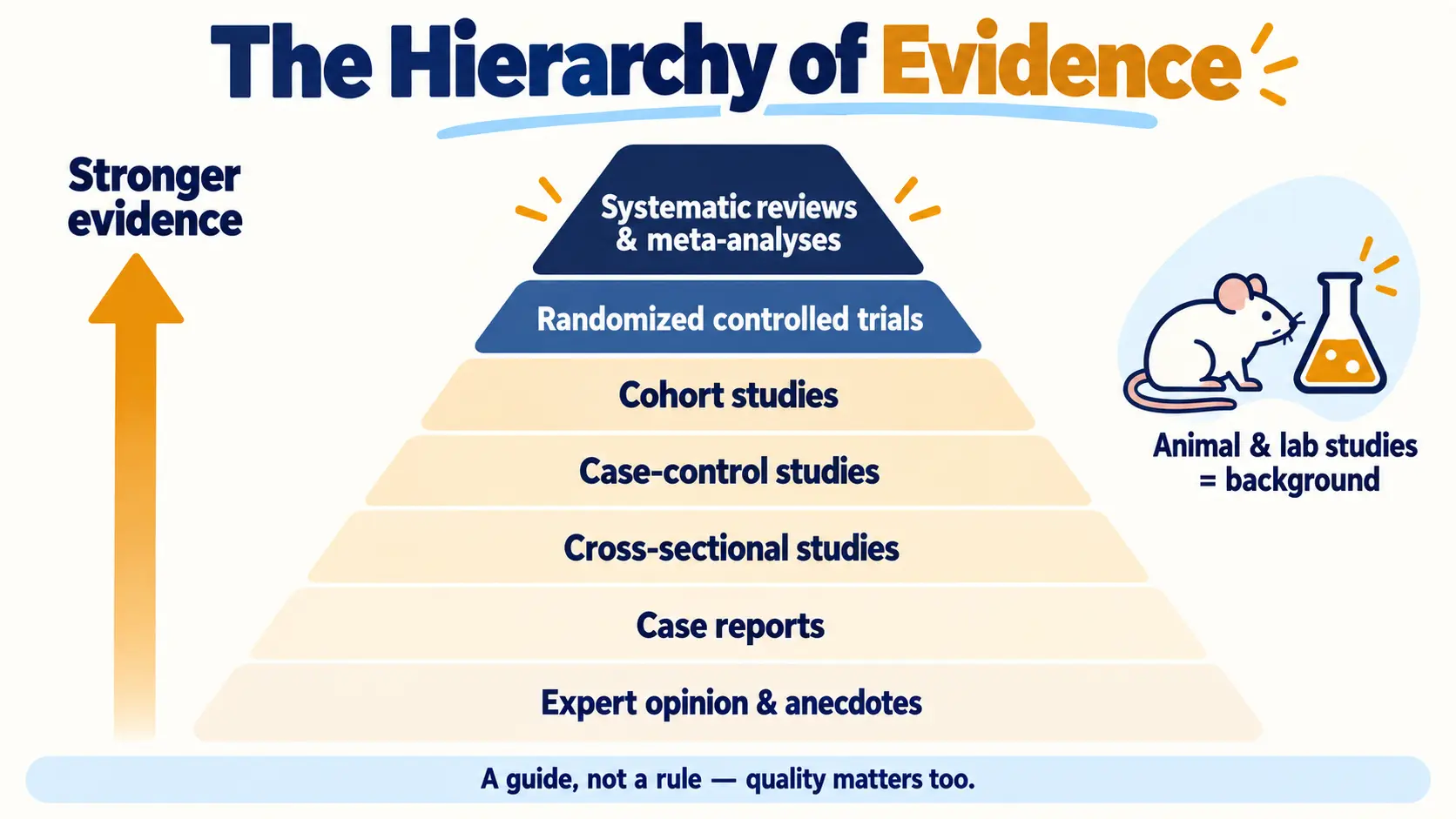
The evidence hierarchy ranks research by how strongly it can support a conclusion. Different textbooks draw it slightly differently, but a common version looks like this, from strongest to weakest:
| Rank | Type of evidence |
|---|---|
| 1 (strongest) | Systematic reviews and meta-analyses of RCTs |
| 2 | Randomized controlled trials |
| 3 | Cohort studies |
| 4 | Case-control studies |
| 5 | Cross-sectional studies |
| 6 | Case reports and case series |
| 7 (weakest) | Expert opinion, anecdotes and testimonials |
Animal and laboratory studies usually sit at the base as background evidence. The hierarchy is a guide, not a rule: a large, well-run cohort study can be more useful than a small, poorly designed trial. Quality matters as much as type.
Interpreting Research
Correlation is not causation
If people who eat more of a food have better health, the food might be the reason — or those people may also exercise more, smoke less or earn more. These other factors are called confounders: they're linked to both the habit and the outcome. Observational studies try to adjust for them, but can never rule them all out. Randomization in an RCT spreads confounders evenly between groups, which is why RCTs are better at showing cause and effect.
Relative vs absolute risk
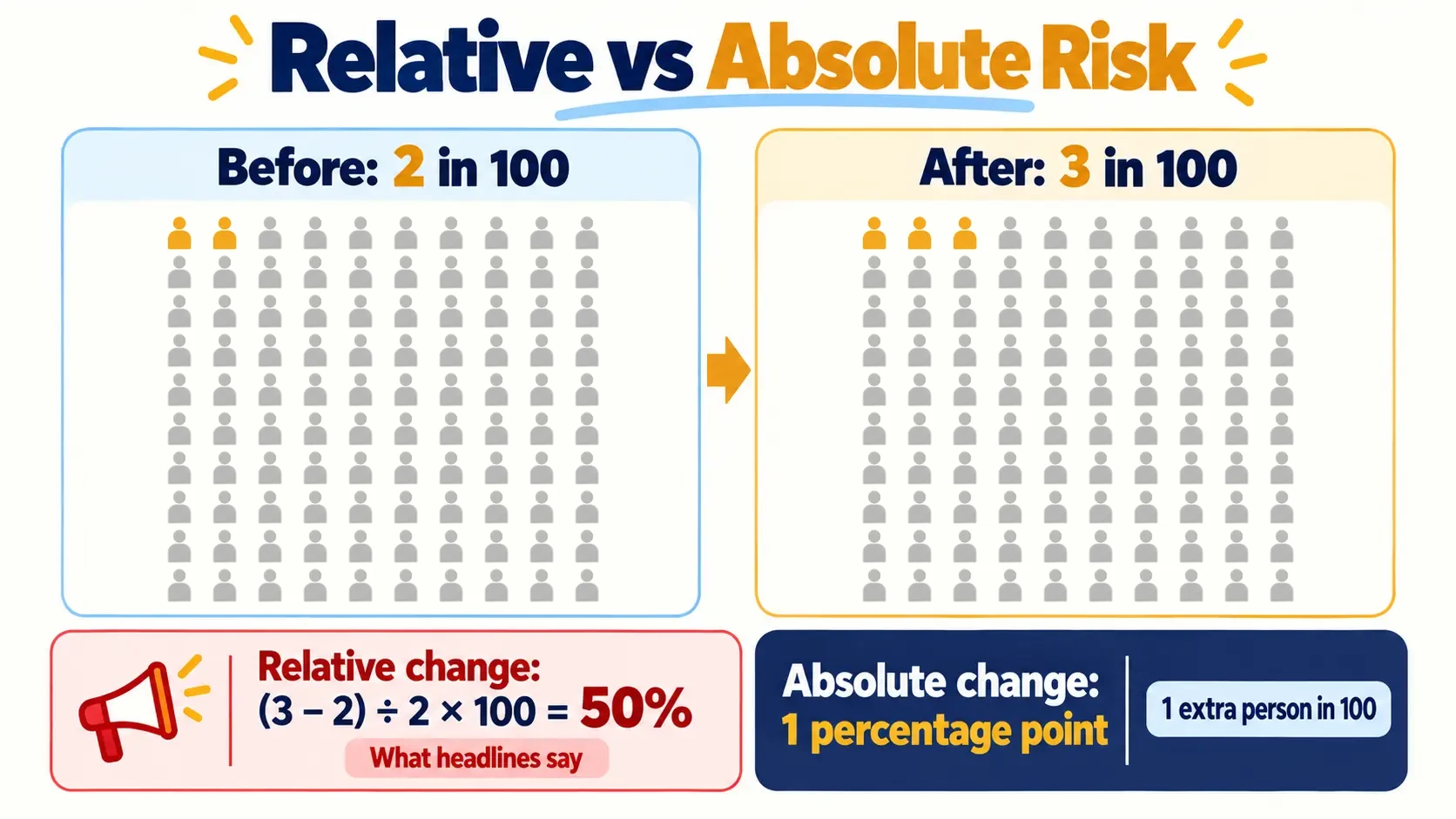
Headlines often report relative risk — the change compared with the starting risk. Absolute risk is the actual difference in how many people are affected.
| Measure | Formula | Example: 2 in 100 → 3 in 100 |
|---|---|---|
| Relative change | (new risk − old risk) ÷ old risk × 100 | (3 − 2) ÷ 2 × 100 = 50% |
| Absolute change | new risk − old risk | 3% − 2% = 1 percentage point (one extra person in every 100) |
"Risk up 50%" and "one extra case per 100 people" describe the same result. Both are true — but the absolute figure tells you much more about what it means for a real person.
Other things to check
- Who was studied?Humans or animals? How many? Do they resemble your client?
- How long?A 2-week study can't tell you much about long-term health.
- Control and blindingWas there a comparison group? Did participants or researchers know who got what? The placebo effect is real.
- Statistical vs practical significanceA result can be statistically significant (unlikely to be chance) but too small to matter in real life.
- Funding and conflicts of interestIndustry funding doesn't automatically make a study wrong, but it's a reason to look closely.
- The wider body of evidenceOne study rarely settles anything. Does it agree with other research?
Reliable vs Unreliable Sources
| Generally more reliable ✅ | Generally less reliable ⚠️ |
|---|---|
| Peer-reviewed journals, especially systematic reviews | Social media posts and influencers |
| National and international public health bodies | Websites selling the product they recommend |
| Professional and scientific organisations | Single news headlines about one new study |
| University and hospital health information pages | Testimonials and before-and-after photos |
| Registered health professionals working within their scope | Celebrities and self-described "experts" with no relevant training |
A useful habit: go back to the source. If a post mentions a study, find the original abstract. Check who did it, who funded it, how many people were in it and what it actually found — which is often far more modest than the headline.
Spotting Nutrition Misinformation
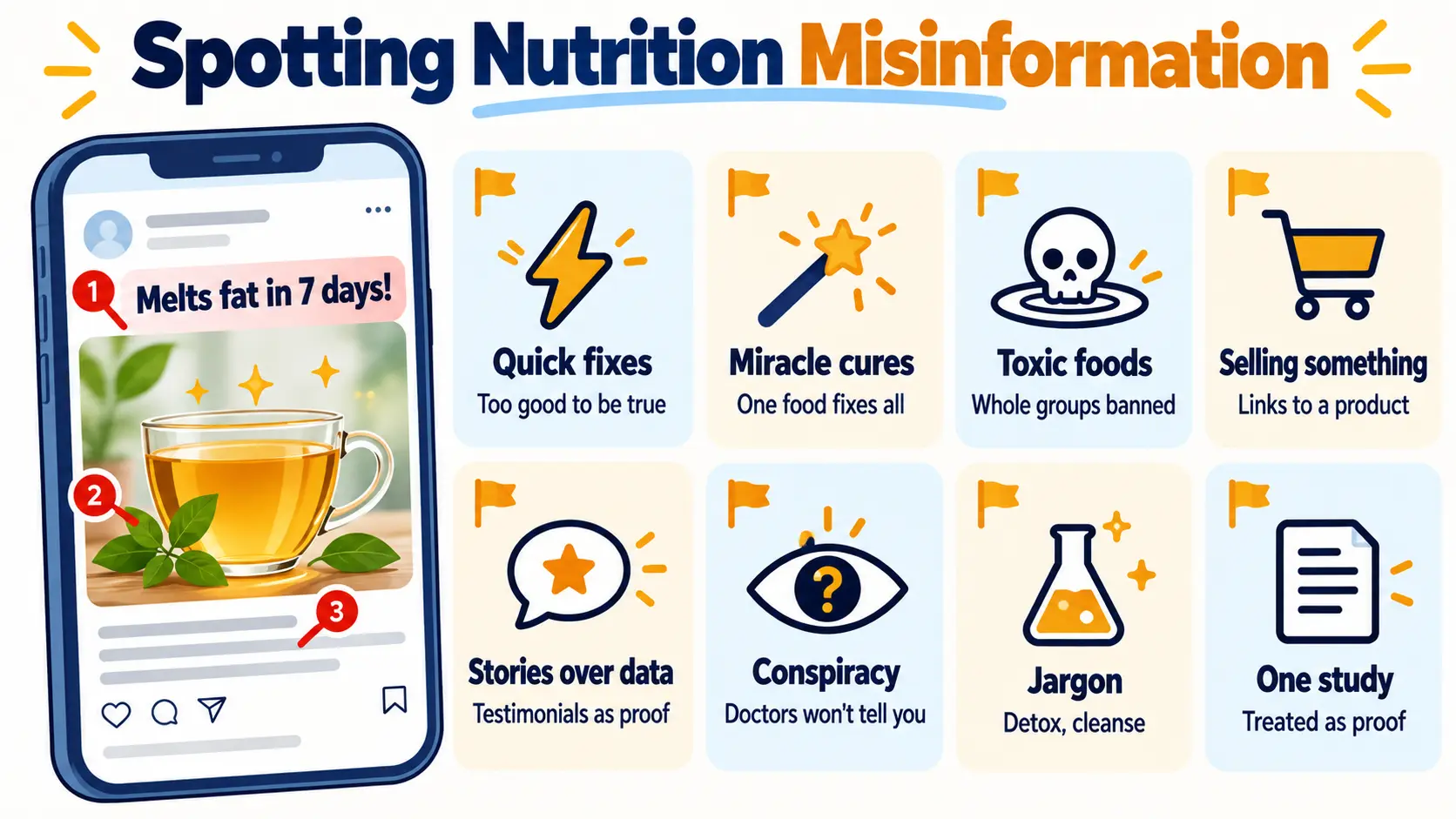
- Quick fixes"Lose 5 kg in a week" or results that sound too good to be true.
- Miracle foods or curesOne food, tea or supplement that fixes everything.
- Good food, bad foodWhole food groups labelled as "toxic" without strong evidence.
- Something to sellThe advice leads straight to a product, programme or discount code.
- Stories over dataTestimonials instead of studies, or one small study treated as proof.
- Conspiracy framing"What doctors don't want you to know."
- Science-sounding jargon"Detox", "cleanse" or "boosts metabolism" with no clear mechanism or evidence.
Evidence-Based Practice
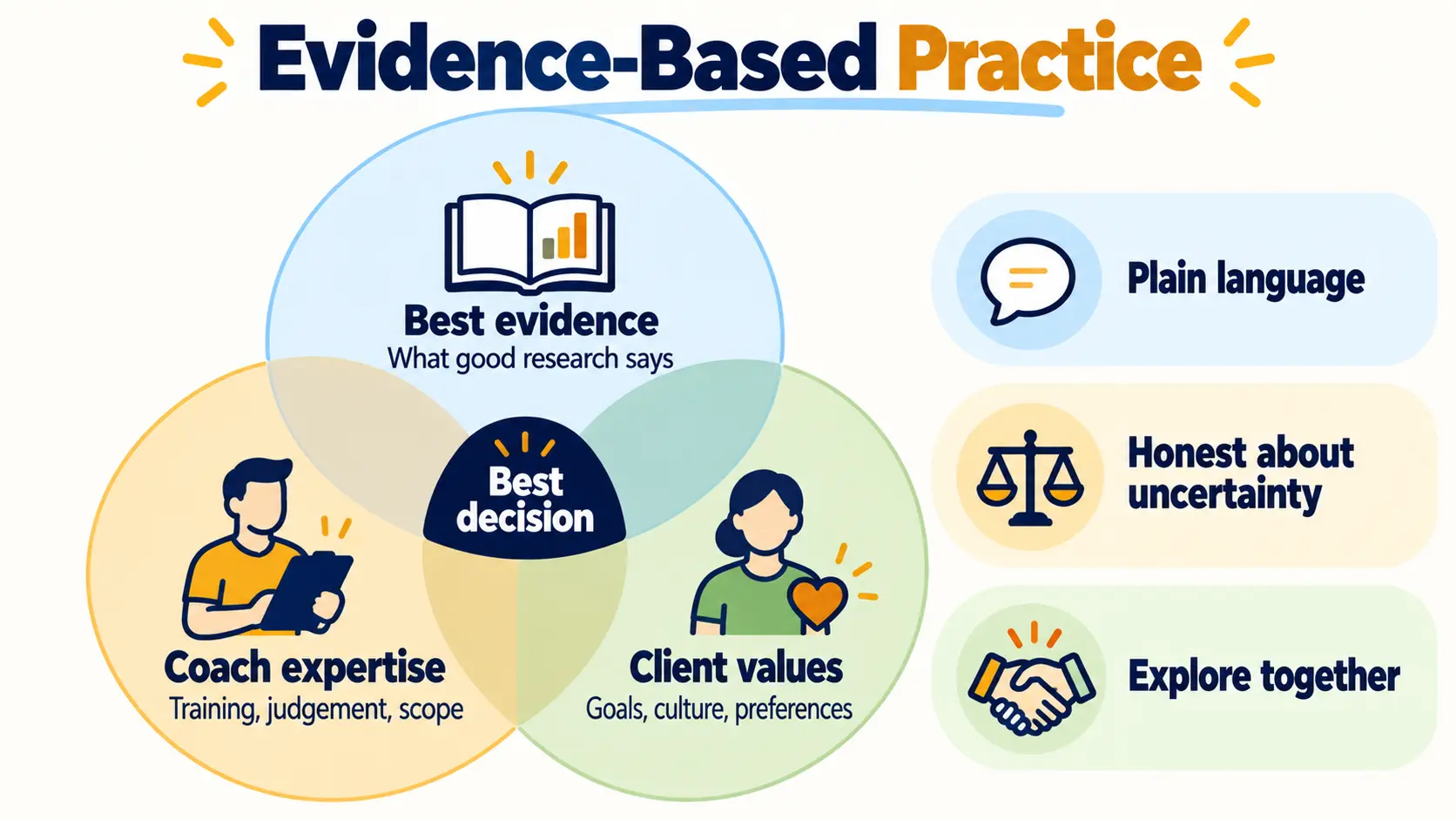
Evidence-based practice doesn't mean following studies blindly. It combines three things:
| Ingredient | What it means for a coach |
|---|---|
| Best available evidence | What high-quality research says about the question |
| Coaching expertise | Your training, experience and judgement — including knowing your scope (Lesson 2) |
| Client values and circumstances | Their goals, culture, preferences, budget and readiness to change (Lesson 4) |
Talking about evidence with clients
Use plain language, be honest about uncertainty ("the evidence is mixed" is a fine answer), and never mock a client for believing something they read. Ask what drew them to the claim, explore it together, and focus on what the stronger evidence supports. Staying current through continuing education is part of the job.
The situation: Neha shares a post: "New study: eating a popular breakfast cereal daily raises your risk of a condition by 20%!" The post links to a website selling a "clean" alternative.
Check the source: the original study is an observational cohort study — it shows an association, not cause and effect. The website has a product to sell.
Check the numbers: the study reports risk rising from 5 in 100 to 6 in 100. Relative change = (6 − 5) ÷ 5 × 100 = 20%. Absolute change = 1 percentage point — one extra person in every 100.
Explain kindly: "It's a fair question. This kind of study can't show the cereal caused it, and the actual difference is small. Let's look at your breakfast as a whole — is there some protein and fibre in there?"
Result: Neha keeps a breakfast she enjoys, adds yoghurt and fruit, and doesn't buy the product.
For more on how nutrition science works, see Precision Nutrition Level 1 Lesson 6: Introduction to Nutritional Science.
12 questions in the style of the CNC exam. Score 70%+ to mark this lesson complete.
- Science tests ideas; peer review and replication make findings more trustworthy.
- Observational studies show association; RCTs are better at showing cause and effect.
- Systematic reviews and meta-analyses sit at the top of the hierarchy; anecdotes at the bottom.
- Watch for confounders, small or short studies, animal-only results and conflicts of interest.
- Relative risk can sound much bigger than the absolute change — check both.
- Evidence-based practice combines research, coaching expertise and client values.
Before moving to Lesson 4:
- Find a recent nutrition headline and trace it back to the original study. What type of study was it?
- If it reported a percentage change in risk, work out the absolute change.
- Bookmark two reliable public health sources you can use with clients.
- Complete the knowledge check above and review any question you missed.