Dietary fat is essential: it supplies energy, helps absorb vitamins A, D, E and K, builds cell membranes and is used to make hormones. Two fatty acids — one omega-6 and one omega-3 — must come from food. The type of fat matters more than the total: favour unsaturated fats, keep saturated fat under about 10% of calories, and avoid industrial trans fats.
Lesson 7 covered carbohydrates. This lesson completes the three macronutrients with fat — the most energy-dense of them at about 9 kcal per gram. For years fat was blamed for weight gain and heart disease; today the picture is more precise. Fat isn't the enemy, but some fats support health far better than others.
Free on YouTube Subscribe to get every lesson video in this course SubscribeWhat Fat Does in the Body
- Energy and energy storageProvides about 9 kcal per gram and is the body's main long-term energy store, in adipose (fat) tissue. Fat is the main fuel at rest and during low-intensity activity.
- Absorbing fat-soluble vitaminsVitamins A, D, E and K need fat to be absorbed.
- Cell membranesEvery cell membrane is built largely from fats called phospholipids.
- Hormone productionCholesterol is used to make steroid hormones such as testosterone, oestrogen and cortisol, as well as vitamin D and bile.
- Protection and insulationFat cushions organs and helps maintain body temperature.
- Satiety and flavourFat slows stomach emptying, helping meals feel filling, and carries flavour and texture in food.
The Three Main Types of Lipids
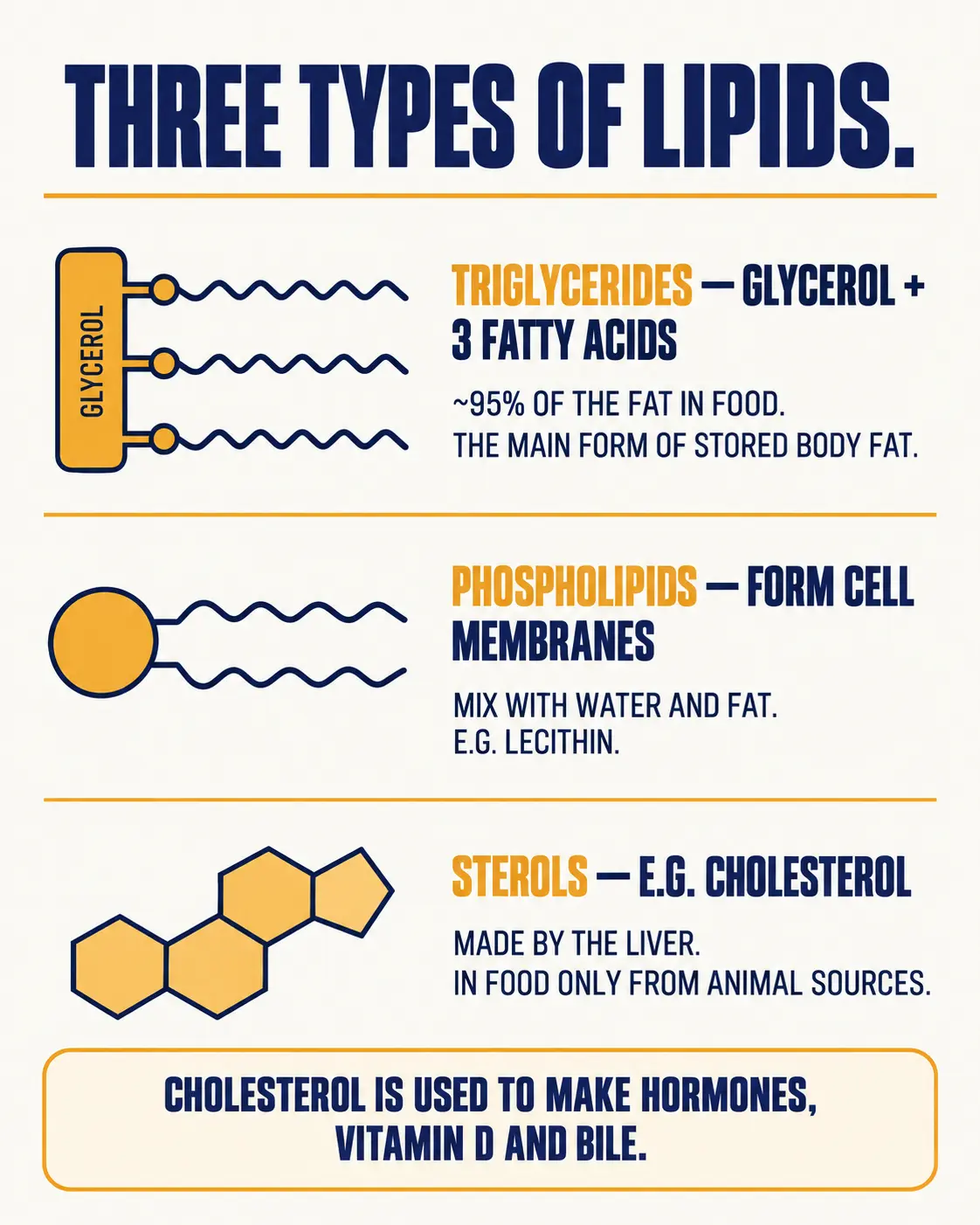
"Lipid" is the scientific term for fats and fat-like substances. There are three main groups:
- TriglyceridesOne glycerol backbone attached to three fatty acids. About 95% of the fat in food and the main form of stored body fat.
- PhospholipidsSimilar to triglycerides but with a phosphate group in place of one fatty acid, so they mix with both water and fat. They form cell membranes and act as emulsifiers — lecithin (found in eggs and soy) is a common example.
- SterolsRing-shaped lipids. The best known is cholesterol, which the body makes in the liver and which is found in food only from animal sources. Plants contain related compounds called plant sterols.
Saturated, Unsaturated and Trans Fats
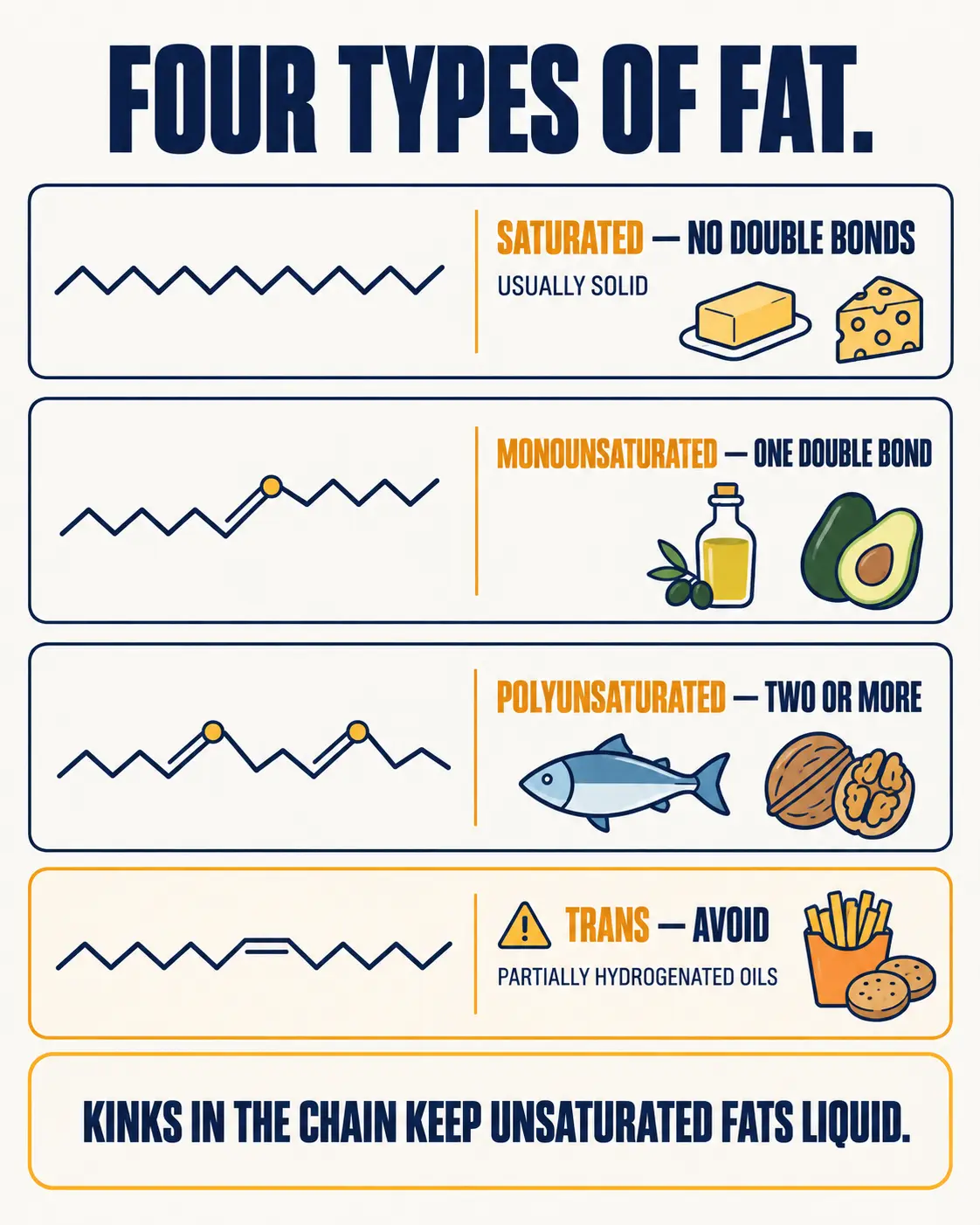
Fatty acids are chains of carbon atoms. What makes them different is whether the chain has double bonds between carbons. A "saturated" chain is fully loaded with hydrogen (no double bonds); an "unsaturated" chain has one or more double bonds, which put kinks in it. Those kinks are why unsaturated fats are usually liquid at room temperature.
| Type | Structure | At room temperature | Main sources | Health notes |
|---|---|---|---|---|
| Saturated | No double bonds | Usually solid | Butter, ghee, cheese, fatty meat, coconut and palm oil | Can raise LDL cholesterol; keep under ~10% of calories |
| Monounsaturated (MUFA) | One double bond | Liquid | Olive oil, avocado, most nuts, groundnut and canola oil | Linked with better heart health when replacing saturated fat |
| Polyunsaturated (PUFA) | Two or more double bonds | Liquid | Oily fish, walnuts, flax, chia, sunflower and soybean oil | Includes the essential omega-3 and omega-6 fats |
| Trans | Unsaturated, but with a straightened "trans" shape | Semi-solid | Partially hydrogenated oils in some fried and baked goods; small natural amounts in dairy and meat | Raises LDL and lowers HDL — avoid industrial trans fats |
Most foods contain a mix of fat types — olive oil still has some saturated fat, and butter some unsaturated fat — so foods are described by the type they have most of. Industrial trans fats are made by partial hydrogenation, a process that turns liquid oils semi-solid. They are the most harmful type of fat, and many countries have restricted or banned them, following World Health Organization calls to eliminate them from the food supply.
Fatty acids are also grouped by chain length. Most dietary fats are long-chain. Medium-chain triglycerides (MCTs), found in coconut oil, are absorbed and used more quickly, which is why they're popular in some supplements — though the evidence for special benefits is limited.
Essential Fatty Acids: Omega-3 and Omega-6
The body can make most fatty acids, but two must come from food:
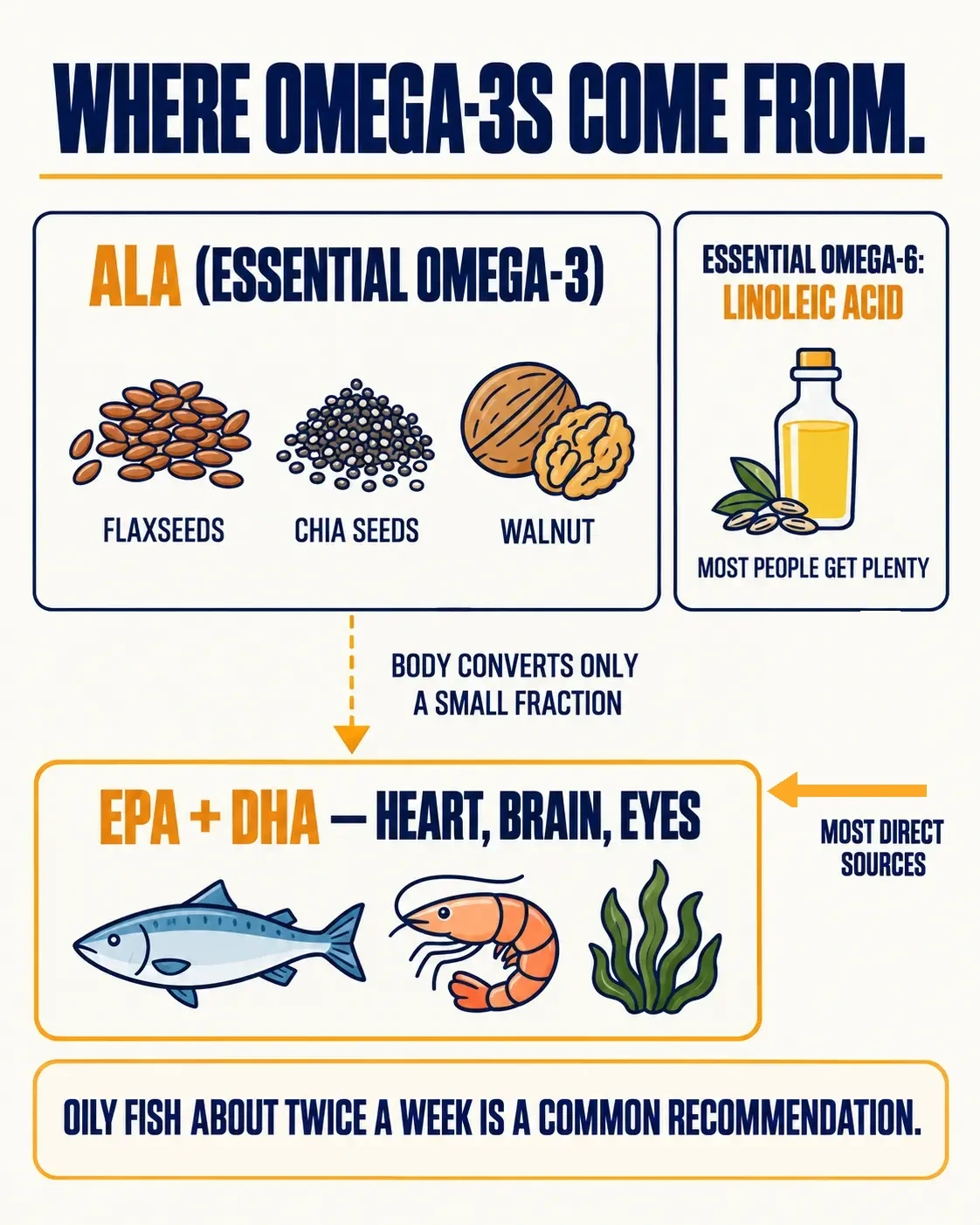
- Linoleic acid (LA) — an omega-6 fatFound in vegetable oils such as sunflower, soybean and corn oil, and in nuts and seeds. Most people get plenty.
- Alpha-linolenic acid (ALA) — an omega-3 fatFound in flaxseed, chia, walnuts, canola and soybean oil. Commonly cited adequate intakes are about 1.1 g/day for women and 1.6 g/day for men.
Two other omega-3 fats, EPA and DHA, are especially important for the heart, brain and eyes. The body can convert some ALA into EPA and DHA, but only a small fraction — so oily fish (salmon, sardines, mackerel), seafood and algae-based products are the most direct sources. A common recommendation is to eat oily fish about twice a week.
Typical modern diets are much higher in omega-6 than omega-3. Rather than chasing a precise ratio, the practical coaching step is to increase omega-3 intake through food. For more, see our post on omega-3 and fish oil benefits.
How Fat Is Digested and Transported
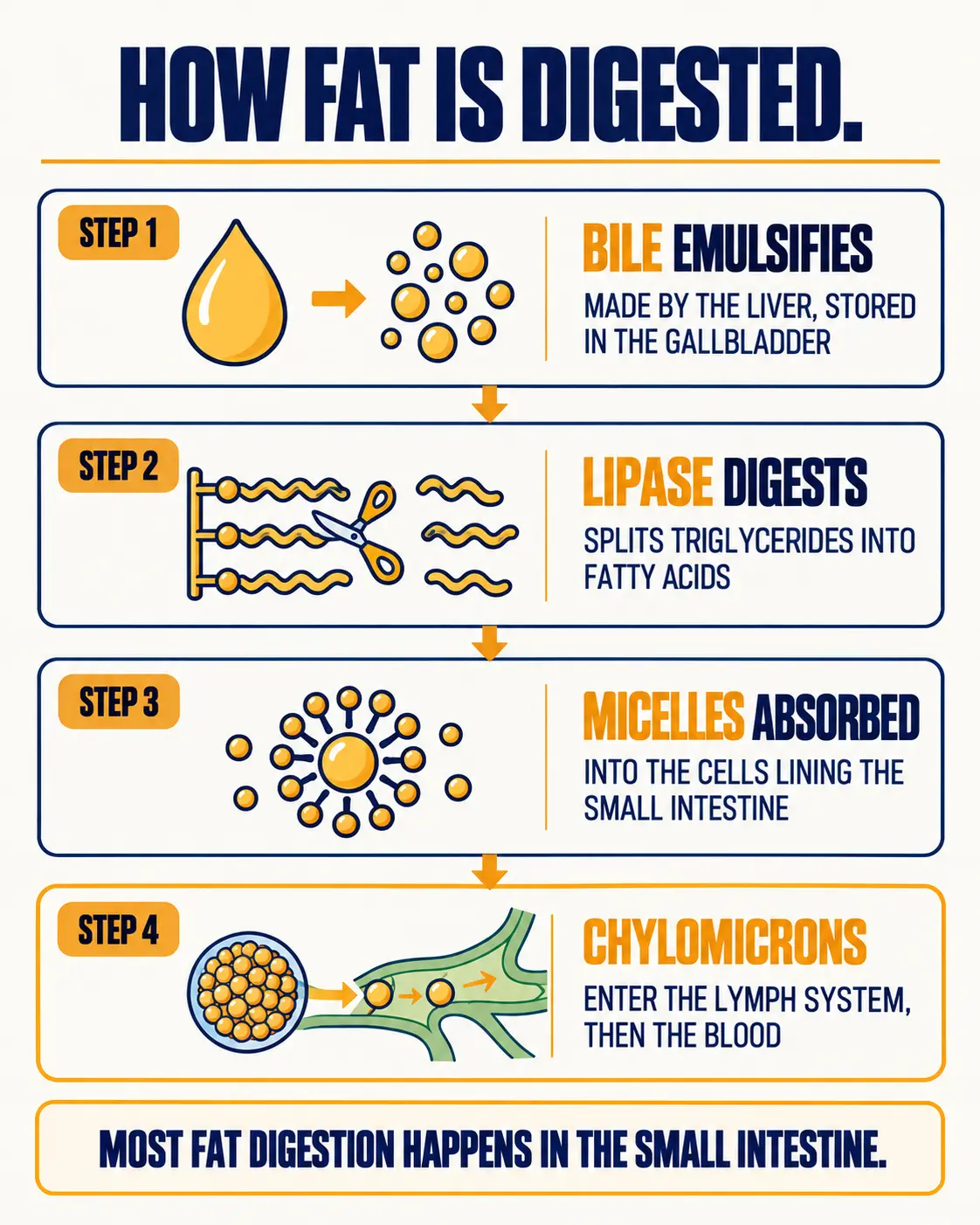
Fat doesn't mix with water, which makes digestion harder than for carbohydrate or protein. A small amount starts in the mouth and stomach (lingual and gastric lipase), but most happens in the small intestine:
- Bile, made by the liver and stored in the gallbladder, emulsifies fat — breaking large droplets into tiny ones so enzymes can reach them.
- Pancreatic lipase breaks triglycerides into free fatty acids and monoglycerides.
- These are packaged into tiny bundles called micelles and absorbed into intestinal cells.
- Inside the cells they're rebuilt into triglycerides and packaged into chylomicrons, which enter the lymphatic system before reaching the blood.
Because fat slows stomach emptying, meals containing fat tend to feel more filling for longer.
Lipoproteins: LDL and HDL
Fat and cholesterol travel in the blood inside protein-coated packages called lipoproteins:
| Lipoprotein | Main job | Common nickname |
|---|---|---|
| Chylomicrons | Carry dietary fat from the intestine | — |
| VLDL (very-low-density lipoprotein) | Carries triglycerides made by the liver | — |
| LDL (low-density lipoprotein) | Carries cholesterol from the liver out to tissues; high levels are linked with higher heart disease risk | "Bad" cholesterol |
| HDL (high-density lipoprotein) | Carries cholesterol back to the liver for removal | "Good" cholesterol |
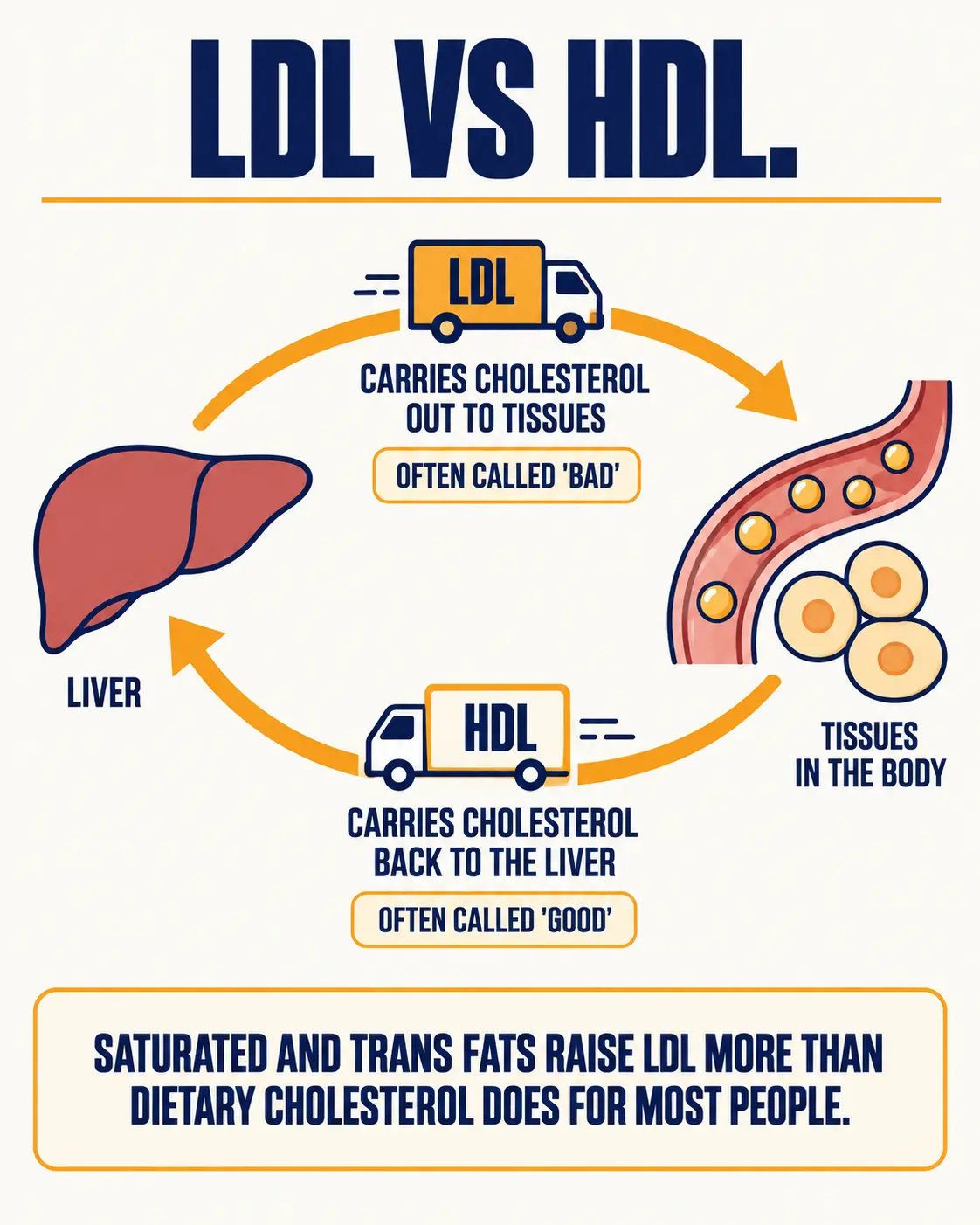
For most people, saturated and trans fats have a bigger effect on blood LDL than the cholesterol in food does. Interpreting blood cholesterol results or managing high cholesterol is a medical matter — clients should work with their doctor or a registered dietitian on this.
How Much Fat Do People Need?
| Measure | Commonly cited recommendation |
|---|---|
| Total fat (AMDR) | 20–35% of total calories |
| Saturated fat | Less than 10% of total calories |
| Trans fat | As low as possible (WHO: under 1% of calories) |
| Omega-3 | Oily fish about twice a week; ALA ~1.1–1.6 g/day |
Arjun eats about 2,000 kcal a day and wants fat to supply 30% of his energy — within the AMDR.
Calories from fat = 2,000 × 0.30 = 600 kcal
Grams of fat = 600 ÷ 9 kcal per gram ≈ 67 g/day
Saturated fat limit = under 10% of 2,000 = 200 kcal ÷ 9 ≈ under 22 g/day
Very low-fat diets make it hard to get enough essential fatty acids and fat-soluble vitamins, while very high-fat diets can easily push calorie intake up because fat is so energy-dense (Lesson 5). The coaching focus is the type of fat: replace saturated and trans fats with unsaturated fats, rather than simply cutting fat.
Food Sources and Coaching Takeaways
| Favour | Moderate | Avoid |
|---|---|---|
| Olive oil, avocado, nuts and seeds, oily fish, flax and chia | Butter, ghee, cheese, fatty and processed meats, coconut and palm oil | Partially hydrogenated oils and foods made with them |
Omega-3 supplements are covered in Lesson 13. Anyone taking medication — especially blood thinners — or managing a medical condition should check with their doctor before taking fish oil. This chapter overlaps with PN Level 1's macronutrients chapter — useful extra practice.
12 questions in the style of the CNC exam. Score 70%+ to mark this lesson complete.
- Fat provides ~9 kcal/g, stores energy, carries vitamins A, D, E and K, builds cell membranes and makes hormones.
- Triglycerides (glycerol + 3 fatty acids) are ~95% of dietary fat; phospholipids form membranes; cholesterol is a sterol.
- Saturated fats have no double bonds; mono- and polyunsaturated fats have one or more; industrial trans fats are the most harmful.
- The essential fatty acids are linoleic acid (omega-6) and ALA (omega-3); EPA and DHA come most directly from fish and algae.
- Bile emulsifies fat and pancreatic lipase digests it; LDL carries cholesterol out to tissues, HDL back to the liver.
- Fat 20–35% of calories, saturated fat under 10%, trans fat as low as possible. Cholesterol problems → doctor or dietitian.
Before moving to Lesson 9:
- List the main fat source in each of your meals yesterday and label it saturated, monounsaturated or polyunsaturated.
- Work out a fat target at 30% of calories for your own energy needs, in grams.
- Name two food sources of ALA and two of EPA and DHA.
- Complete the knowledge check above and review any question you missed.