Water makes up around 60% of an adult's body weight and is involved in almost every process — from controlling temperature to moving nutrients. The body balances intake and losses using thirst, the kidneys and hormones such as ADH. Needs vary widely, so thirst and urine colour are practical guides. Losing about 2% of body weight in fluid can hurt performance, but drinking far more than you lose can cause dangerous low blood sodium. Around exercise, the aim is to replace losses — not to drink as much as possible.
Of all the nutrients, water is the one the body can go without for the shortest time. Yet hydration advice is full of myths — "eight glasses a day", "coffee dehydrates you", "if you're thirsty it's too late". This lesson sets out what the evidence supports, how to estimate needs, and how to hydrate around training.
Free on YouTube Subscribe to get every lesson video in this course SubscribeWater in the Body
Water makes up roughly 50–70% of an adult's body weight — about 60% on average. The share varies with body composition: muscle is about 75% water, while fat tissue holds far less. That's why people with more muscle tend to have a higher percentage of body water.
About two-thirds of body water sits inside cells (intracellular fluid). The remaining third is outside cells (extracellular fluid) — in blood plasma and the fluid that surrounds cells.
- Temperature controlSweat evaporating from the skin carries heat away — the main way the body cools itself during exercise.
- TransportBlood plasma carries nutrients, oxygen and hormones to cells, and waste products to the kidneys.
- Chemical reactionsWater is the medium for most reactions in the body and takes part in many, such as breaking down food during digestion.
- Lubrication and protectionIt lubricates joints and eyes, and cushions the brain, spinal cord and a developing baby.
- Blood volume and pressureEnough fluid keeps blood volume up, helping the heart pump efficiently.
Water Balance: Intake vs Losses
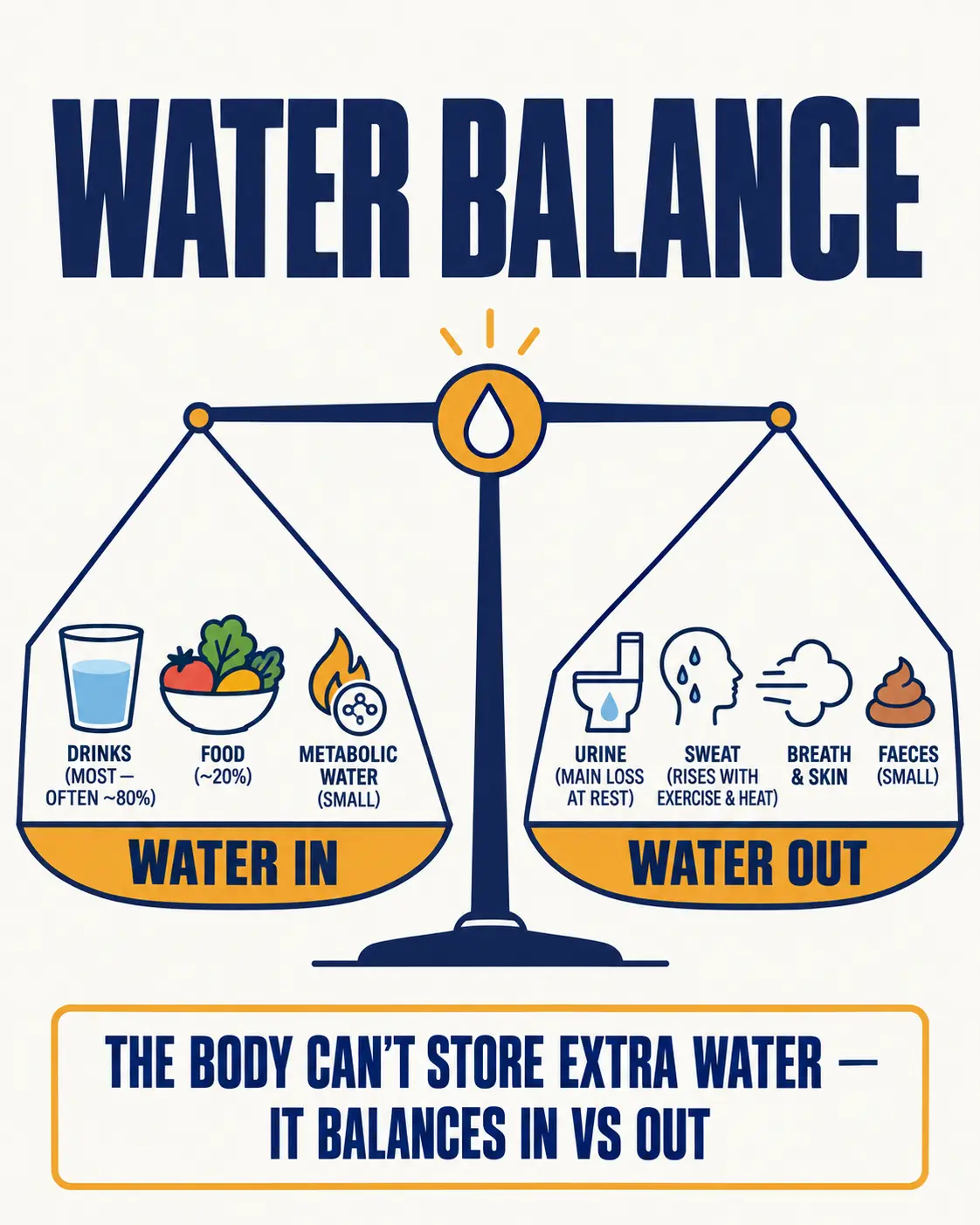
The body can't store extra water for later, so it constantly balances what comes in against what goes out.
| Water in | Water out |
|---|---|
| Drinks — the largest source for most people (often around 80% of intake) | Urine — the largest route of loss for most people at rest |
| Food — roughly 20% of intake; fruit and vegetables are often 80–95% water | Sweat — small at rest, but can reach well over a litre an hour in hard exercise or heat |
| Metabolic water — a small amount made when the body breaks down carbohydrate, fat and protein | Breath and skin — "insensible" losses you don't notice; rise in dry air and at altitude |
| Faeces — usually small, but large with diarrhoea |
How the body keeps the balance
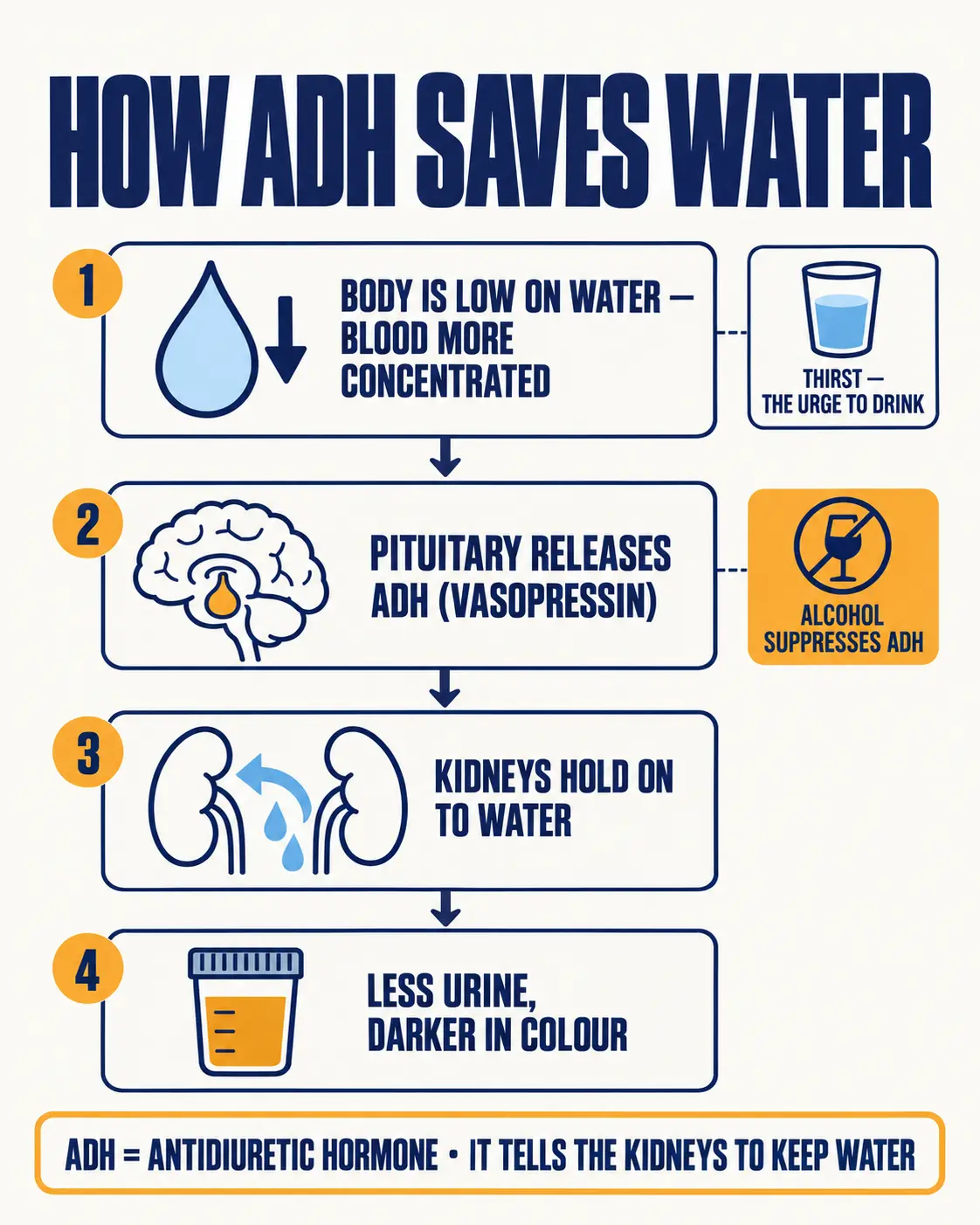
- ThirstThe brain senses when blood becomes more concentrated and triggers the urge to drink. Thirst is less reliable in older adults.
- Antidiuretic hormone (ADH, or vasopressin)Released from the pituitary gland when the body is low on water. It signals the kidneys to hold on to water, making urine smaller in volume and darker. Alcohol suppresses ADH (Lesson 9).
- AldosteroneA hormone from the adrenal glands that tells the kidneys to keep sodium — and water follows sodium.
- The kidneysAdjust how much water and sodium leave in urine, minute by minute.
How Much Fluid Do People Need?
There's no single number that fits everyone. Reference values give a starting point for healthy adults in mild conditions — and they cover total water from drinks and food, not just plain water.
| Reference | Women | Men |
|---|---|---|
| US/Canada Adequate Intake (total water) | ~2.7 L/day | ~3.7 L/day |
| European reference (total water) | ~2.0 L/day | ~2.5 L/day |
The popular "eight glasses a day" rule isn't based on strong evidence. Needs go up with heat and humidity, altitude, exercise and heavy sweating, larger body size, pregnancy and breastfeeding, and illness with fever, vomiting or diarrhoea.
Practical ways to check hydration
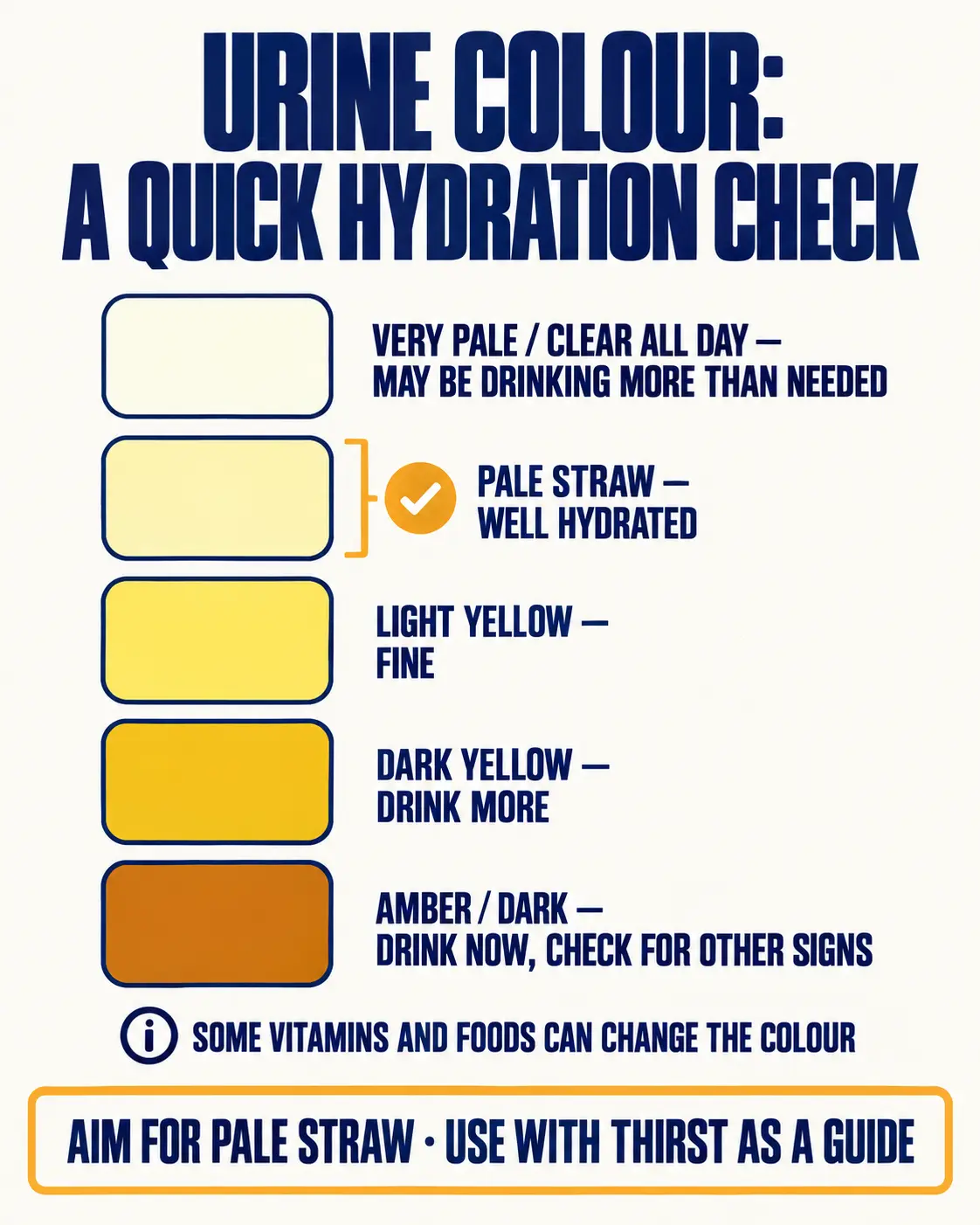
- Urine colour: pale straw-coloured suggests good hydration; dark yellow suggests more fluid is needed. Some supplements and foods (such as B vitamins or beetroot) change the colour.
- Thirst: for most healthy people in daily life, drinking when thirsty works well.
- Body weight around exercise: weight lost during a session is mostly fluid — the basis of the sweat-rate check below.
What counts: water, milk, tea, coffee, soups and water-rich foods all contribute. In people who drink them regularly, moderate caffeine has only a small diuretic effect — so coffee and tea still count towards fluid intake. Alcohol, on the other hand, increases urine output.
Dehydration and Overhydration
Both too little and too much fluid can cause problems.
| Dehydration | Overhydration (hyponatremia) | |
|---|---|---|
| What it is | Losing more water than you take in | Blood sodium falls too low, usually from drinking far more than you lose |
| Common causes | Heavy sweating, heat, not drinking enough, vomiting or diarrhoea | Drinking large amounts of plain water during long endurance events, well beyond sweat losses |
| Signs | Thirst, dark urine, passing little urine, headache, tiredness, dizziness, dry mouth | Nausea, headache, bloating or swelling, confusion — and weight gained during exercise |
| Effect on training | Losing about 2% of body weight can reduce endurance performance and concentration, especially in heat | Can become life-threatening |
| Who's more at risk | Older adults (weaker thirst), young children, people working or training in heat | Slower endurance participants who drink at every station |
Electrolytes
Electrolytes are minerals that carry an electrical charge when dissolved in body fluids. They control where water moves, and they're essential for nerve signals and muscle contraction.
| Electrolyte | Where it's concentrated | Key roles | Notes |
|---|---|---|---|
| Sodium | Outside cells (the main extracellular electrolyte) | Fluid balance, blood volume, nerve signals, muscle contraction | The main electrolyte lost in sweat. Most people eat more than recommended, mainly from processed and restaurant food. |
| Potassium | Inside cells (the main intracellular electrolyte) | Fluid balance, nerve signals, heart rhythm, muscle contraction | Fruit, vegetables, legumes, dairy. Many people eat less than recommended. |
| Chloride | Outside cells, alongside sodium | Fluid balance; part of stomach acid | Mostly eaten as salt (sodium chloride). |
| Magnesium and calcium | Bone, and inside and outside cells | Muscle contraction and relaxation, nerve function | Lost in small amounts in sweat (Lesson 10). |
Sodium and salt aren't the same thing. Salt (sodium chloride) is about 40% sodium, so 1 g of salt ≈ 400 mg of sodium. To turn sodium into salt, multiply by 2.5. The World Health Organization recommends that adults in the general population eat less than 2,000 mg of sodium (5 g of salt) a day; national guidelines vary. People who sweat heavily for long periods may need more sodium around training — how much depends on the individual, because sweat sodium varies a lot from person to person. For more, see our guide on why water alone isn't always enough.
Hydration Before, During and After Exercise
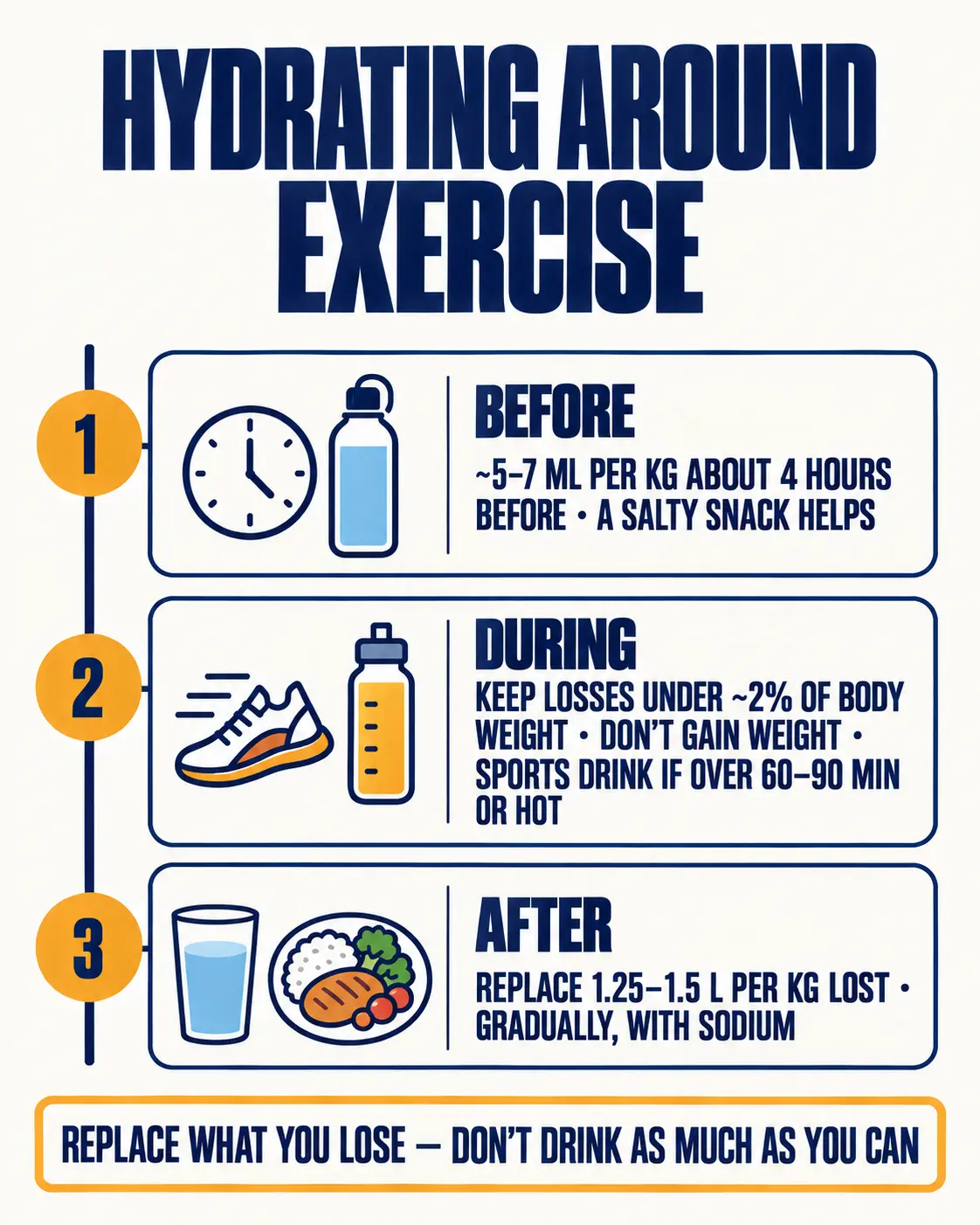
For most short, easy sessions, drinking to thirst and having a normal meal afterwards is enough. Longer, harder or hotter sessions need more planning. The general targets below are widely used in sports nutrition guidance:
| When | General target | Practical tips |
|---|---|---|
| Before | Start well hydrated — about 5–7 ml per kg of body weight around 4 hours before | Pale urine is a good sign. A salty snack or meal can help the body hold on to fluid. |
| During | Drink to limit fluid loss to less than about 2% of body weight — without gaining weight | Many people need roughly 0.4–0.8 L an hour, but sweat rates vary widely. Sports drinks with sodium and carbohydrate help in sessions longer than about 60–90 minutes or in heat. |
| After | Replace about 1.25–1.5 L of fluid for every 1 kg of body weight lost | Drink gradually over the next few hours, with food or drinks that contain sodium to help the body keep the fluid. |
Estimating sweat rate
Weighing before and after a session is the simplest way to personalise fluid needs:
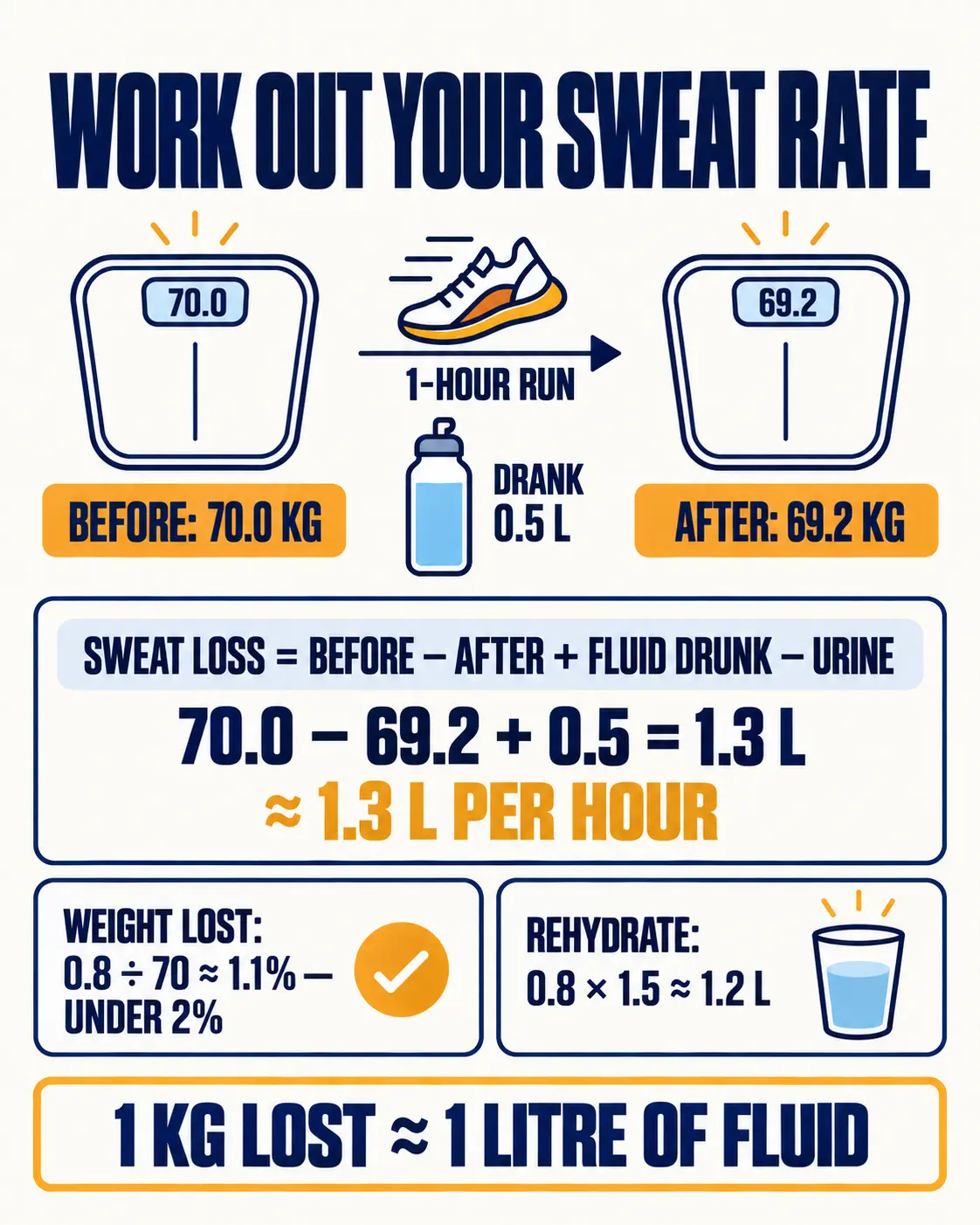
Sweat loss (L) = weight before (kg) − weight after (kg) + fluid drunk (L) − urine passed (L)
Each kilogram of body weight lost is roughly one litre of fluid. Divide by the session length in hours to get the sweat rate per hour.
Kabir weighs 70.0 kg before a 1-hour run and 69.2 kg after. He drank 0.5 L during the run and didn't use the toilet.
Sweat loss = 70.0 − 69.2 + 0.5 = 1.3 L → a sweat rate of about 1.3 L per hour.
Body weight lost = 0.8 kg ÷ 70 kg = about 1.1% — under the 2% guide, so his drinking plan is working.
To rehydrate: 0.8 kg × 1.5 = about 1.2 L over the next few hours, with a meal or a drink that contains sodium.
Coaching Hydration
For most clients, better hydration is about simple habits, not precise targets:
- Keep a water bottle within reach and drink with each meal.
- Use thirst and urine colour as everyday guides.
- Include water-rich foods such as fruit, vegetables, yoghurt and soups.
- Plan fluids for long, hard or hot sessions — and weigh before and after to learn personal needs.
- Remind older clients to drink regularly, since their thirst may be weaker.
- Avoid extremes: no need to force down litres of water, and no need to fear coffee or tea.
This chapter overlaps with PN Level 1's water and fluid balance lesson — useful extra practice.
12 questions in the style of the CNC exam. Score 70%+ to mark this lesson complete.
- Water is about 60% of adult body weight; about two-thirds is inside cells.
- Drinks supply most water, food about 20%; urine is the main loss at rest, sweat during exercise.
- Thirst, ADH, aldosterone and the kidneys keep water balance; ADH tells the kidneys to hold on to water.
- Needs vary — reference values cover total water from drinks and food; thirst and pale urine are practical guides.
- Losing ~2% of body weight can impair performance; drinking far beyond losses can cause hyponatremia.
- Sodium is lost most in sweat (sodium × 2.5 = salt); after exercise replace 1.25–1.5 L per kg lost. Medical conditions and fluid restrictions → doctor.
Before moving to Lesson 12:
- Weigh yourself before and after your next training session and calculate your sweat rate.
- Check the sodium on three food labels and convert each to grams of salt.
- Write two signs of dehydration and two signs of hyponatremia from memory.
- Complete the knowledge check above and review any question you missed.