Nutrient timing is fine-tuning, not the foundation. Total daily energy and macronutrients matter far more. Once those are in place, timing can help: a carbohydrate-focused meal a few hours before training, carbohydrate during long sessions, and a protein-rich meal within a couple of hours afterwards. Spreading protein across three to four meals supports muscle repair. The "30-minute anabolic window" and "six meals to boost metabolism" are myths — the best schedule is the one a client can follow.
Few nutrition topics generate as many rules as timing: eat within 30 minutes of training, never eat after 8 pm, eat six small meals, never skip breakfast. This lesson explains which timing strategies have good evidence behind them, who they matter for most, and which rules can be dropped.
Free on YouTube Subscribe to get every lesson video in this course SubscribeWhere Timing Fits
Nutrient timing means planning when nutrients are eaten — especially around exercise — to support performance, recovery or body composition. It's useful, but it sits near the top of the priority list, not the bottom:
| Priority | What it covers | Why it's here |
|---|---|---|
| 1. Energy balance | Total calories in vs out (Lesson 5) | Drives weight change more than anything else |
| 2. Macronutrients | Enough protein; carbohydrate and fat to suit goals (Lessons 6–8) | Shapes body composition, performance and recovery |
| 3. Micronutrients and hydration | Varied whole foods and enough fluid (Lessons 10–11) | Supports health and every process above |
| 4. Nutrient timing | When meals, protein and carbohydrate are eaten | Fine-tuning — matters most for athletes and hard training |
| 5. Supplements | Filling specific gaps (Lesson 13) | Smallest effect for most people |
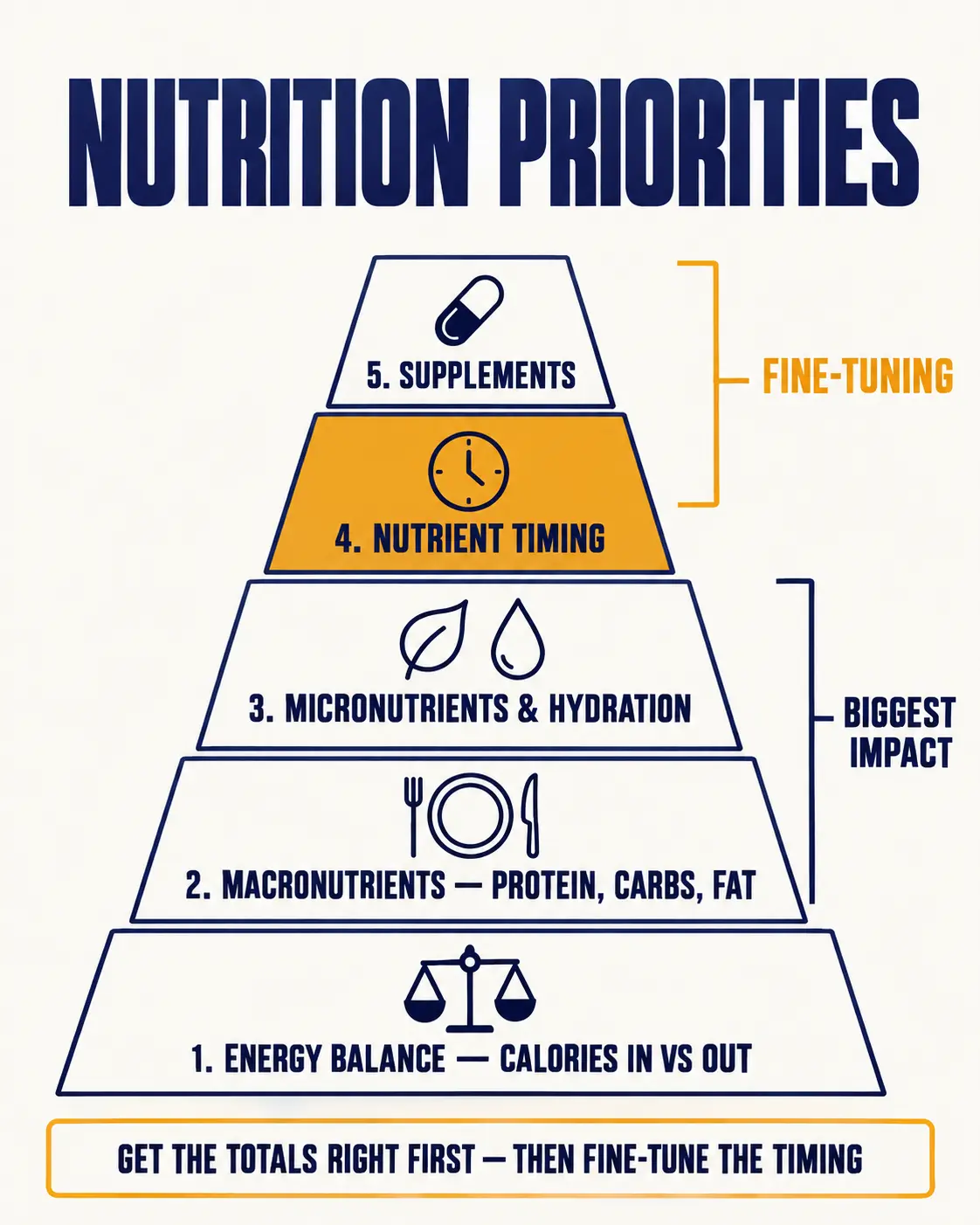
Timing matters more for endurance athletes, people who train twice a day or compete, and those training hard in a fasted state. For most clients exercising a few times a week to improve health, getting the first three levels right delivers almost all the results.
Before Exercise
The pre-exercise meal aims to top up energy stores, prevent hunger, and avoid stomach problems during the session.
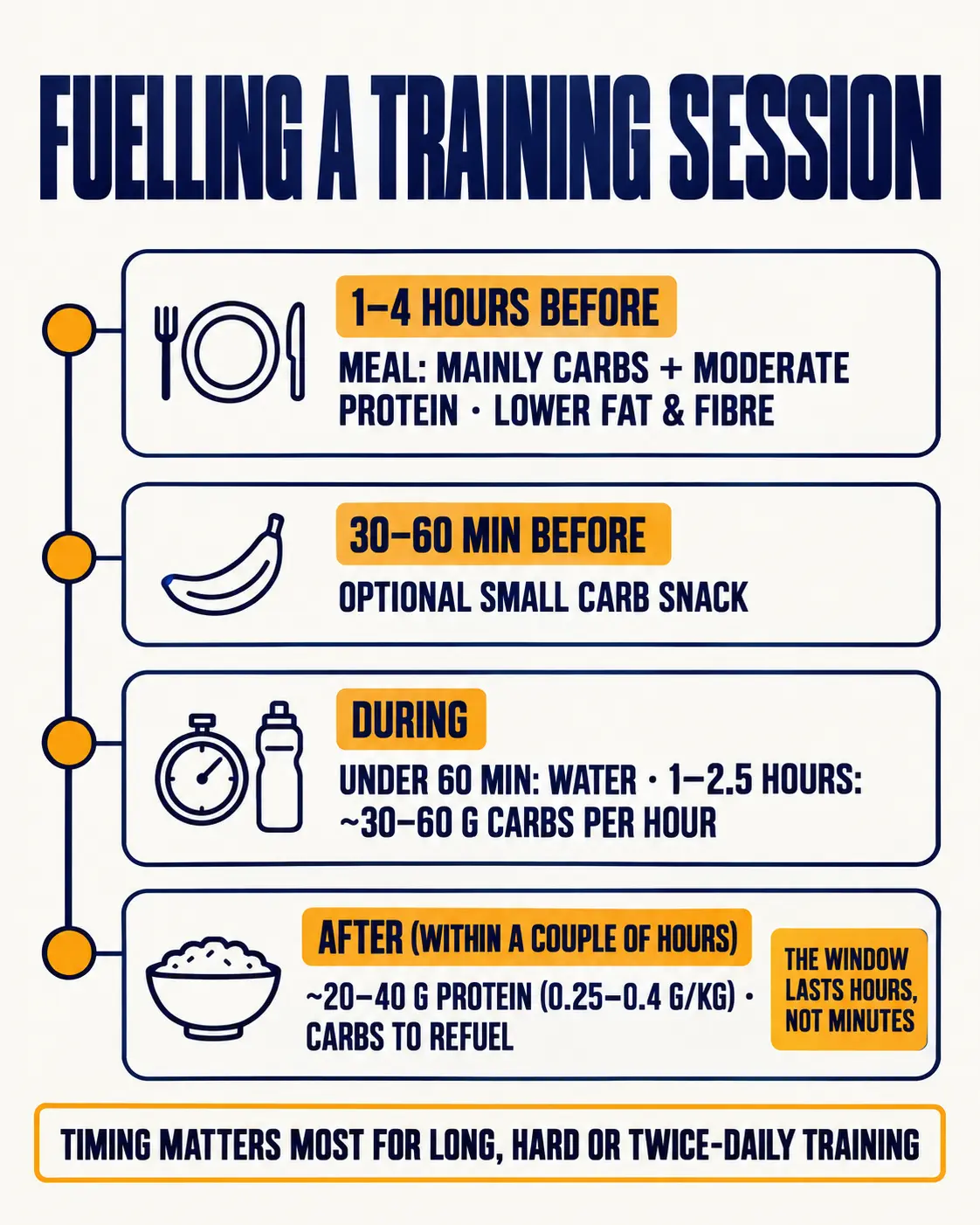
- 1–4 hours before: a mealMainly carbohydrate (commonly 1–4 g/kg body weight, with more carbohydrate the further out the meal is) plus moderate protein. Examples: rice with dal and vegetables, oats with milk and fruit, a chicken sandwich.
- 30–60 minutes before: a small snack, if neededEasy-to-digest carbohydrate — a banana, toast with honey, a small yoghurt.
- Keep fat and fibre lower close to trainingBoth slow digestion and can cause stomach discomfort during exercise.
- Test in training, never on event dayTolerance varies a lot. New foods or timings should be tried in practice sessions first.
Fasted training — exercising without eating first, often in the morning — is fine for short or low-intensity sessions and some people prefer it. For long or high-intensity sessions, performance may drop without fuel. It isn't a shortcut to more fat loss: over a day, total energy balance decides fat loss.
During Exercise
For most sessions under about an hour, water is enough. Longer sessions draw down glycogen, and carbohydrate during exercise can help maintain performance.
| Session length | Carbohydrate during exercise | Notes |
|---|---|---|
| Under ~60 minutes | Not usually needed | Water is enough for most people |
| ~1–2.5 hours | ~30–60 g per hour | Sports drinks, gels, bananas, dates |
| Over ~2.5 hours | Up to ~90 g per hour | Needs a mix of glucose and fructose, and a gut trained to handle it |
Fluid and sodium needs during exercise were covered in Lesson 11. For endurance events lasting more than about 90 minutes, some athletes also carbohydrate-load — eating around 10–12 g of carbohydrate per kg of body weight per day for the 36–48 hours before — to top up glycogen stores (Lesson 7).
After Exercise
Recovery nutrition has two main jobs: repairing and building muscle (protein) and refilling glycogen (carbohydrate).
- Protein: ~0.25–0.4 g/kgAbout 20–40 g of high-quality protein within a couple of hours after training helps muscle repair and growth.
- Carbohydrate: depends on the next sessionIf the next hard session is less than about 8 hours away, fast refuelling matters — roughly 1.0–1.2 g/kg per hour for the first few hours. With a day or more between sessions, normal meals over the day refill glycogen.
- Fluid and sodiumReplace about 1.25–1.5 L per kg of body weight lost (Lesson 11).
The "anabolic window"
An old rule said protein must be eaten within 30–60 minutes of training or the benefit would be lost. Current evidence shows the window is much wider — hours rather than minutes, especially if a meal with protein was eaten in the few hours before training. Post-workout timing matters more after fasted training, when the body has gone longer without protein. For most clients, a protein-rich meal within a couple of hours after training is plenty — no need to rush a shake in the changing room.
Spreading Protein Across the Day
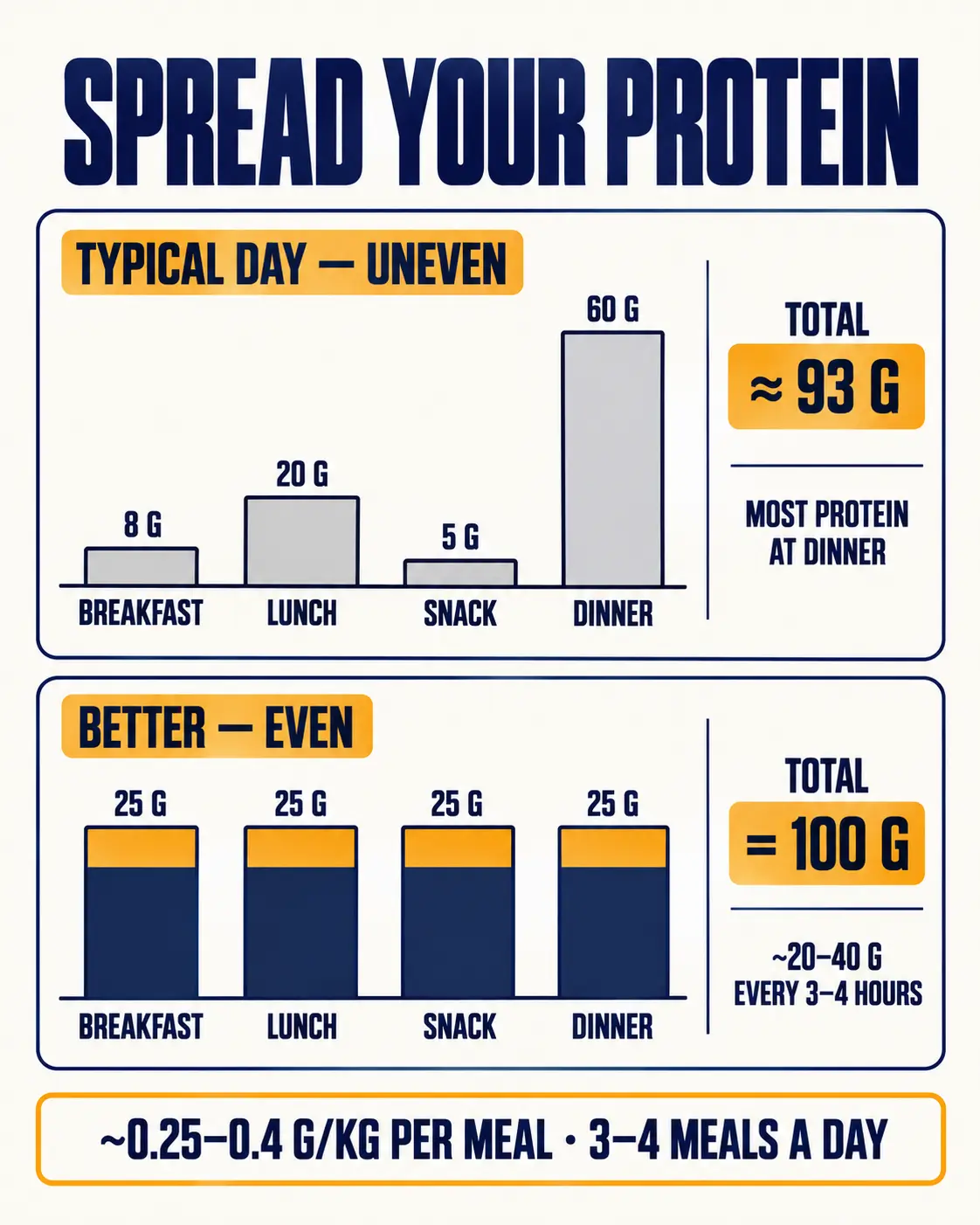
Muscle protein synthesis rises for a few hours after a protein-rich meal and then returns to baseline. Many people eat little protein at breakfast and most at dinner. Spreading it more evenly gives the muscles several chances to rebuild each day.
- Per meal: ~0.25–0.4 g/kgRoughly 20–40 g for most adults, containing about 2–3 g of the amino acid leucine (found in plenty in animal proteins, soy and whey).
- How often: every 3–4 hoursUsually three to four protein-containing meals or snacks a day.
- Daily total still comes firstFor people who train, about 1.4–2.0 g/kg per day (Lesson 6). Distribution helps you hit it well.
- Before sleep: an optionAbout 30–40 g of slow-digesting protein, such as casein (in milk, curd, paneer or cottage cheese), before bed may support overnight muscle repair.
For a deeper look, see our guide to protein per meal and distribution.
Tanvi weighs 60 kg and does strength training from 6 to 7 pm after work. She eats lunch at 1 pm, and aims for about 1.6 g/kg of protein a day.
Daily protein = 60 × 1.6 = about 96 g. Per meal at 0.4 g/kg = 60 × 0.4 = 24 g, across four meals ≈ 96 g.
Before: lunch is five hours before training, so a small carbohydrate-focused snack at about 4:30–5 pm — a banana and yoghurt — keeps her fuelled.
After: dinner by about 8 pm with around 24 g of protein (for example, paneer or chicken with rice and vegetables) covers recovery. No shake needed unless dinner will be much later.
Meal Timing Myths
| Claim | What the evidence says |
|---|---|
| "Six small meals boost metabolism" | When total calories are matched, meal frequency makes little difference to weight change. The energy used to digest food depends on how much you eat, not how often. |
| "Breakfast is the most important meal" | Eating or skipping breakfast has no clear effect on weight when total intake is the same. It depends on preference, hunger and training time. |
| "Eating late at night causes fat gain" | Total calories over the day matter more than the clock. Late eating can still be a problem if it leads to extra snacking or disturbs sleep. |
| "You must eat protein within 30 minutes of training" | The window lasts hours. A protein-rich meal within a couple of hours is enough for most people. |
| "Fasted cardio burns more fat" | It uses more fat during the session, but total fat loss over time depends on energy balance. |
Intermittent fasting
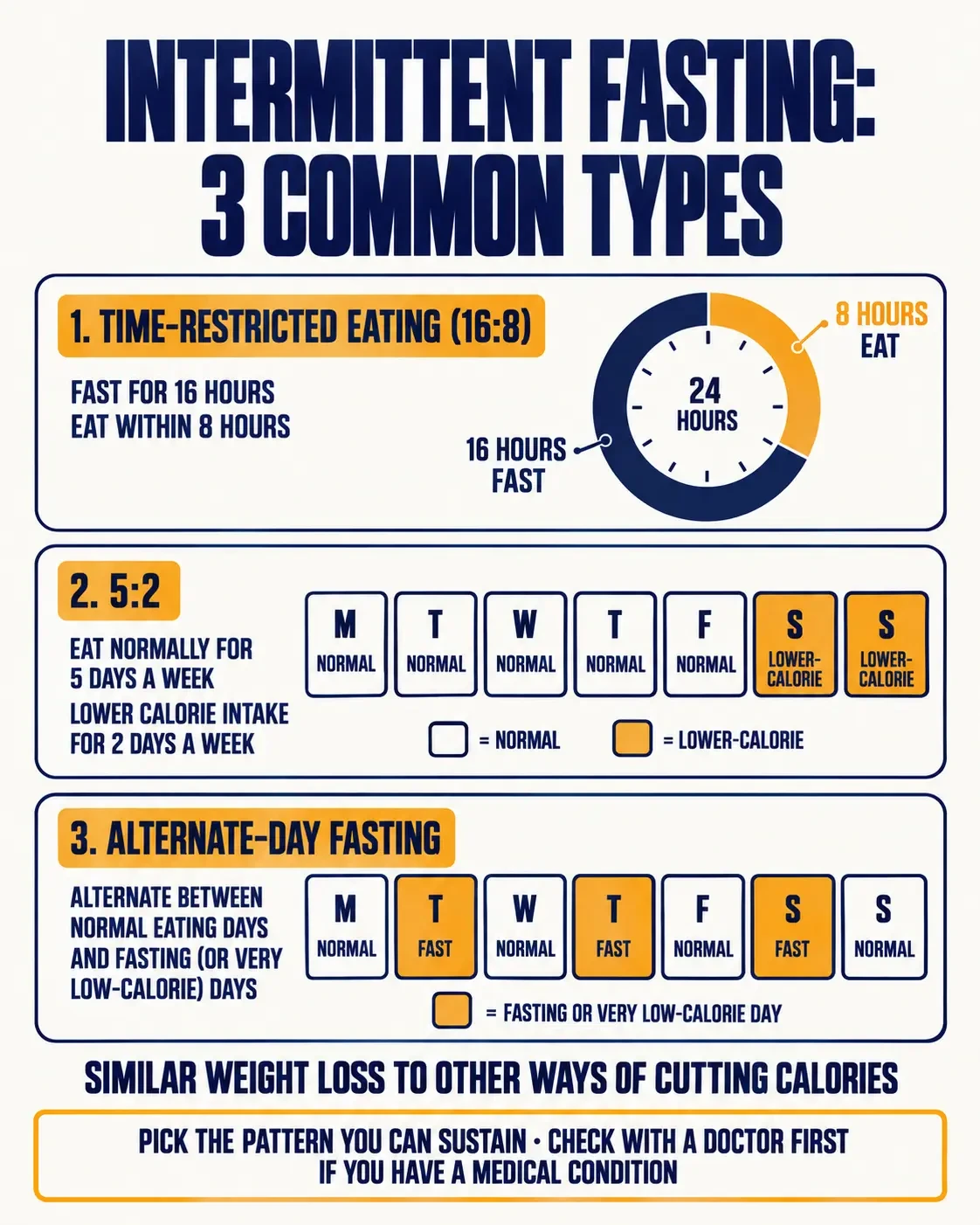
Intermittent fasting (IF) means cycling between periods of eating and not eating. Common types are time-restricted eating (for example, eating within an 8-hour window — "16:8"), 5:2 (two lower-calorie days a week), and alternate-day fasting. In most studies, IF leads to similar weight loss to other ways of cutting calories — it works mainly by helping some people eat less. It can suit people who like fewer, larger meals, but some find it leads to overeating or makes it harder to fit protein and training nutrition in. More in our post on what intermittent fasting actually does.
Coaching Nutrient Timing
- Get the basics right first: total calories, protein, and plenty of whole foods.
- Plan meals around the client's training time and daily routine — not a rigid rulebook.
- Add a protein source to breakfast if most protein currently comes at dinner.
- For long or twice-daily training, plan carbohydrate before, during and after.
- Let clients choose the meal pattern they can sustain — three meals, five meals, or a set eating window.
12 questions in the style of the CNC exam. Score 70%+ to mark this lesson complete.
- Energy balance and macronutrients come first; timing is fine-tuning that matters most for athletes and hard training.
- Pre-exercise: a mainly carbohydrate meal with moderate protein 1–4 hours before; keep fat and fibre lower close to training.
- During: water is enough under ~60 minutes; ~30–60 g carbohydrate per hour for 1–2.5 hours.
- After: ~0.25–0.4 g/kg protein (20–40 g) within a couple of hours; fast carbohydrate refuelling if the next session is within ~8 hours.
- Spread protein across 3–4 meals, every 3–4 hours; the anabolic window lasts hours, not minutes.
- Meal frequency, breakfast and intermittent fasting don't change weight loss when calories match — choose what a client can sustain. Medical conditions → doctor.
Before moving to Lesson 13:
- Calculate a per-meal protein target at 0.3 and 0.4 g/kg for your own body weight.
- Plan a pre- and post-training meal around your usual training time.
- List three timing myths and write the evidence-based answer to each from memory.
- Complete the knowledge check above and review any question you missed.