Labels are one of the most practical tools a client has — once they know where to look. Start with the serving size, because every number on the label depends on it. Use the per 100 g column to compare products, read the ingredient list (it's in order of weight), and treat front-of-pack claims with healthy scepticism. Supplement labels need extra care: check the dose per serving, watch for proprietary blends, and look for independent testing. And because people eat portions, not servings, simple tools like the hand method help clients estimate amounts without weighing everything.
Lesson 18 covered how to assess what a client eats. This lesson gives clients — and coaches — the tools to understand what's in their food and how much of it they're eating. Label formats and rules differ between countries, so this lesson focuses on the parts that are common to most labels.
Free on YouTube Subscribe to get every lesson video in this course SubscribeReading a Nutrition Label
Most packaged foods carry a nutrition panel. The layout varies by country, but most show the same core information. Read it in this order:
| Part of the label | What it tells you | What to check |
|---|---|---|
| 1. Serving size and servings per pack | The amount all the numbers refer to, and how many servings the pack holds | Is the serving size close to what the client actually eats? |
| 2. Energy | Calories (kcal) and/or kilojoules (kJ) per serving and often per 100 g | 1 kcal = 4.184 kJ, so divide kJ by about 4.2 to get kcal |
| 3. Macronutrients | Protein, carbohydrate (including sugars and often added sugars), fat (including saturated fat), fibre | Protein and fibre relative to energy; added sugars and saturated fat |
| 4. Sodium or salt | Shown as sodium, salt, or both, depending on the country | Salt ≈ sodium × 2.5 |
| 5. Reference values | % Daily Value (%DV) or % Reference Intake — the share of a typical day's amount in one serving | On US-style labels, 5% DV or less is low and 20% DV or more is high |
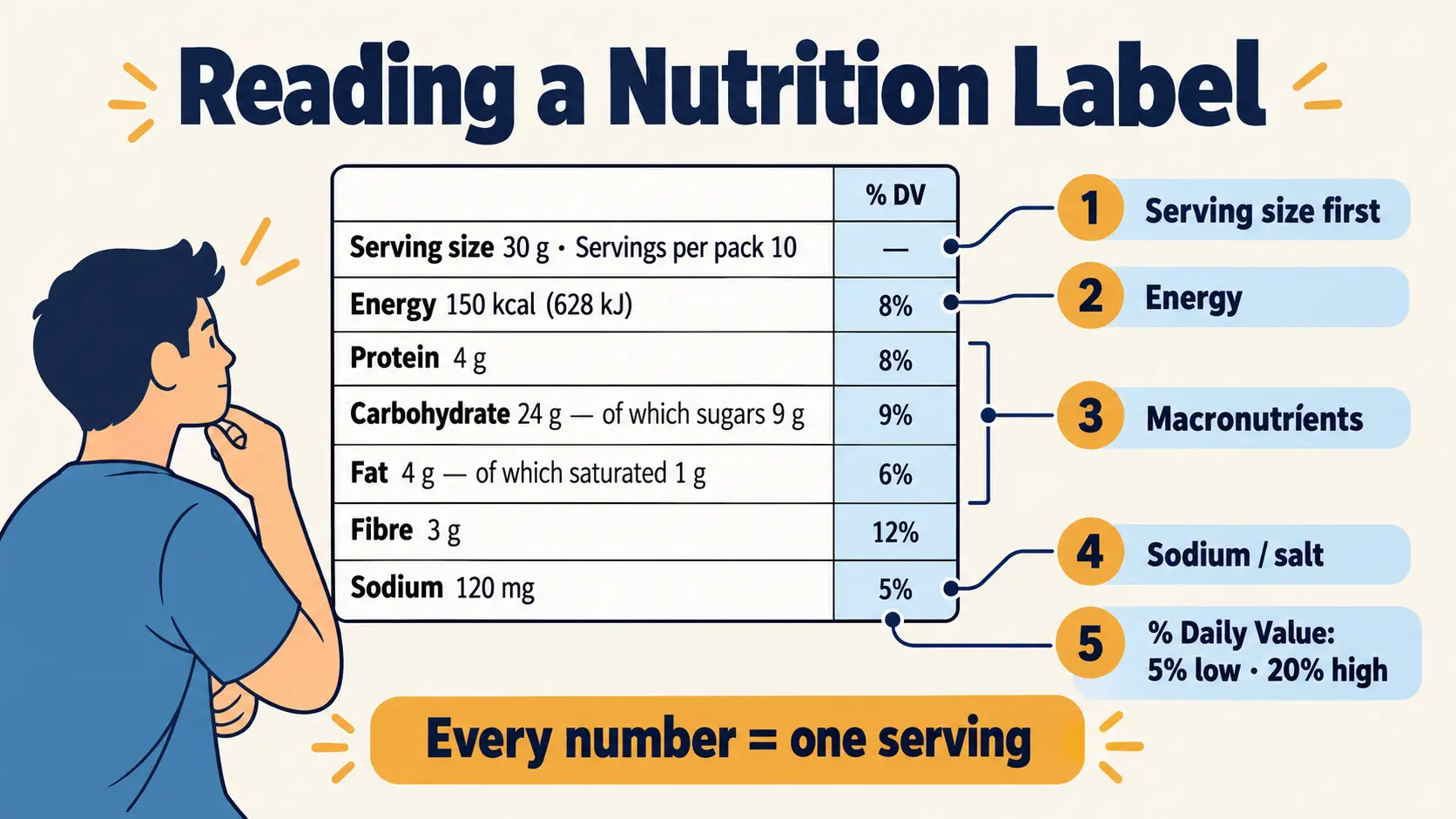
Serving size comes first
Every number on the label refers to one serving. If a client eats more or less than that, every number changes in proportion:
Servings eaten = amount eaten ÷ serving size, then multiply each label number by the servings eaten.
For example, a cereal lists 150 kcal per 30 g serving. A client pours 90 g: 90 ÷ 30 = 3 servings, and 3 × 150 = 450 kcal.
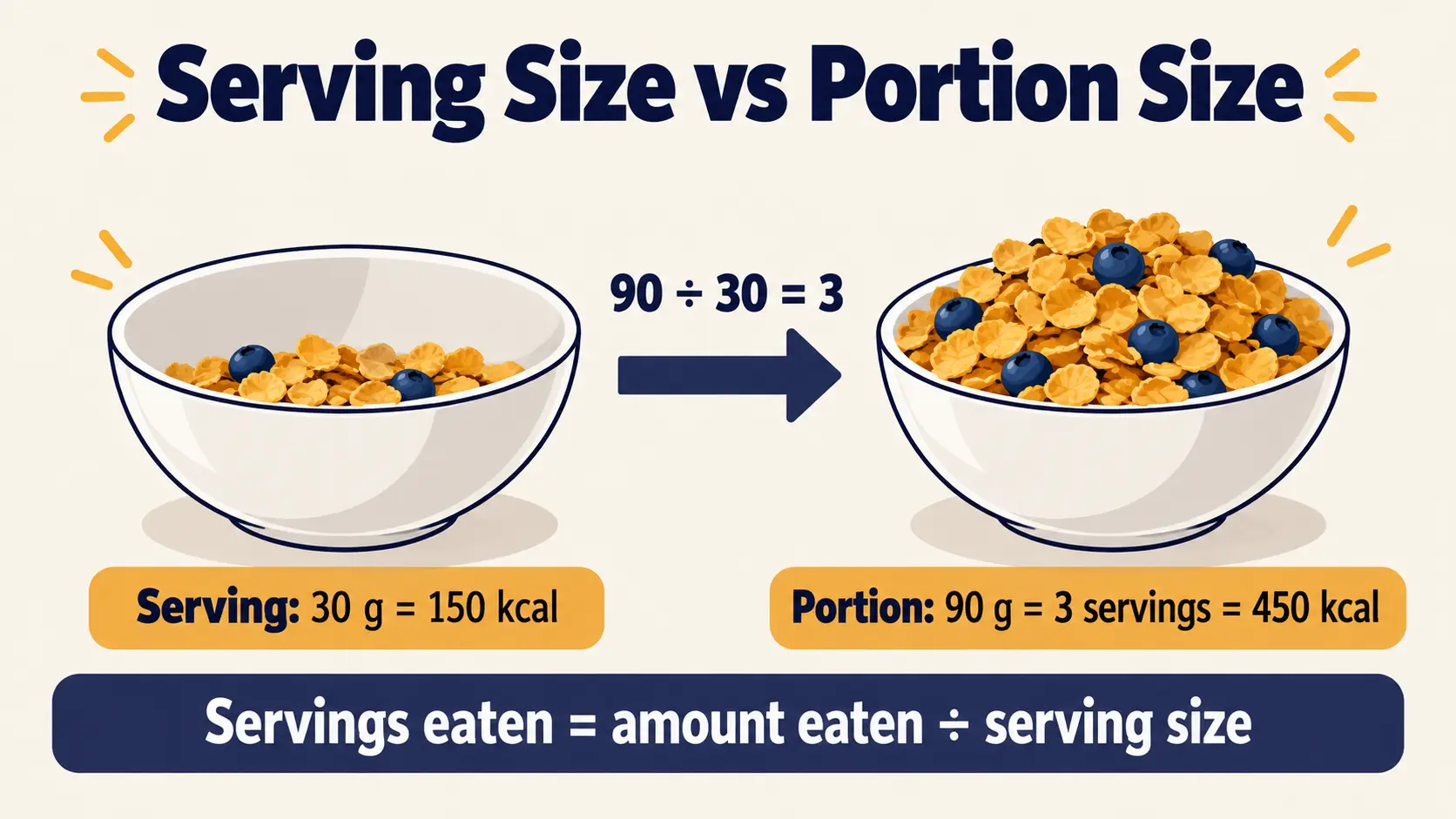
Compare products per 100 g
Serving sizes differ between brands, which makes per-serving numbers hard to compare. Many labels also show values per 100 g (or 100 ml), which puts every product on the same scale.
Checking energy from macronutrients
Energy can be estimated from the macronutrients (Lesson 5): protein and carbohydrate provide about 4 kcal per gram, fat about 9 kcal per gram, and alcohol about 7 kcal per gram. A serving with 10 g protein, 20 g carbohydrate and 5 g fat provides about (10 × 4) + (20 × 4) + (5 × 9) = 165 kcal. Label figures are rounded and allowed some tolerance, so small differences are normal.
Ingredient Lists and Label Claims
In most countries, ingredients are listed in descending order by weight — the first ingredient is present in the largest amount. This makes the ingredient list a quick reality check on the front of the pack.
- The first few ingredientsThese make up most of the product. A "wholegrain" cracker whose first ingredient is refined flour is mostly refined flour.
- Sugars under other namesSucrose, glucose, fructose, dextrose, maltose, corn syrup, honey, malt extract, fruit juice concentrate, jaggery, agave. Several different sugars can each sit lower on the list, even when the total is high.
- AllergensMany countries require common allergens (such as milk, egg, peanuts, tree nuts, soy, wheat, fish, shellfish and sesame) to be declared or highlighted. "May contain" statements warn about possible cross-contact.
- Length isn't everythingA long list isn't automatically bad, and a short one isn't automatically healthy — spices, vitamins and familiar foods all add to the list.
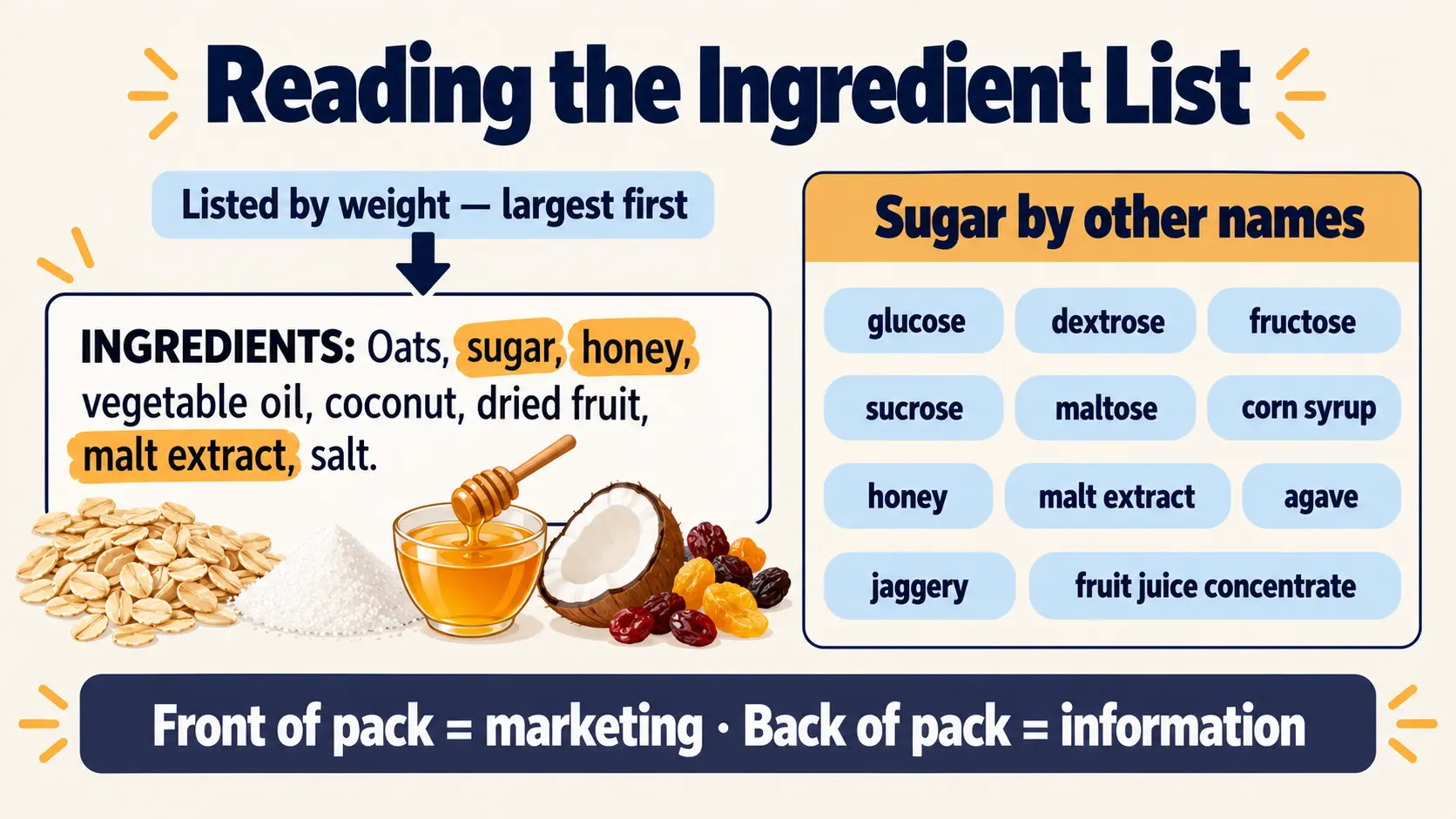
Claims on the front of the pack
| Type of claim | Examples | What to know |
|---|---|---|
| Nutrient content claims | "Low fat", "high fibre", "reduced sugar", "source of protein" | Usually defined by law, but "low fat" can still be high in sugar or energy — check the panel |
| Health claims | Linking a food or nutrient to a health benefit | Usually regulated and must be approved; wording is often cautious ("may help") |
| Marketing terms | "Natural", "wholesome", "multigrain", "made with real fruit", "clean" | Often loosely defined or not defined at all — read the ingredients |
| Front-of-pack schemes | Traffic-light colours, star ratings, letter grades, warning symbols | Vary by country; helpful for quick comparisons within a food category |
The key habit to teach clients: the front of the pack is marketing; the back is information.
Supplement Labels
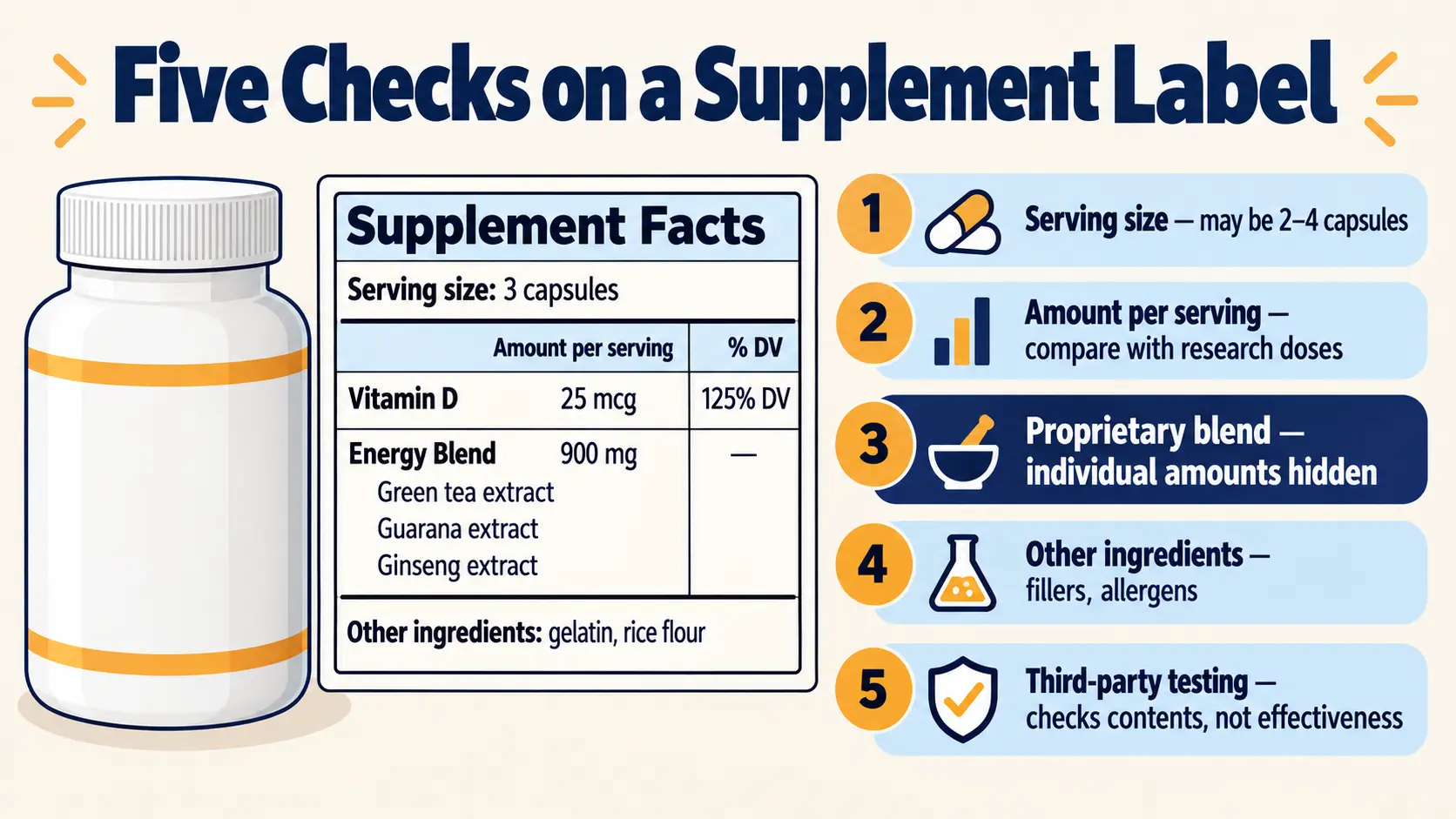
Supplements (Lesson 13) carry their own panel — often called a supplement facts panel. It lists the serving size (for example, 2 capsules or 1 scoop), the amount of each active ingredient per serving, and often a % Daily Value.
- 1. Serving sizeThe dose shown may need 2–4 capsules, not one — which changes both the dose and the real cost per serving.
- 2. Amount per servingCompare it with the dose used in research. Very high %DV values (for example, several thousand percent) are a reason to check upper limits (Lesson 10).
- 3. Proprietary blendsA blend lists only the total weight of a mix, not how much of each ingredient it contains — so you can't tell whether any ingredient is at an effective dose.
- 4. Other ingredientsFillers, sweeteners, colours and allergens.
- 5. Third-party testingIndependent certification checks that the product contains what the label says and is screened for certain contaminants or banned substances. It does not prove the supplement works.
In many countries, supplements don't need approval for safety or effectiveness before they're sold, and claims such as "supports immunity" (structure/function claims) are not the same as proven health benefits. Supplements must not claim to treat, cure or prevent disease.
Serving Size vs Portion Size
| Serving size | Portion size | |
|---|---|---|
| What it is | A standard amount set by the label or a food guide | The amount a person actually serves and eats |
| Who decides | The manufacturer or guideline, within the rules | The eater — influenced by hunger, habit, plate size and packaging |
| Example | 30 g of cereal | The 90 g bowl a client actually pours |
Portion distortion describes how typical portions — in restaurants, packaged snacks and even home crockery — have grown over the decades, shifting what feels "normal". Larger plates, bowls and packages tend to lead people to eat more without noticing.
The hand portion method
Hands are always available, and they roughly scale with body size — so they make a practical portion guide.
| Hand guide | Food group | Examples |
|---|---|---|
| Palm (thickness and size) | Protein | Chicken, fish, tofu, paneer, eggs, lentils as a main |
| Fist | Vegetables | Salad, cooked vegetables |
| Cupped hand | Carbohydrate-rich foods | Rice, pasta, potatoes, fruit, oats |
| Thumb | Fats | Oils, butter, nut butter, nuts, seeds, cheese |
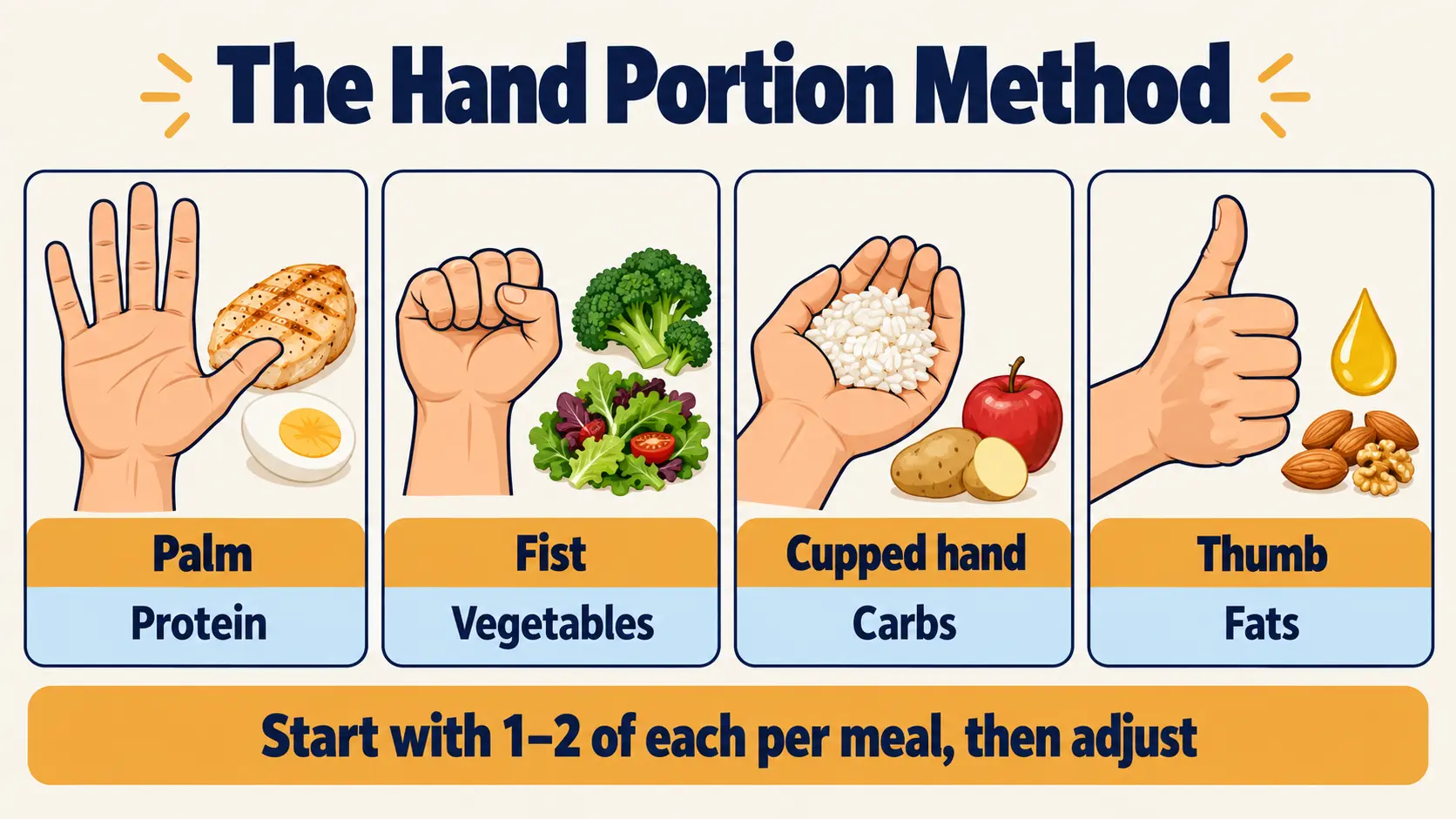
A common starting point is about 1–2 of each per meal, then adjusting based on hunger, goals and progress. Hand portions are estimates — not precise measures — but they're usually accurate enough for coaching and far easier to stick with.
Other ways to estimate portions
- Plate methodHalf the plate vegetables, a quarter protein, a quarter carbohydrate-rich food, plus a little fat.
- Visual comparisonsAbout 85–100 g of cooked meat ≈ a deck of cards; 1 cup ≈ a tennis ball or fist; 30 g of cheese ≈ two dice.
- Measuring cups and spoonsMore consistent than eyeballing, especially for oils, cereals and rice.
- Digital food scaleMost precise. Useful for a short "calibration" period so clients learn what portions look like — not usually needed forever.
The situation: Arjun eats a "high-fibre, natural" granola each morning. The label shows 200 kcal and 8 g sugars per 45 g serving.
His portion: he weighs his usual bowl once — it's 90 g. 90 ÷ 45 = 2 servings, so 2 × 200 = 400 kcal and 2 × 8 = 16 g sugars (about 4 teaspoons).
The ingredient list: oats, sugar, honey, vegetable oil, coconut, dried fruit, malt extract — three forms of sugar in the first seven ingredients.
Comparing per 100 g: his granola has about 18 g sugars per 100 g; a plain muesli on the same shelf has about 6 g.
Coaching use: no food is banned. Arjun chooses to try half granola, half plain oats, topped with fruit — and uses a cupped hand as his guide for the cereal.
For a quick everyday version, see How to Read a Nutrition Label in Under 30 Seconds.
12 questions in the style of the CNC exam. Score 70%+ to mark this lesson complete.
- Start with the serving size — every label number depends on it; multiply by the servings actually eaten.
- Compare products per 100 g; check energy with 4-4-9-7 kcal per gram.
- Ingredients are listed by weight, largest first; watch for sugars under other names.
- The front of the pack is marketing; the back is information.
- On supplements, check the dose per serving, avoid hidden proprietary blends, and look for third-party testing.
- Servings aren't portions; the hand method (palm, fist, cupped hand, thumb) makes portions easy to estimate.
Before moving to Lesson 20:
- Pick one packaged food at home, weigh your usual portion, and work out how many servings it really is.
- Compare two similar products using the per 100 g column.
- Find every form of sugar in one ingredient list.
- Complete the knowledge check above and review any question you missed.