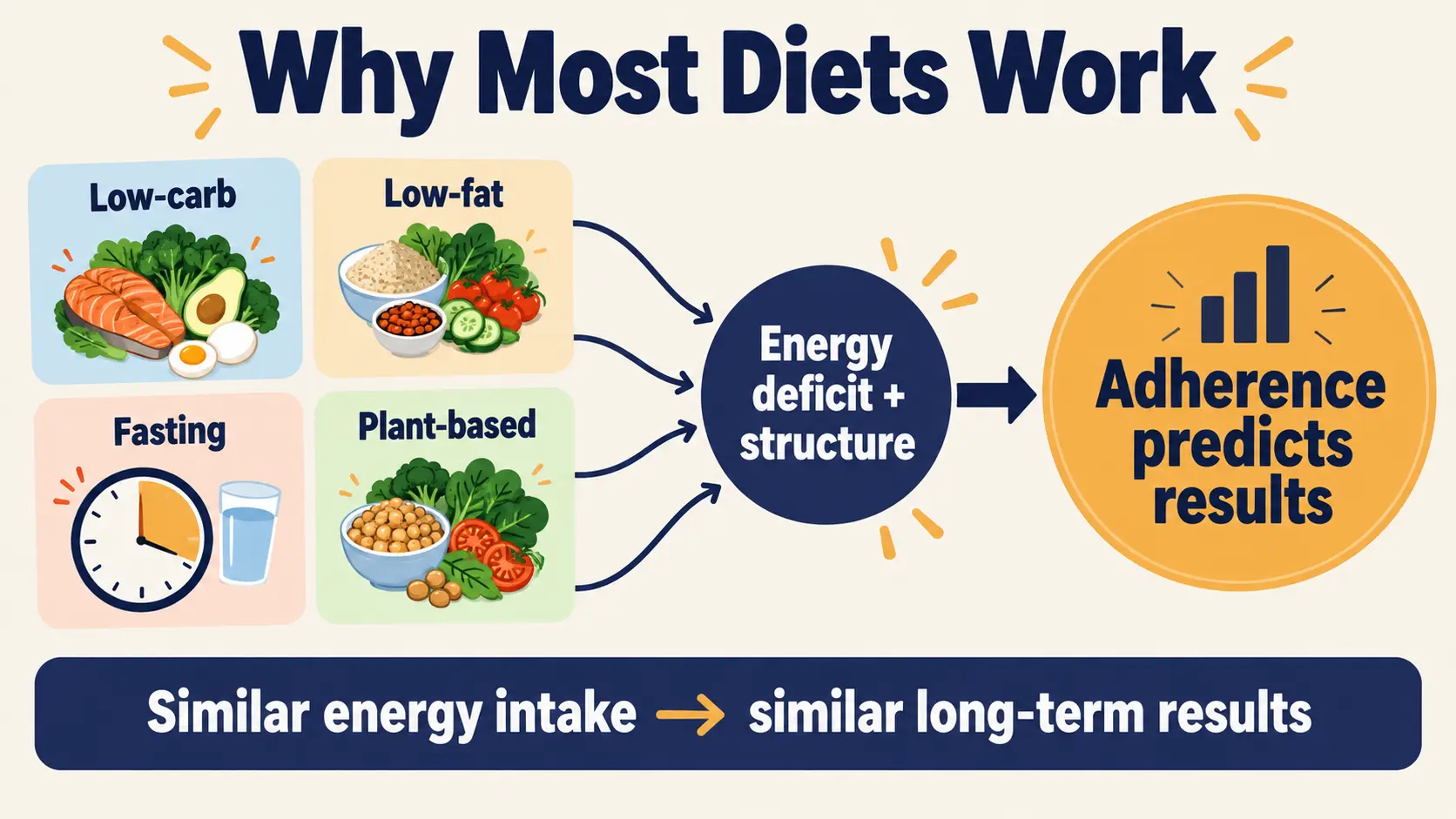
There is no single best diet. Most popular diets cause weight loss for the same underlying reason — they create an energy deficit and give people structure — and when energy intake is similar, long-term results tend to be similar too. What matters most is adherence: a nutritionally adequate approach the client enjoys, can afford and can keep up. A coach's job is to help clients evaluate diets honestly, spot fad-diet red flags, and choose — or build — an approach that fits their life, culture and health.
Clients arrive with questions about keto, fasting, veganism and whatever diet is trending this year. This lesson gives you a calm, evidence-based way to talk about them — without dismissing what interests the client, and without endorsing claims that don't hold up.
Free on YouTube Subscribe to get every lesson video in this course SubscribeWhy Diets Work — and Why They Stop Working
Different diets use very different rules, but most produce weight loss through the same mechanisms:
- An energy deficitRemoving foods, food groups or eating times usually means eating less energy overall (Lesson 5).
- Structure and fewer decisionsClear rules reduce choices and make planning easier.
- More attentionFollowing any plan makes people more aware of what they eat.
- Often more protein, fibre and whole foodsMany diets cut ultra-processed foods, which helps with fullness.
Studies comparing popular diets head-to-head — for example, low-carbohydrate versus low-fat — generally find similar long-term weight loss when energy intake is similar. The biggest predictor of results is adherence: how well someone can stick with the approach over months and years. Diets often "stop working" not because of biology alone, but because strict rules become hard to follow, leading to weight regain and repeated cycles of dieting (weight cycling).
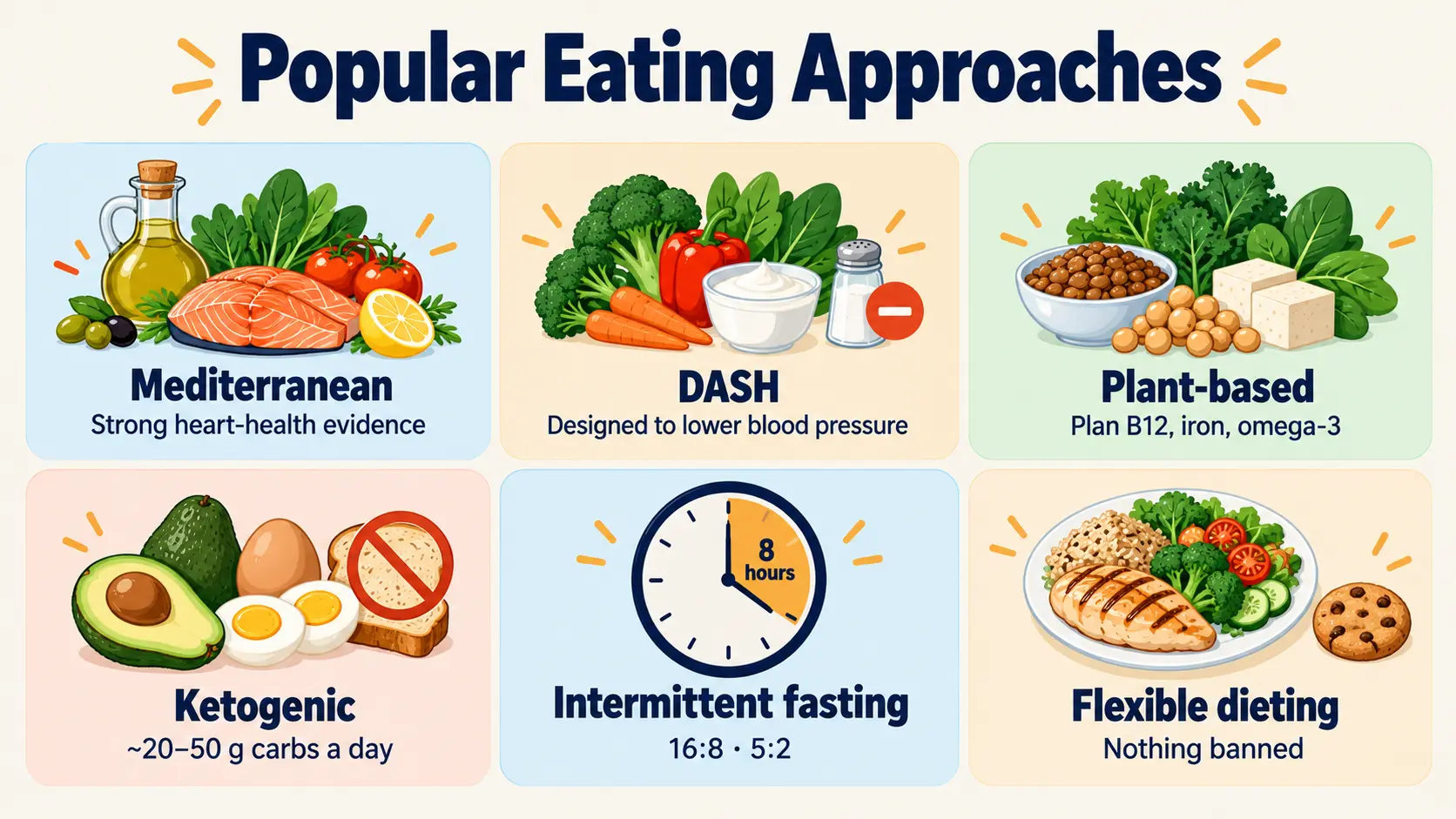
Popular Eating Approaches
| Approach | What it is | Potential benefits | Watch-outs |
|---|---|---|---|
| Mediterranean | Vegetables, fruit, legumes, whole grains, nuts, olive oil and fish; moderate dairy; little red and processed meat | Strong evidence for heart health; flexible and enjoyable | Energy-dense foods like oil and nuts still count toward intake |
| DASH (Dietary Approaches to Stop Hypertension) | Rich in vegetables, fruit, low-fat dairy, whole grains and legumes; lower in sodium, saturated fat and added sugar | Designed to lower blood pressure; well researched | Takes planning; needs attention to sodium in packaged foods |
| Plant-based / vegetarian / vegan | Mostly or entirely plant foods; vegetarians usually include dairy and/or eggs, vegans exclude all animal products | High in fibre; linked with lower risk of heart disease; environmental benefits | Needs planning for B12, iron, zinc, calcium, iodine, vitamin D, omega-3 and protein |
| Low-carbohydrate | Reduces carbohydrate, often to under about 130 g a day, with more protein and fat | Can reduce appetite; may help blood sugar management | Can be low in fibre; adherence may fade |
| Ketogenic | Very low carbohydrate (often 20–50 g a day, about 5–10% of energy) and high fat, so the body produces ketones | Used medically for some forms of epilepsy; may reduce appetite | Hard to sustain; "keto flu"; low fibre; may raise LDL cholesterol in some people |
| Low-fat | Limits fat, often to about 20–30% of energy | Fat is energy-dense, so cutting it can reduce intake | Low-fat processed foods can be high in sugar |
| Intermittent fasting | Time-restricted eating (such as 16:8), 5:2, or alternate-day fasting (Lesson 12) | Simple structure; similar results to daily energy restriction | Hunger, overeating in the eating window; not suitable for everyone |
| Paleo | Based on foods presumed available to early humans; excludes grains, legumes, dairy and processed foods | Emphasises whole foods, protein and vegetables | Excludes nutritious food groups; historical claims are debated |
| Flexible dieting (e.g., "if it fits your macros") | Meets energy and macronutrient targets with any foods | No foods banned; teaches portions and labels | Can ignore food quality and micronutrients if not guided |
Very-low-calorie diets (often about 800 kcal a day or less, sometimes using meal replacements) can produce rapid weight loss but should be used only with medical supervision.
A closer look: low-carb, keto and the "quick start"
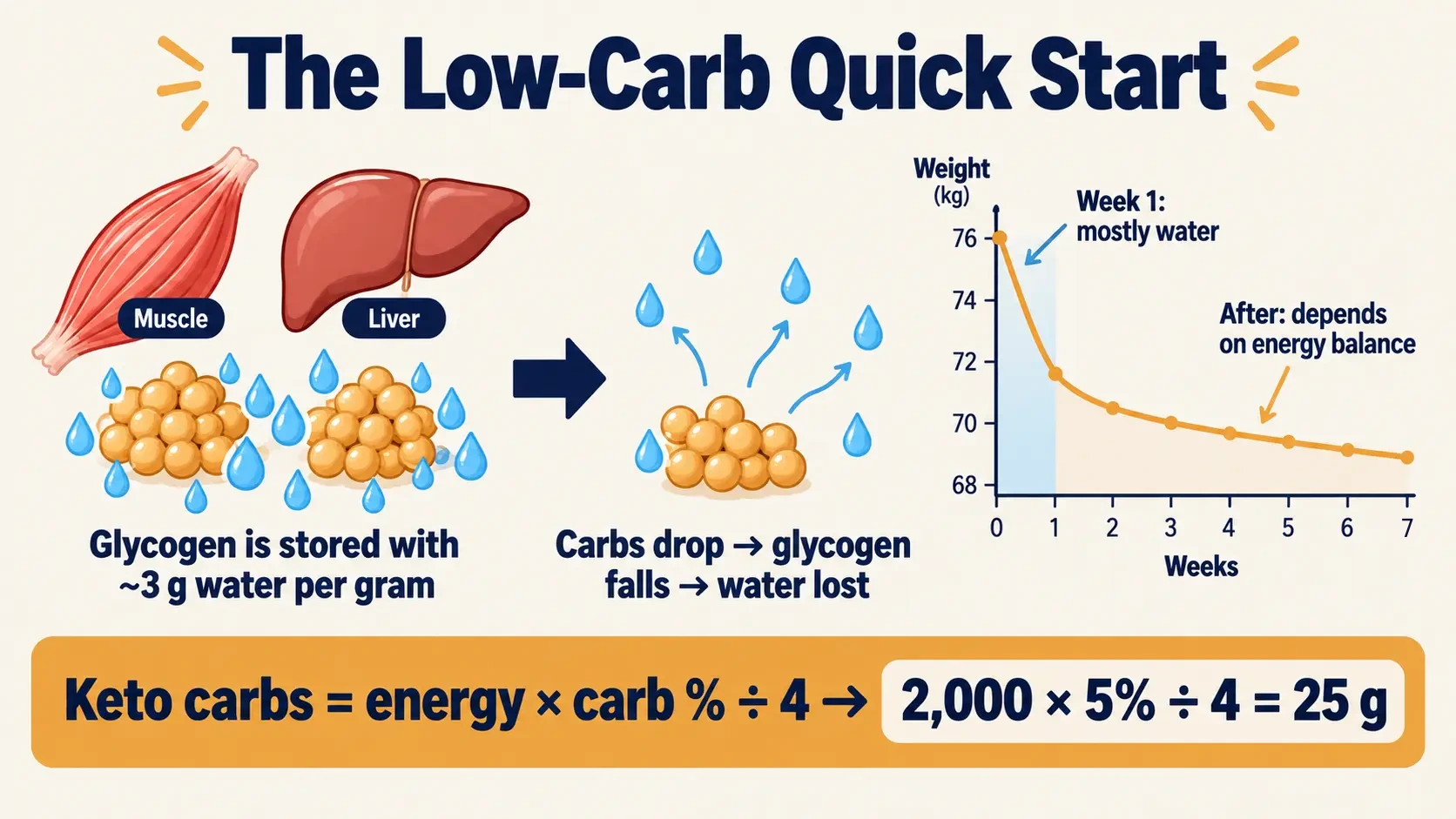
People often lose weight quickly in the first week of a low-carbohydrate diet. Much of this is water: the body stores glycogen with water (roughly 3 g of water per gram of glycogen), so as glycogen stores fall, water is lost too. After that, fat loss depends on energy balance, just as with any other diet.
To estimate a ketogenic carbohydrate target: energy × carb % ÷ 4 kcal per gram. For example, 2,000 kcal × 5% = 100 kcal from carbohydrate; 100 ÷ 4 = 25 g of carbohydrate a day.
A closer look: plant-based diets
- Vitamin B12Not reliably found in plant foods — a supplement or fortified foods are needed (Lesson 10).
- Iron and zincPresent in legumes, whole grains and seeds but less well absorbed; pairing iron-rich foods with vitamin C helps.
- Calcium, vitamin D and iodineFortified plant milks, tofu set with calcium, iodised salt, and sunlight or supplements as needed.
- Omega-3 fatsALA from flax, chia and walnuts; algae-based supplements provide EPA and DHA.
- ProteinLegumes, tofu, tempeh, seitan and soy milk; a variety across the day covers the essential amino acids (Lesson 6).
Evaluating a Diet: Fad Diet Red Flags
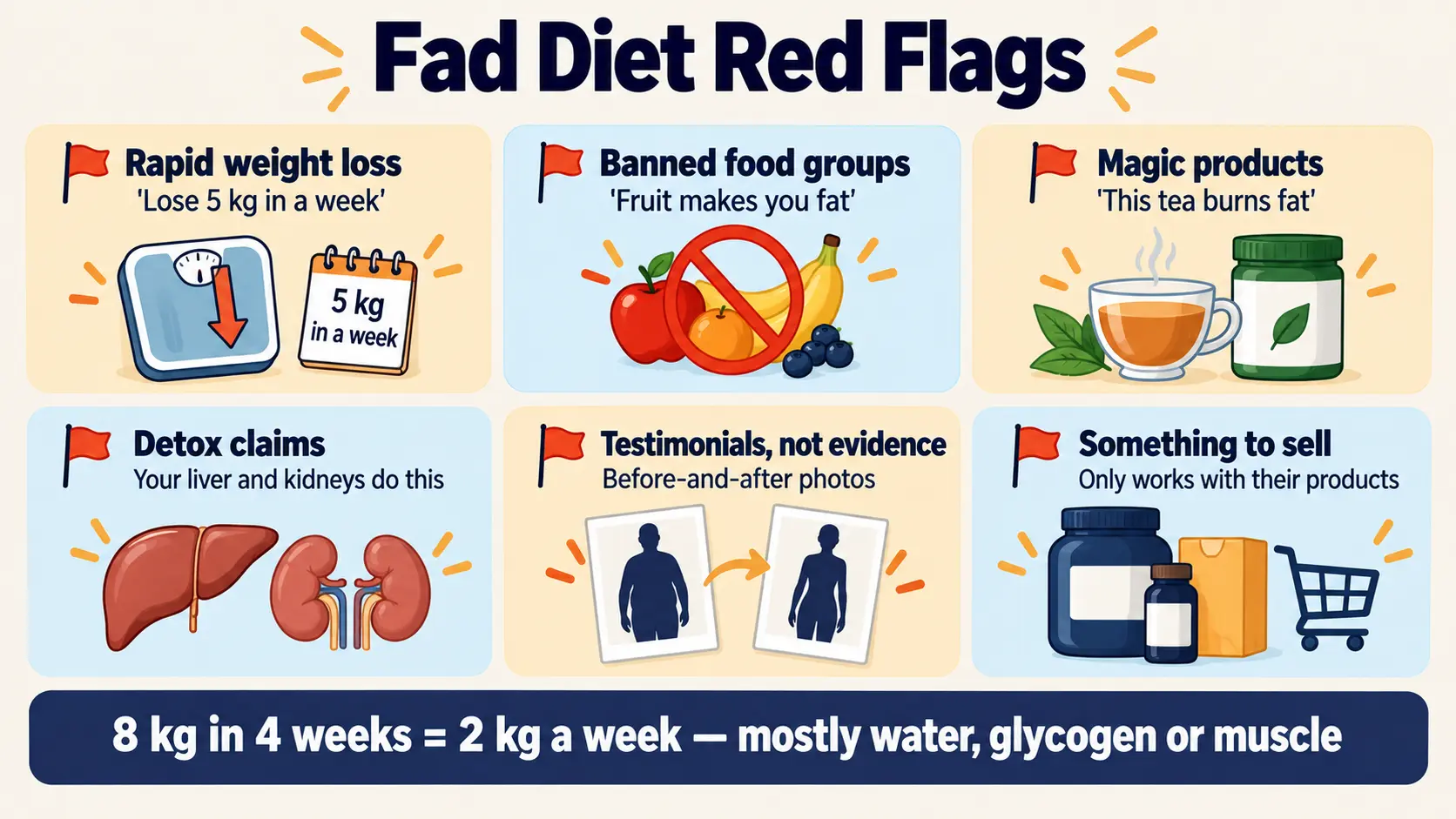
A fad diet promises fast, dramatic results with little effort — and usually can't deliver them long-term. Teach clients to look for these warning signs:
| Red flag | Example |
|---|---|
| Promises rapid weight loss | "Lose 5 kg in a week." Sustained loss of more than about 0.5–1% of body weight a week is unusual and largely water or muscle |
| Cuts out whole food groups without a medical reason | "Fruit makes you fat"; "all grains are toxic" |
| Magic foods or supplements | "This tea burns belly fat" |
| "Detox" or "cleanse" claims | The liver and kidneys already remove waste products |
| Testimonials instead of evidence | Before-and-after photos, celebrity endorsements |
| Rigid rules and fear-based language | "Never eat after 6 pm"; "toxic" foods |
| Something to sell | The plan only works with the brand's products |
For example, a plan promising 8 kg in 4 weeks implies 8 ÷ 4 = 2 kg a week — well above what most people can lose as fat, so much of that loss would be water, glycogen or muscle.
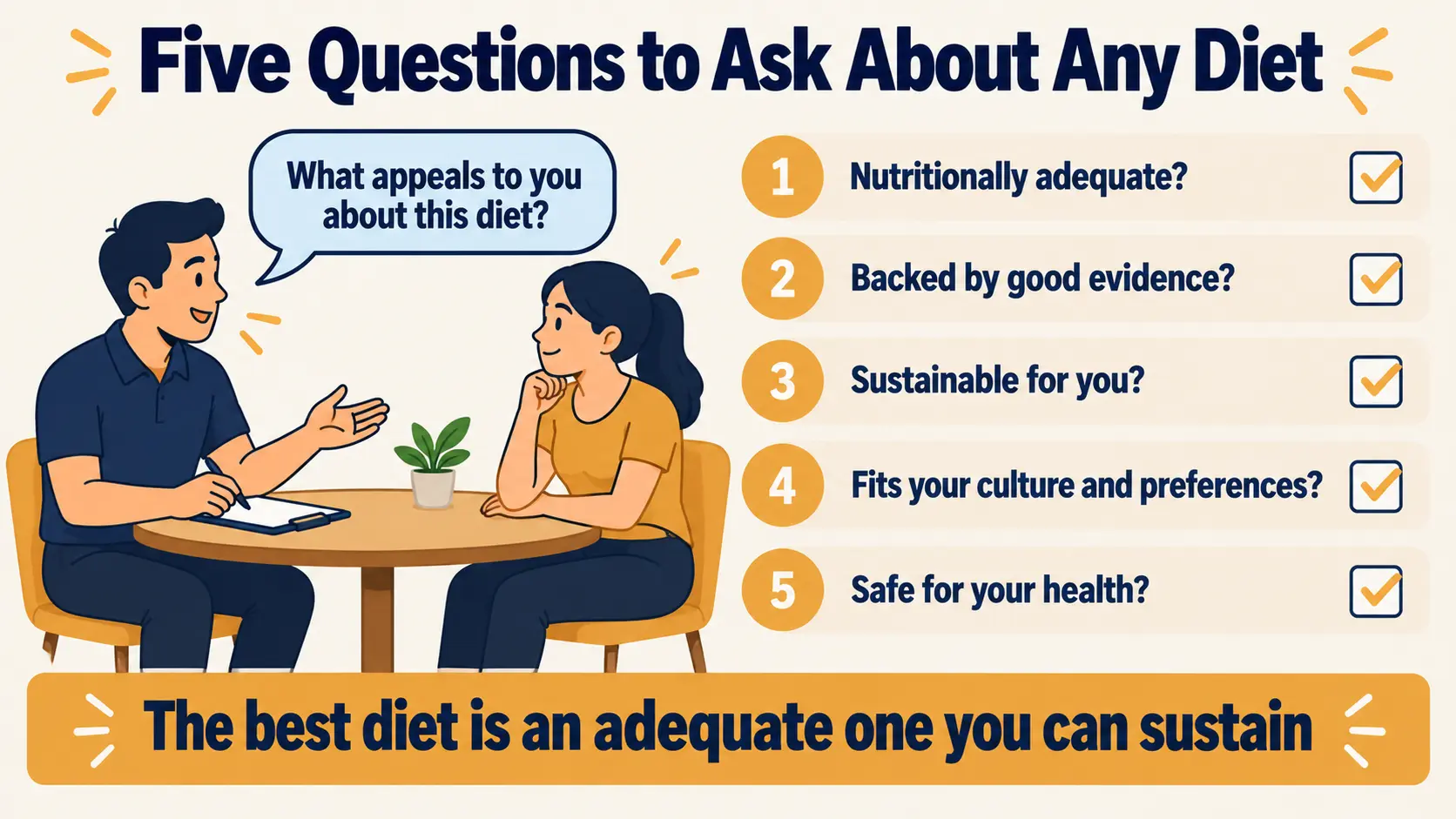
Five questions to ask about any diet
- 1. Is it nutritionally adequate?Does it include enough protein, fibre, vitamins and minerals — or exclude foods without a plan to replace them?
- 2. Is it backed by good evidence?Controlled studies in people, not just testimonials, animal studies or theory (Lesson 2).
- 3. Is it sustainable for this client?Could they imagine eating this way in a year? Does it fit their schedule, budget and cooking skills?
- 4. Does it fit their culture and preferences?Food traditions, religion, family meals and enjoyment all matter.
- 5. Is it safe for their health?Medical conditions, medications, pregnancy and any history of disordered eating.
Helping Clients Choose
When a client asks about a diet, a client-centred conversation (Lessons 15–16) works better than a verdict:
| Step | What the coach does |
|---|---|
| 1. Explore | "What appeals to you about this diet?" — interest often points to a real need, such as simplicity or appetite control |
| 2. Share balanced information | With permission, give the likely benefits and the watch-outs (elicit–provide–elicit) |
| 3. Check safety | Ask about medical conditions and medications; refer when needed |
| 4. Make it adequate | If the client chooses it, plan around the gaps — fibre on keto, B12 on vegan |
| 5. Test and review | Treat it as an experiment: try it for a few weeks, then review results, energy and enjoyment |
Often, the best "diet" isn't a named diet at all — it's the client's usual way of eating with a few well-chosen changes (Lesson 17).
The situation: Daniel wants to try a ketogenic diet after a friend lost 6 kg in the first two weeks.
Explore: he likes the idea of clear rules and fewer cravings in the afternoon.
Balanced information: the coach explains that much of the early loss is water from glycogen, and that keto works mainly through an energy deficit — with fibre and long-term adherence as the main challenges.
Safety check: Daniel takes no medication and has no medical conditions.
The plan: he chooses a moderate low-carb approach instead — protein at every meal, plenty of non-starchy vegetables, and carbohydrate mainly around his workouts — as a 4-week experiment, reviewed on energy, cravings and enjoyment.
For more on fasting, see What Intermittent Fasting Actually Does to Your Body — No Hype, No Religion.
12 questions in the style of the CNC exam. Score 70%+ to mark this lesson complete.
- Most diets work through an energy deficit and structure; long-term results are similar when energy intake is similar.
- Adherence is the biggest predictor of success — the best diet is an adequate one the client can sustain.
- Mediterranean and DASH have strong health evidence; DASH targets blood pressure.
- Keto is very low carb (≈20–50 g/day); early low-carb loss is mostly water. Vegan diets need B12 and careful planning.
- Spot fad-diet red flags: rapid loss, banned food groups, magic products, detox claims, testimonials.
- Explore, inform, check safety, fill gaps and test — and refer clients on relevant medication first.
Before moving to Lesson 22:
- Pick a trending diet and run it through the five evaluation questions.
- List three fad-diet red flags you've seen in adverts or social media.
- Calculate a 5% carbohydrate target for 1,800 kcal.
- Complete the knowledge check above and review any question you missed.