
"Muscle confusion" is one of the most durable pieces of fitness marketing ever produced. The pitch: your muscles get used to the same exercises, they "adapt" in a way that stalls progress, so you need to constantly switch movements to keep them "guessing" and growing. It sold a lot of DVD workout programmes in the 2000s, and it still shows up today in gym-floor advice and programme descriptions promising a "new workout every single day."
It's also not how muscle physiology works. Muscle tissue can't be surprised, bored, or confused — those are properties of a mind, not a muscle fibre. What muscle responds to is mechanical tension and demand relative to what it has already adapted to, a completely different mechanism than "novelty." This is a straightforward myth-check: what the claim gets wrong, what the research on exercise variation actually shows, and what genuinely drives progress instead — plus where planned variety still earns a real place in a smart programme.
What "Muscle Confusion" Actually Claims
The theory, in its most common form, argues that muscles adapt to a specific exercise over repeated exposure, and once adapted, that exercise stops producing further results — supposedly because the muscle has "figured out" the movement. The proposed fix: prevent that adaptation from settling in, by frequently and sometimes randomly changing exercises, rep ranges, or entire workout structures, often session to session.
It's worth separating two claims often bundled under this label. "Training variety has zero benefit" is false, and this article isn't arguing that. The stronger claim — "constant, unplanned switching produces superior strength and growth compared to a stable, progressively loaded programme" — is the actual muscle confusion pitch, and it's the one that doesn't hold up.
Why the Theory Doesn't Hold Up
The core physiological problem with muscle confusion is that it misapplies a real concept — adaptation — to a mechanism that isn't real. Muscle tissue adapts to a training stimulus over time, but that adaptation isn't a kind of "immunity" switching exercises prevents; it's a beneficial, necessary response — more capable fibres, better neural recruitment, greater force output. Constantly changing the stimulus doesn't out-trick the muscle. It just prevents you from ever applying enough consistent, increasing demand to any single movement to get meaningfully stronger at it.
This connects directly to what actually determines whether a training programme keeps producing results — progressive overload, the gradual, deliberate increase in demand placed on a muscle over time. Overload requires a stable enough exercise selection to track and increase against. Randomly swapping exercises every session removes the one lever that reliably drives adaptation, and replaces it with novelty, which research doesn't support as a substitute.
The Myth-Check: Common Claims About Muscle Confusion, Tested
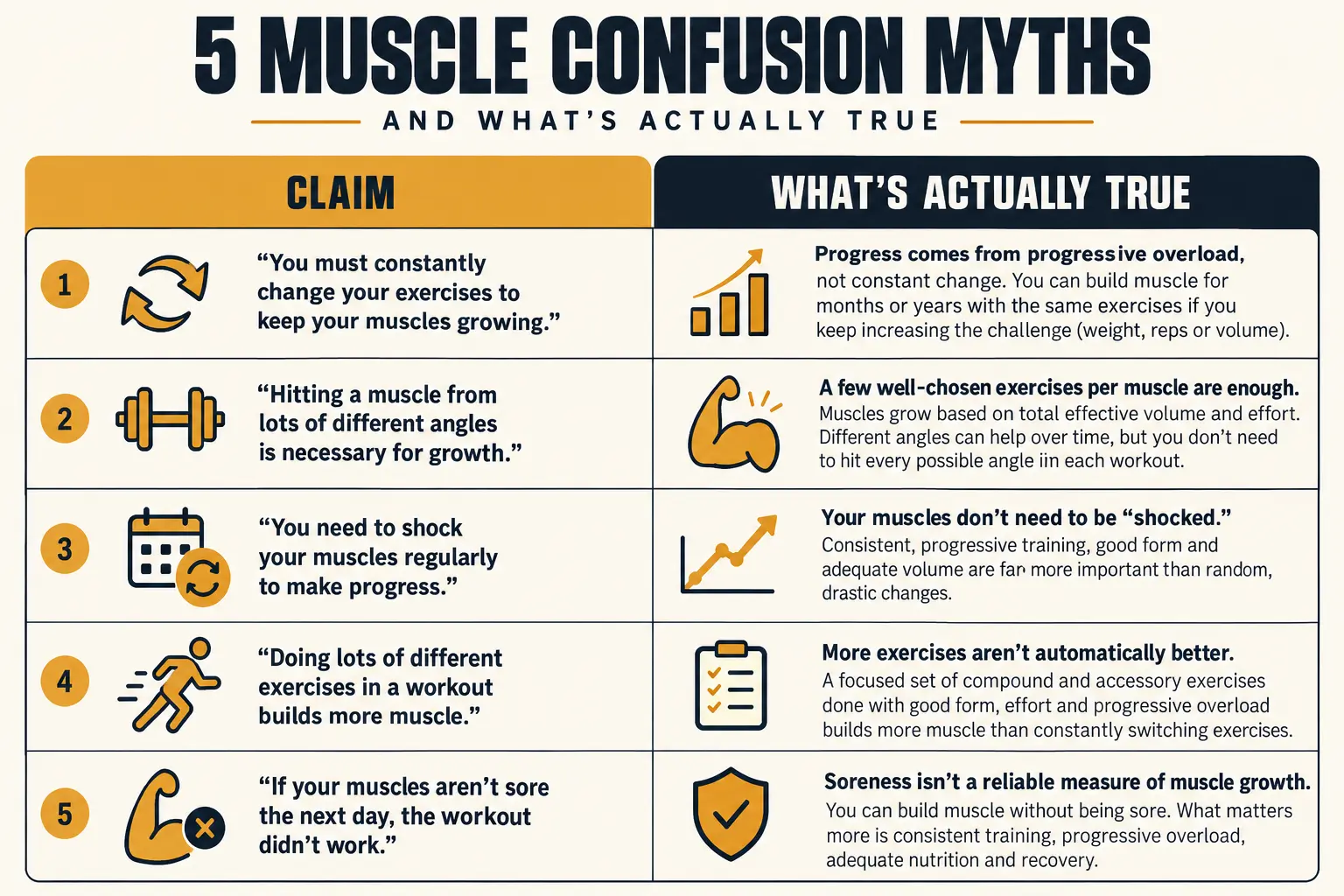
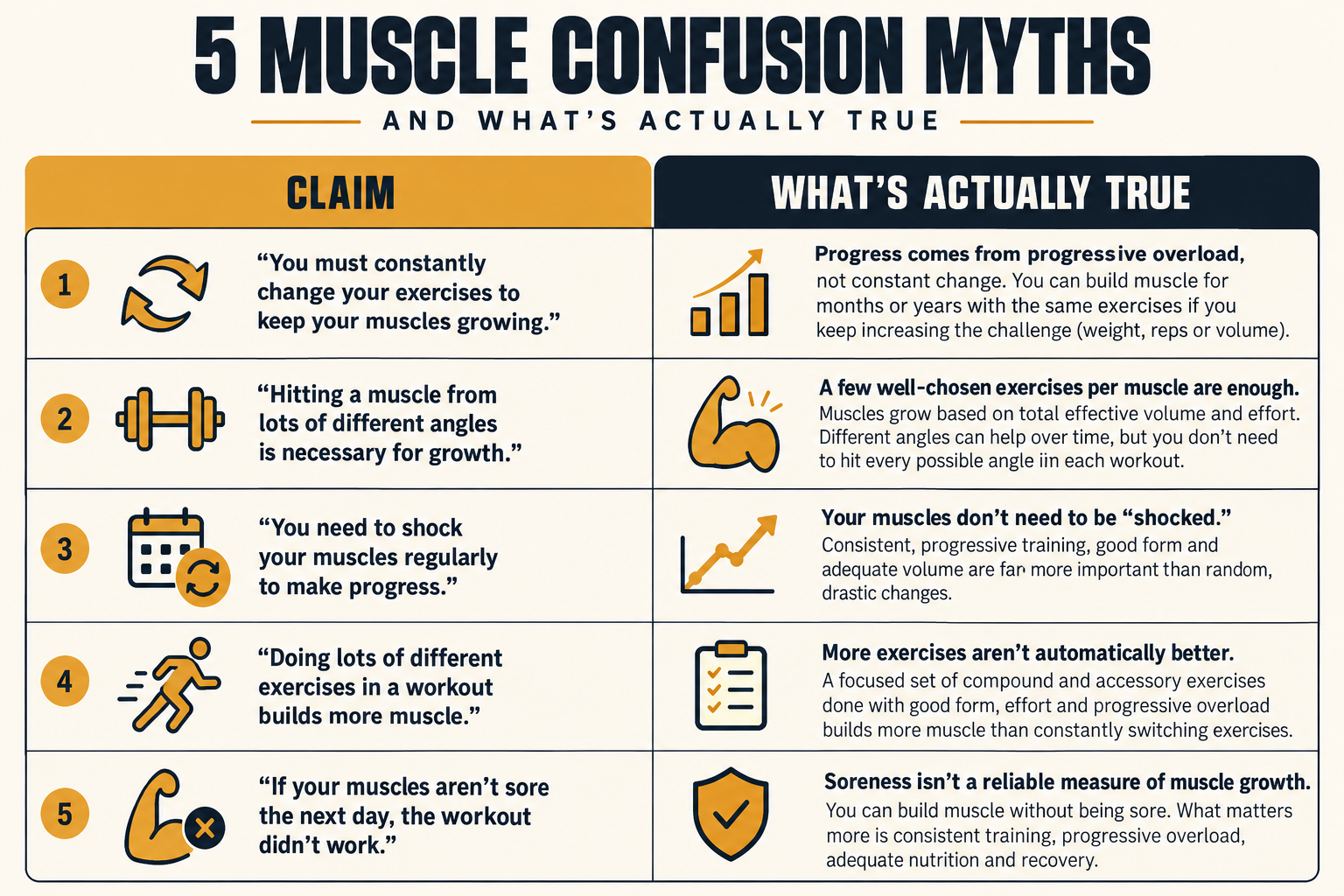
| Claim | What's actually true |
|---|---|
| "Your muscles get used to an exercise and stop responding" | What actually stalls progress is demand staying flat (same weight, same reps, same sets), not the exercise itself becoming ineffective. |
| "Switching exercises every session builds more muscle than sticking with a programme" | Studies comparing constant against randomly varied exercise selection repeatedly find similar strength and hypertrophy outcomes — no clear advantage for constant switching. |
| "A harder, more unfamiliar exercise is automatically more effective" | Unfamiliar exercises feel harder and produce more soreness mainly because the movement pattern isn't practiced yet — a novelty effect, not proof of superior stimulus. |
| "Plateaus happen because your body needs a new routine" | Most genuine plateaus trace back to stalled progressive overload, inadequate recovery, or insufficient volume — not a lack of exercise variety. |
| "There's no downside to switching exercises constantly" | Constant rotation makes it hard to apply and track progressive overload on any single movement, and can slow skill acquisition on technical lifts. |
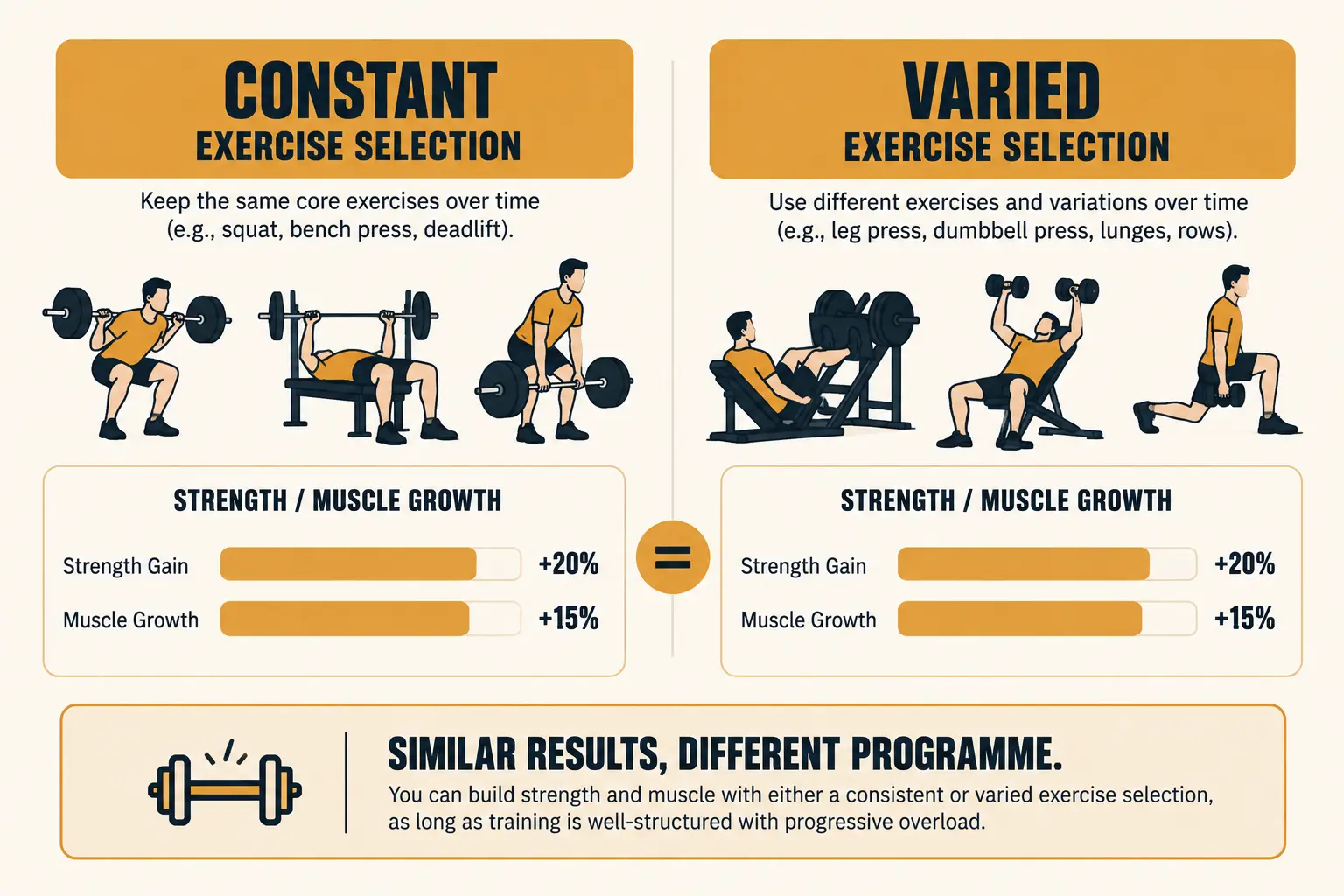
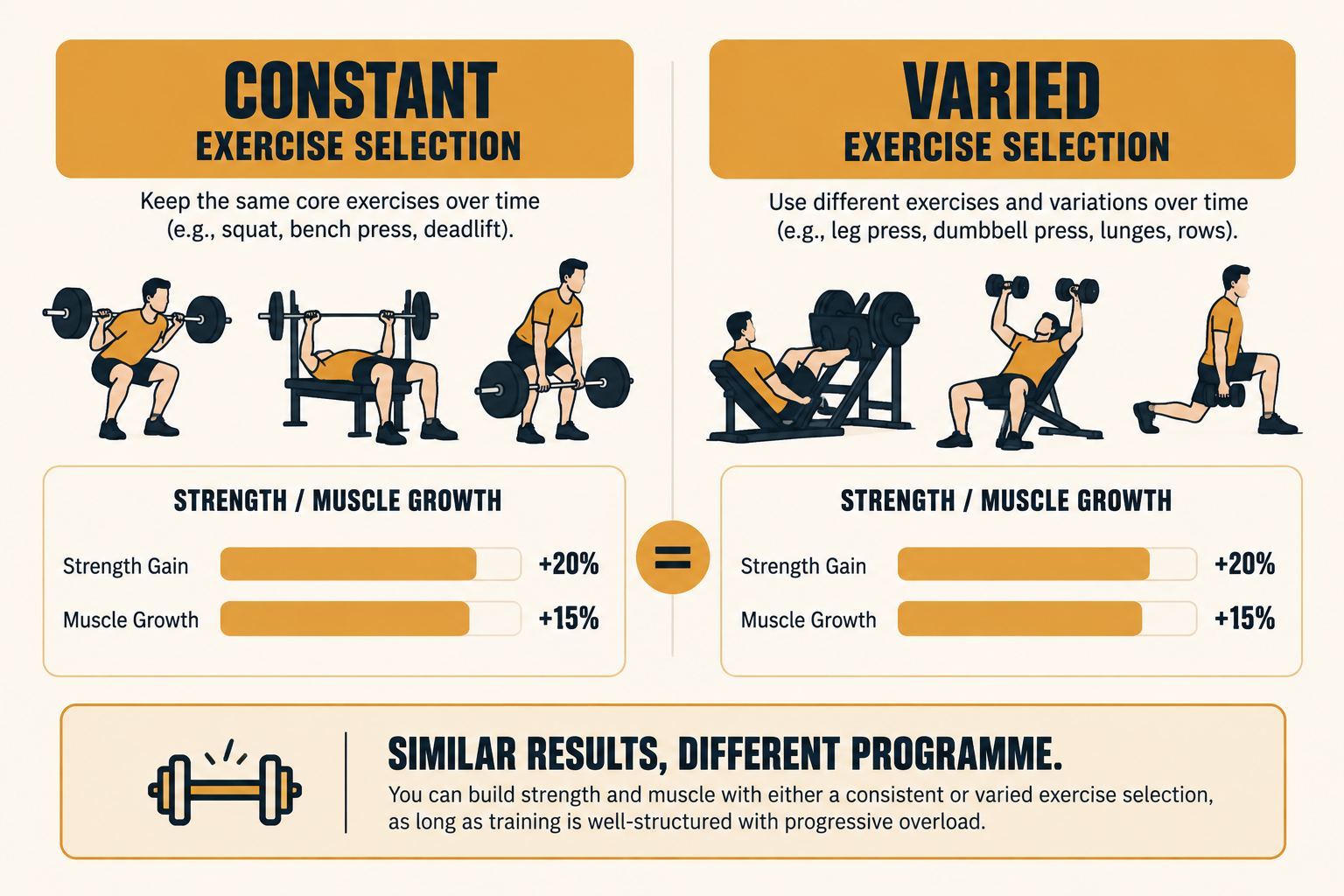
A 2024 study published in Research Quarterly for Exercise and Sport tested the core claim directly, randomising 70 untrained young women into two groups over 10 weeks of equated-volume resistance training: one group repeated the same two lower-body exercises every session, the other rotated between three different exercise pairings across the week. Muscle thickness increases and one-rep-max strength gains were statistically similar between the two groups.[1] Varying the exercises didn't produce a superior outcome — it produced a comparable one, through a very different-looking programme.
A broader systematic review and meta-analysis comparing traditional resistance training approaches against more "advanced" paradigms — including frequent exercise variation — reached a similar conclusion: added variation isn't reliably associated with greater hypertrophy once volume and progression are accounted for.[2] What a programme does with load, volume, and progression over time predicts outcomes far better than how often its exercise list changes.
What Actually Drives Progress
If not variety, then what? Research on resistance training adaptation points to a short list of variables that actually matter, with progressive overload at the top. Reps and sets, applied in the right ranges for your goal, are the next lever — how many reps and sets you actually need breaks down the volume research behind strength, hypertrophy, and endurance goals.
-
Progressive overload Gradually increasing demand on a muscle over time — more weight, reps, sets, or a harder variation — applied to a stable exercise selection you can actually track.
-
Sufficient training volume Enough total weekly sets per muscle group to drive adaptation — a stimulus that was enough for a beginner often stops being enough as training age increases.
-
Proximity to failure / effort Training sets hard enough — generally within a few reps of technical failure — to actually recruit the higher-threshold motor units responsible for most growth.
-
Consistency and recovery Showing up on a repeatable schedule, with enough sleep and nutrition for the body to actually adapt to the demand it's being asked to handle.
Notice that "exercise variety" doesn't appear on that list as a primary driver. It's not absent from the picture entirely — it plays a real, secondary role, covered next — but it isn't the lever that explains why one person's training produces results and another's doesn't.
Where Training Variety Does Help
None of this means a routine should stay frozen forever, or that variety has no place in smart programming. It means variety's real benefits are different from — and more modest than — what muscle confusion marketing claims. The legitimate reasons to rotate exercises:
- Joint and tendon health. The same movement pattern at the same joint angles, for years with zero variation, can concentrate repetitive strain on the same tendons. Periodically rotating accessory exercises spreads that load out.
- Addressing weak points and imbalances. Any single exercise selection trains some ranges of motion more than others. A deliberately chosen variation can round out gaps a fixed routine leaves unaddressed.
- Adherence and motivation. A routine that feels identical for years can get genuinely boring, and staying engaged matters more for real-world results than almost any programming variable. This is a psychological benefit, not a muscular one — but a real one.
- Working around constraints. Travel, a busy gym, or an injury sometimes make substitution the only practical option, and a well-chosen substitute trains the same muscle group effectively — no "confusion" required.
Notice the mechanism in every case is joint health, programme gaps, adherence, or practicality — never "keeping the muscle guessing." If you're building a home routine from scratch, the home workout routine from scratch guide covers picking a stable core before layering in accessory variation.
How Much Variety Is Actually Useful
A practical middle ground works better than either extreme — neither a frozen routine you never touch, nor a different workout every single session. A structure that tends to work well for most lifters:
| Exercise type | How stable to keep it |
|---|---|
| Core compound lifts (squat, deadlift, bench, row, overhead press) | Keep consistent for at least 6-12 weeks so progressive overload can be tracked and applied session to session. |
| Accessory and isolation exercises | Rotate more freely every 4-8 weeks — enough stability to track progress, enough change for weak points and engagement. |
| Warm-up and mobility work | Can vary session to session with little downside — not where you're applying progressive overload. |
The consistent theme, whether you're on a barbell programme or a bodyweight-only routine, is that you need to know what you did last time to deliberately do more this time. The free Habit Tracker works well for the consistency side, and the downloadable planner below separates what should stay fixed from what's free to rotate.
Common Mistakes
- Changing your main lifts every session. The single biggest reason people following "confusion" style programmes plateau despite training hard.
- Mistaking soreness for effectiveness. Extra soreness from a new exercise usually signals unpracticed movement, not superior stimulus — chasing it leads straight back to unplanned switching.
- Blaming a plateau on "needing a new routine" before checking the basics. Recovery, training volume, and whether load has actually increased recently are more likely culprits — check those first.
- Never rotating anything, ever. Years of an identical routine with zero variation can leave joints overworked and imbalances unaddressed. Planned rotation of accessory work is still worth doing.
- Treating "confusing" programmes as inherently superior. A complicated-looking programme with constantly shifting exercises isn't automatically more sophisticated.
Final Thoughts
Muscle confusion earns credit for one thing: it correctly identifies that plateaus are real and frustrating. Where it goes wrong is the proposed cause and fix — muscles don't stall because they've grown "used to" a movement in some way switching prevents. They stall because demand stopped increasing, recovery isn't keeping pace, or training volume has fallen short of what's needed to keep adapting.
Your muscles don't need to be confused to grow. They need to be asked to do a little more than they've already adapted to, consistently, over time.
That doesn't mean your routine has to stay frozen — planned variety in accessory work has a real, if modest, place. It just isn't the lever to pull first when progress stalls. For a complete, structured system built around this principle, the Move More course walks through it step by step, and the free 21-Day Movement Streak challenge is a low-pressure way to build the consistency habit this depends on.
This article is for informational purposes only and does not constitute medical or clinical advice. If you have an existing injury or health condition, consult a qualified healthcare or fitness professional before changing your training programme.
Sources
[1] Muscle Hypertrophy and Strength Adaptations to Systematically Varying Resistance Exercises. Research Quarterly for Exercise and Sport, 2024. Available at: pubmed.ncbi.nlm.nih.gov
[2] Comparison of Traditional and Advanced Resistance Training Paradigms on Muscle Hypertrophy in Trained Individuals: A Systematic Review and Meta-Analysis. Available at: ncbi.nlm.nih.gov