
Search for nutrition help and you'll meet three job titles almost immediately: dietitian, nutritionist and nutrition coach. They're often used as if they mean the same thing. They don't. The differences in training, regulation and what each one is allowed to do matter — both when you're choosing who to trust with your health, and when you're choosing which path to train for.
A quick note on where I'm coming from: I'm not a dietitian. I write The Flex Cult's nutrition coaching exam-prep courses, so I spend a lot of time on exactly where a coach's role ends and a dietitian's begins. This guide sets out that line as clearly as possible.
The Short Answer
One simple way to remember it: most dietitians could call themselves nutritionists, but not every nutritionist is a dietitian — and a nutrition coach is a different role altogether, built around behaviour change, not clinical treatment.
What Is a Dietitian?
A dietitian (often "registered dietitian", RD or RDN) applies nutrition science to people in both health and disease. They're the nutrition professionals trained to work in clinical settings — hospitals, kidney clinics, diabetes services, oncology, eating-disorder teams — and to design therapeutic diets for diagnosed conditions.
The training is long and standardised. It typically includes a university degree in dietetics, supervised clinical placements, and registration with a national body that requires ongoing professional development. In the United States, for example, candidates now need at least a master's degree, an accredited programme with at least 1,000 hours of supervised practice, and a national registration exam.[2] In the UK, "dietitian" is a legally protected title, and dietitians are the only nutrition professionals regulated by law.[1]
Best for: diagnosed medical conditions, food allergies, digestive disorders, pregnancy complications, eating disorders, and any diet that interacts with medication.
What Is a Nutritionist?
"Nutritionist" is the trickiest of the three, because the word covers a wide range of people. At one end are nutrition scientists with degrees and postgraduate experience who work in research, public health, food industry or education. At the other end, in many countries, the title isn't protected at all — anyone can use it, with or without training.
Some countries close that gap with voluntary registers. In the UK, for example, "nutritionist" isn't protected, but "Registered Nutritionist" is reserved for people on a competency-based register — usually with an accredited degree and at least three years of assessed experience. Even qualified nutritionists generally aren't trained to advise on special diets for medical conditions or to work with hospital patients without a dietitian's supervision.[1]
Best for: evidence-based general nutrition information, public-health and community nutrition, food and nutrition research — as long as you've checked the specific credential behind the title.
What Is a Nutrition Coach?
A nutrition coach works with generally healthy people on the gap between knowing what to eat and actually doing it. The focus is habits, behaviour change, accountability and practical skills — protein at each meal, a realistic meal-prep routine, eating more slowly, reading labels, consistency over perfection.
Coaches usually hold a certification rather than a degree. Two widely recognised options are Precision Nutrition Level 1 and the NASM Certified Nutrition Coach (NASM-CNC). Both teach coaching skills alongside core nutrition science, and both are explicit about scope: coaches share general, evidence-based guidance, but they don't diagnose, treat medical conditions, interpret lab results or advise on medication. When a client's needs go beyond that, the coach refers — see the scope-of-practice lesson in our NASM-CNC prep for how that line is drawn.
Best for: generally healthy adults who want help with fat loss, energy, performance or simply eating better — and who need support staying consistent more than they need a prescription.
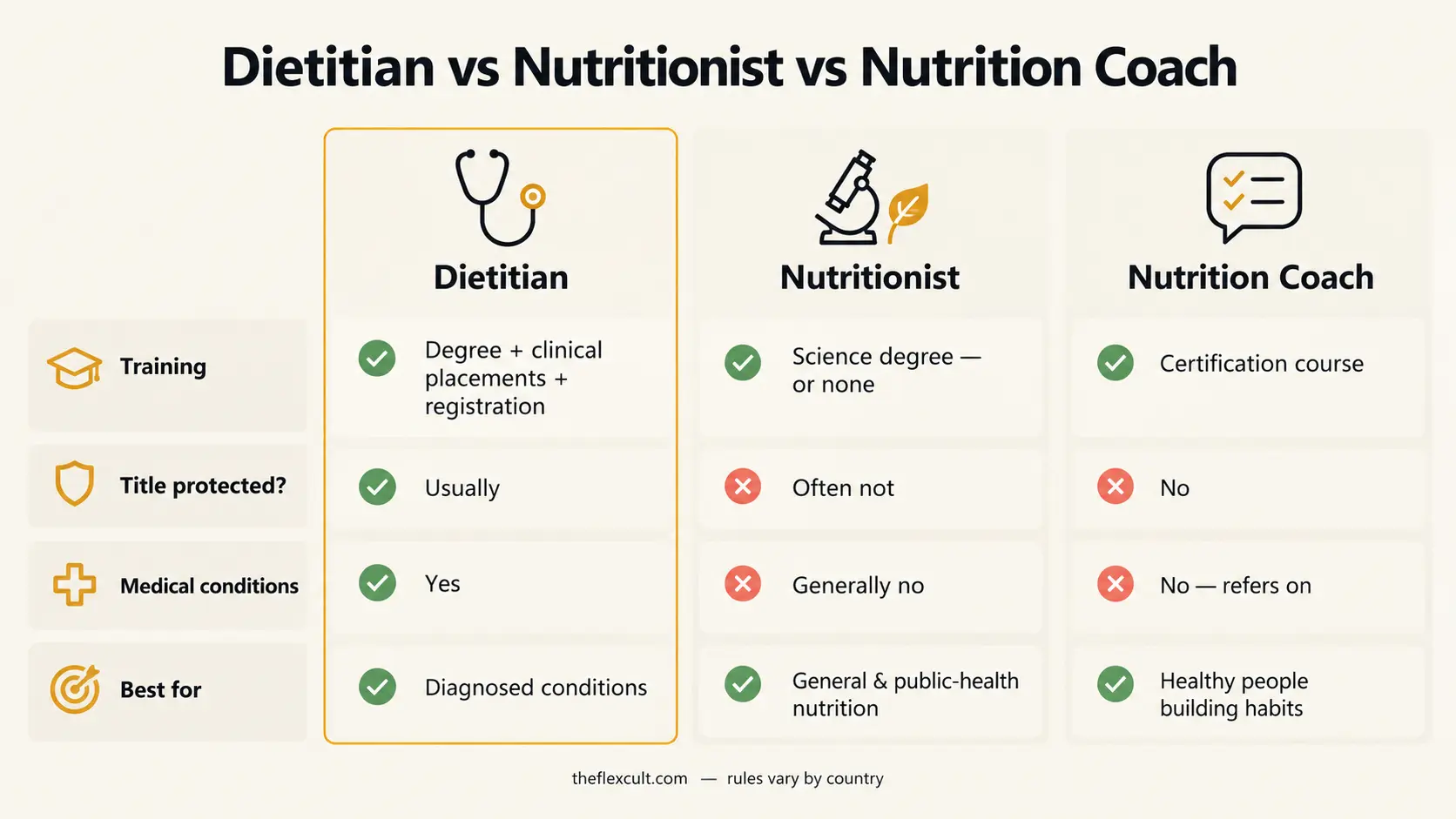
Side-by-Side Comparison
| Dietitian | Nutritionist | Nutrition coach | |
|---|---|---|---|
| Typical training | Dietetics degree + supervised clinical practice + registration exam | Ranges from a science degree to no formal training | Certification course (weeks to months) |
| Title protected? | Usually, in countries that regulate it | Often not — "registered" versions may be | No |
| Medical conditions | Yes — core of the role | Generally no | No — refers onward |
| Therapeutic diets | Yes | Generally no | No |
| Habit and behaviour coaching | Sometimes | Sometimes | Yes — core of the role |
| Typical settings | Hospitals, clinics, private practice | Research, public health, industry, media | Gyms, online coaching, workplaces |
| Ongoing education | Mandatory to stay registered | Depends on register | Depends on certifying body |
Rules differ widely between countries and even between states or provinces. Treat the table as a general pattern, and check the regulator where you live before relying on any title.
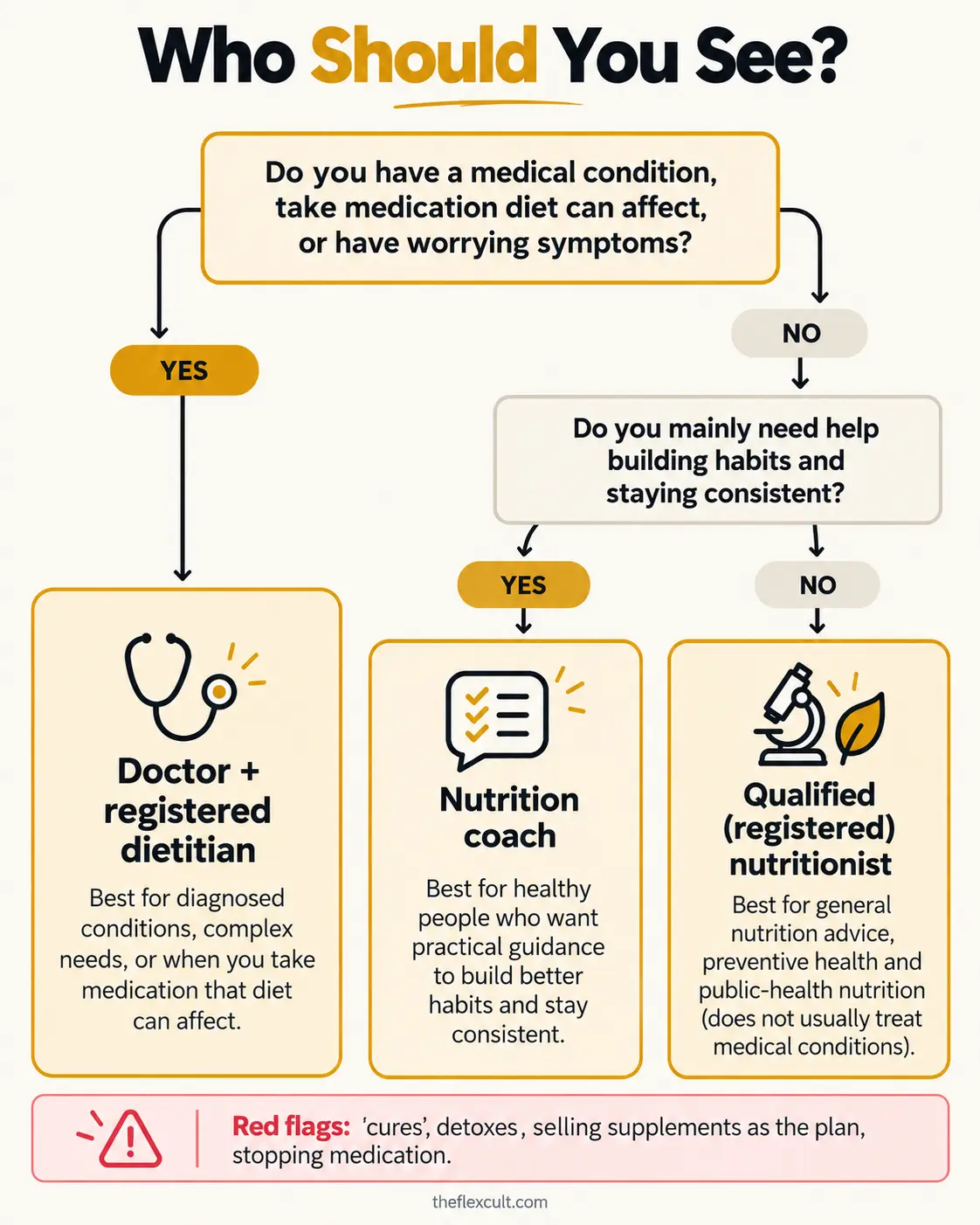
Who Should You See? A Practical Guide
The right professional depends on the problem, not the title that sounds most impressive. Use this as a starting point:
-
See a doctor and dietitian if… You have a diagnosed condition (such as diabetes, heart, kidney or digestive disease), a food allergy, take medication affected by diet, are pregnant with complications, have unexplained weight loss or symptoms, or have a history of disordered eating.
-
A qualified nutritionist may suit you if… You want evidence-based general nutrition information, workplace or community nutrition programmes, or help interpreting nutrition research — and you've confirmed their degree or registration.
-
A nutrition coach is a good fit if… You're generally healthy, broadly know what to eat, and need structure, accountability and realistic habits to reach goals like fat loss, more energy or better training performance.
How to Check Someone's Credentials
- Ask for the exact credential, not just the title — "Registered Dietitian with [national body]" or "Precision Nutrition Level 1 certified", not "nutrition expert".
- Look them up on the register. Most countries that regulate dietitians have a public online register. Voluntary nutritionist registers usually do too.
- Ask how they handle medical issues. A coach or nutritionist should describe a clear referral process. Vagueness here is a warning sign.
- Check that the advice is evidence-based. Ask where their recommendations come from. A good answer mentions research or official guidelines, not testimonials.
- Watch for conflicts of interest, such as a "plan" built around products they sell.
The downloadable vetting checklist below turns these questions into a simple score, so you can compare practitioners side by side.
Common Myths About All Three
- "Nutritionist and dietitian mean the same thing." Sometimes the person behind each title has similar training — but only the dietitian title reliably guarantees clinical training and regulation in countries that protect it. "Nutritionist" alone tells you very little until you know the credential behind it.
- "A nutrition coach is just a cheaper dietitian." It's a different job, not a discount version of the same one. A good coach's value is behaviour change and accountability over weeks and months; a dietitian's is clinical assessment and therapeutic planning. Many people benefit from both — a dietitian sets the medical plan, and a coach helps with the daily habits around it, within the dietitian's guidance.
- "Coaches aren't allowed to talk about food." They are. Sharing general, evidence-based healthy-eating guidance — protein at meals, more vegetables, fewer ultra-processed foods, hydration — is squarely within a coach's role. What's out of scope is using food to diagnose or treat a medical condition.
- "More letters after a name means better advice." Not necessarily. A long list of short online certificates isn't the same as one rigorous qualification. Look for an accredited degree or a recognised certification, plus a clear referral process, rather than counting acronyms.
- "Online nutrition advice is fine if the account is big." Follower count isn't a credential. Some of the most popular nutrition content online comes from people with no formal training at all — check before you change your diet based on it.
Want to Work in Nutrition? Choosing Your Path
If you're on the other side of the table — thinking about a career — the three routes lead to very different jobs:
- Dietetics is the path if you want clinical work with patients and medical conditions. Expect a degree, supervised placements and registration — typically four years or more, depending on your country.
- Nutrition science suits research, public health, food industry and education roles. It's a degree route, but usually without the clinical scope of dietetics.
- Nutrition coaching is the fastest route if you want to help healthy clients change habits — especially alongside personal training. A good certification can be completed in weeks to months.
If coaching is your direction, the free Become a Gym Nutrition Coach course covers the role, the certification landscape and knowing your limits with special populations. Trainers weighing it up as extra income should read whether nutrition coaching is a good side hustle, and the free Which Certification Is Right for You? quiz takes about two minutes. Once you've picked a certification, there's free, independent exam prep for both Precision Nutrition Level 1 and NASM-CNC.
And if you just want to eat better yourself, you don't need any professional at all to start. The free Eat With Intent course and the 14-Day Meal Prep Challenge cover the fundamentals, and reading a nutrition label in 30 seconds is a good first skill.
Final Thoughts
None of these three roles is "better" than the others. They do different jobs. Dietitians handle the clinical side of nutrition, qualified nutritionists bring the science, and nutrition coaches help healthy people turn knowledge into habits. Problems only start when someone works outside their lane — or when a title is used to imply training that isn't there.
Don't choose the most impressive-sounding title. Choose the professional whose training matches your problem — and who's honest about when to send you to someone else.
This article is general information, not medical or dietetic advice. Professional titles, training requirements and legal scope vary by country and region — check your local regulator. If you have a medical condition, take medication, are pregnant, or have concerns about your eating, speak to a doctor or registered dietitian. The Flex Cult is not affiliated with Precision Nutrition or NASM.
Sources
[1] Working in Nutrition — FAQs (dietitian vs nutritionist, protected titles, HCPC and UKVRN registration). British Nutrition Foundation. Available at: nutrition.org.uk
[2] How to Become a Registered Dietitian — CDR graduate-degree requirement (from January 1, 2024), ACEND-accredited supervised practice and the national registration exam. Tulane University School of Public Health. Available at: sph.tulane.edu