
If you've searched "is the NASM exam hard," you've probably already seen both extremes — forum posts calling it brutal, and others saying they passed after a couple of weekends. Neither tells you much about how you'll do. What actually helps is knowing what the exam is, what the published pass rates really mean, where the marks are concentrated, and which specific topics catch prepared people out.
This is that breakdown — built from NASM's own published exam information and statistics, with a practical study checklist at the end. It's written for anyone who has chosen NASM (or is close to it) and wants a realistic picture before booking an exam date. If you're still choosing between certifications, start with the NASM vs ACE vs ISSA comparison first.
The Short Answer: Moderately Hard, Very Passable
In other words, the exam rewards understanding over memorisation. You'll rarely be asked to recite a definition. You'll be asked what to do with a client who shows a specific compensation, which phase of training fits a goal, or which regression is appropriate — questions where knowing the concept well enough to apply it is the whole test.
The NASM CPT Exam at a Glance
Before judging difficulty, it helps to know exactly what you're sitting. These are the core facts from NASM's official exam information pages:[2][3]
| Detail | What NASM states |
|---|---|
| Number of questions | 120 multiple-choice — 100 scored, plus 20 unscored pretest items you can't identify |
| Time limit | 2 hours (about 60 seconds per question) |
| Passing score | Scaled score of 70 or higher |
| Format | Closed-book; at a PSI testing centre or via remote proctoring |
| Window to sit the exam | Within 180 days of purchasing your programme |
| Before you can test | Current CPR/AED certification and a valid government-issued photo ID |
| Retake waiting periods | 1 week after a first fail, 30 days after a second, 1 year after a third or later |
| Renewal | Every 2 years, with 2.0 CEUs (about 20 contact hours) |
Policies and fees change, so treat this as a snapshot and confirm the current details on nasm.org before you register. The free NASM-CPT study companion keeps an Exam Snapshot block that's re-checked against NASM's outline every six months.
What the NASM Pass Rate Actually Tells You
NASM is one of the few certifying bodies that publishes candidate statistics. Its 2023 report covers November 1, 2022 to November 1, 2023: 33,496 candidates sat the NASM-CPT exam, 26,696 passed and 6,800 didn't — a 79% pass rate.[1] NASM's current FAQ goes further, stating that roughly 85% of candidates pass on their first attempt based on its most recently reported 2025 data.[2]
Older blog posts often quote much lower first-time pass rates, but those figures rarely cite a source. NASM's own numbers are the ones to trust. They still deserve some context:
- It's a self-selected group. Almost everyone sitting the exam has paid for a study programme and chosen when to test. A high pass rate reflects a prepared population, not an easy exam.
- "Most pass" still means thousands don't. Even at 85%, roughly one in seven first-time candidates fails — and at 79%, it's about one in five. Each of those people paid for a retest and lost weeks.
- Scaled scoring hides the raw cut-off. A scaled 70 isn't necessarily "70 out of 100 correct." Scaling adjusts for differences in difficulty between exam versions, so aiming to scrape 70% on practice tests is cutting it fine.
What Actually Trips People Up
When candidates fail, it's rarely because the whole exam was over their head. It's usually a cluster of specific topics plus the question style. NASM Master Instructor Rick Richey's exam advice points at the same high-yield areas that come up again and again:[4]
-
Overactive vs underactive muscles Linking each overhead squat compensation (feet turning out, knees caving in, excessive forward lean, low back arching, arms falling forward) to the muscles that are likely overactive and underactive. It's pure recall under pressure, and there's a lot of it.
-
OPT model acute variables The reps, sets, tempo, intensity and rest that define each of the five OPT phases. Questions often give a client goal and ask which phase — or which variable — fits.
-
Progressions and regressions Knowing the next harder or easier version of an exercise, and why. Two answer options often look reasonable; only one follows the right progression logic.
-
Scenario questions that cross domains A single question can need assessment, program design and coaching knowledge at once — for example, a deconditioned client with a specific compensation and a motivation issue.
-
Cueing and exercise categorisation Which exercise belongs to which training type (stabilisation, strength, power), and how to cue it correctly. Easy to skim during study, easy to second-guess on the day.
-
Overthinking under time pressure Two hours sounds generous, but people who agonise over early questions end up rushing the last 30. Richey's own advice: trust your first instinct, answer what you know first, and flag the rest.
Two of those topics have dedicated free lessons: Assessment & Program Design Basics covers the overhead squat assessment and its compensations, and The OPT Model Explained walks through all five phases and their acute variables. If the terms themselves are new, progressive overload and reps and sets for each goal are good plain-English warm-ups.
Where the Points Are: The Six Exam Domains
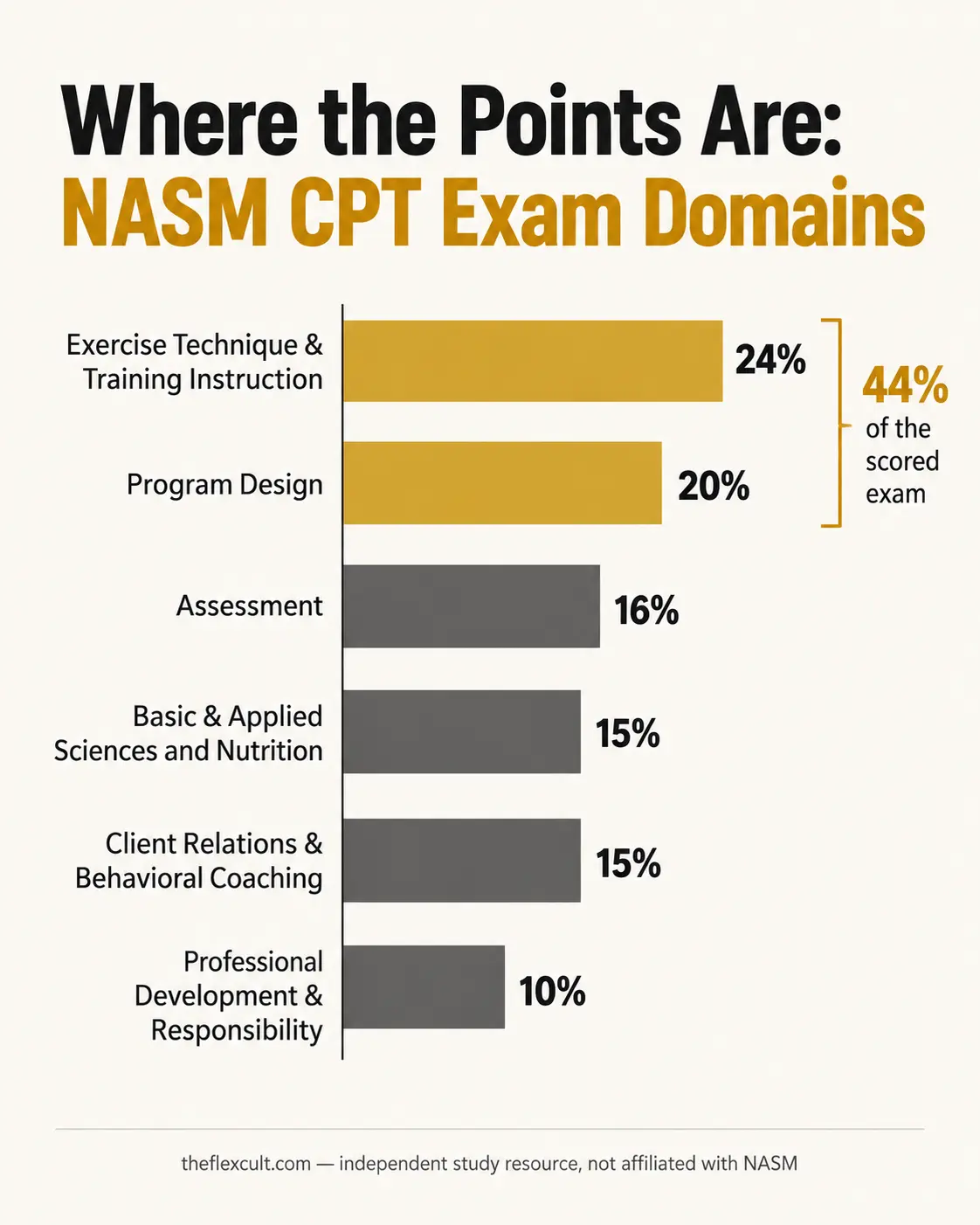
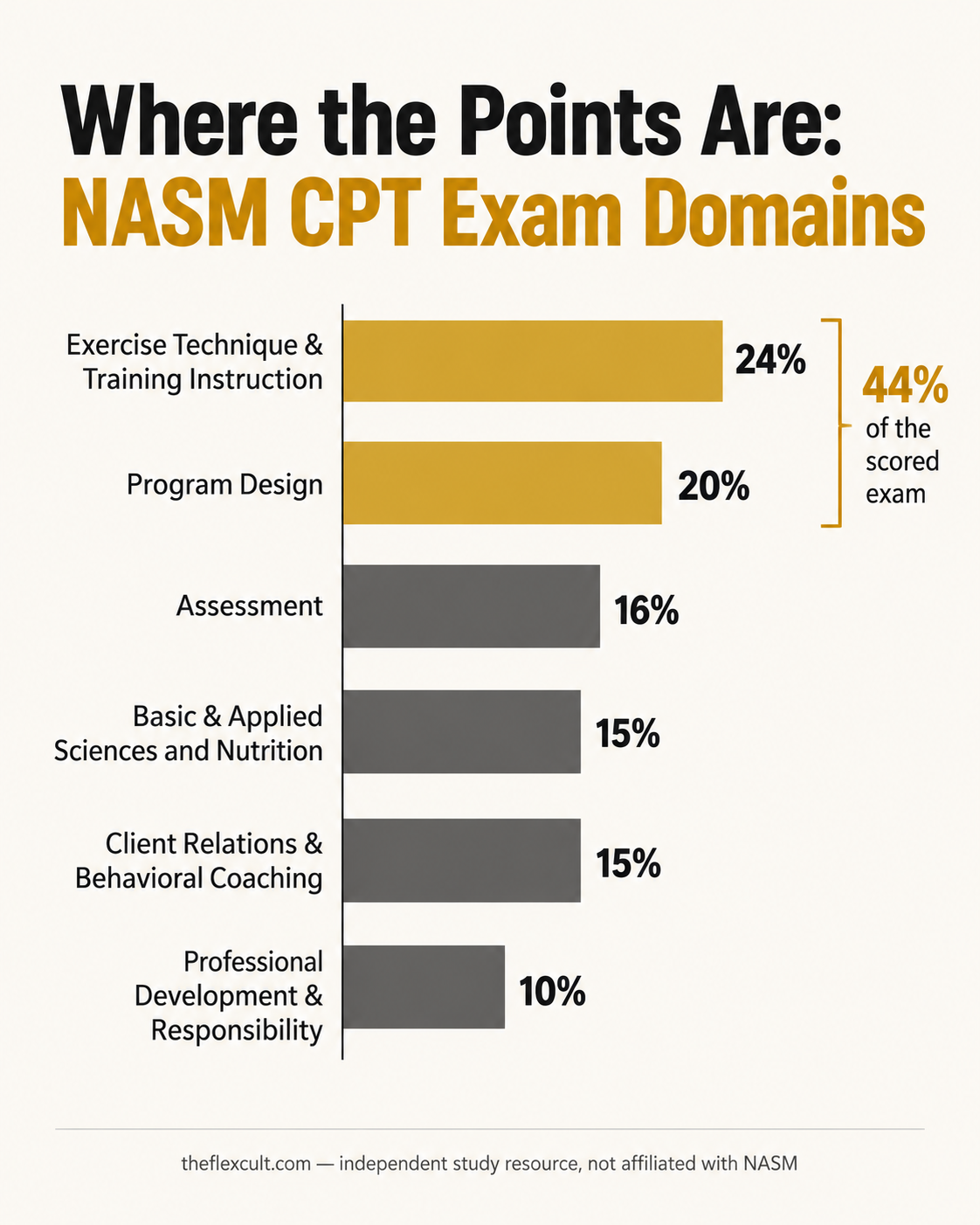
NASM weights the exam across six domains. Nearly half the scored questions come from just two of them, which is why studying "chapter by chapter, equally" is one of the least efficient ways to prepare.[4][5]
| Domain | Weight | Free lessons that cover it |
|---|---|---|
| Exercise Technique & Training Instruction | 24% | Lessons 7–12 (flexibility, cardio, core, balance, plyometrics, SAQ) |
| Program Design | 20% | Lessons 13–16 (assessment-to-program, OPT model, modalities, special populations) |
| Assessment | 16% | Lesson 6 (screening, vitals, body composition, posture) |
| Basic & Applied Sciences and Nutritional Concepts | 15% | Lessons 1–5, 17–18 |
| Client Relations & Behavioral Coaching | 15% | Lesson 19 (stages of change, OARS, SMART goals) |
| Professional Development & Responsibility | 10% | Lesson 20 (business, scope, liability) |
A good rule: split your study hours roughly in proportion to these weights, then shift extra time toward whichever domain your practice scores show is weakest. The free one-page domain cram sheets on the NASM-CPT syllabus page are built around the same six domains.
How Long Should You Study?
NASM says many candidates finish in 4 to 6 weeks at about 10–15 hours per week.[2] That's realistic if you're studying close to full-time, or already have an exercise science background. For most people fitting this around a job, a steadier pace works better:
| Your situation | Weekly study time | Realistic timeline |
|---|---|---|
| Exercise science degree or coaching experience | 8–10 hours | 4–6 weeks |
| Regular gym-goer, no formal background | 6–8 hours | 8–10 weeks |
| Complete beginner, working full-time | 5–6 hours | 10–12 weeks |
All three timelines fit comfortably inside NASM's 180-day window. The bigger risk isn't running out of time — it's drifting. People who don't book an exam date tend to study in bursts, forget earlier material, and push the date back. Book it first and plan backwards.
A Study Approach That Actually Works
Two of the most reliable findings in learning research apply directly here. Retrieval practice — testing yourself instead of re-reading — produces much better long-term recall. In Roediger and Karpicke's well-known study, students who practised recalling material remembered far more a week later than students who spent the same time re-studying it.[6] Spaced practice — revisiting material across several sessions instead of cramming it once — improves retention too, across hundreds of studies.[7]
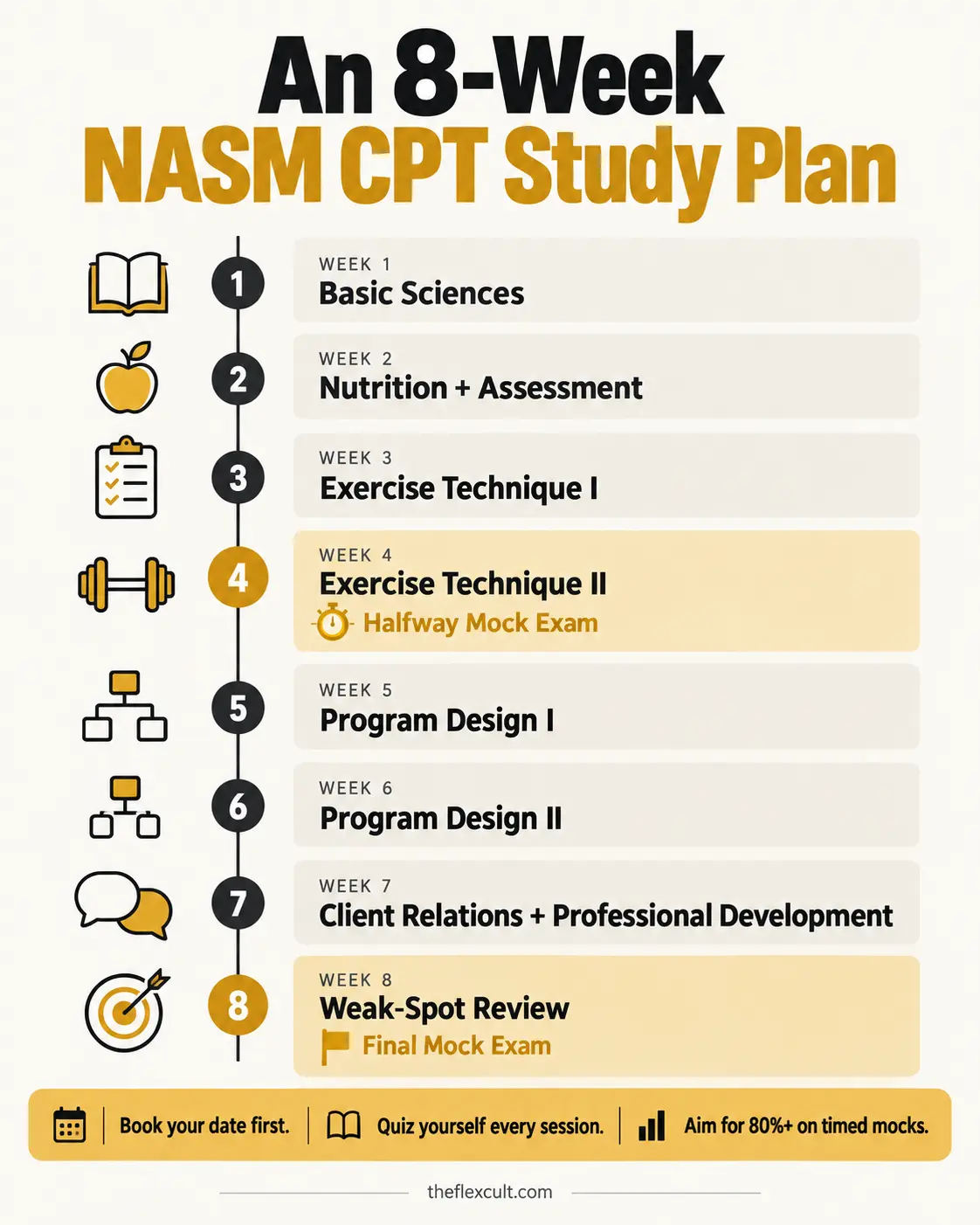
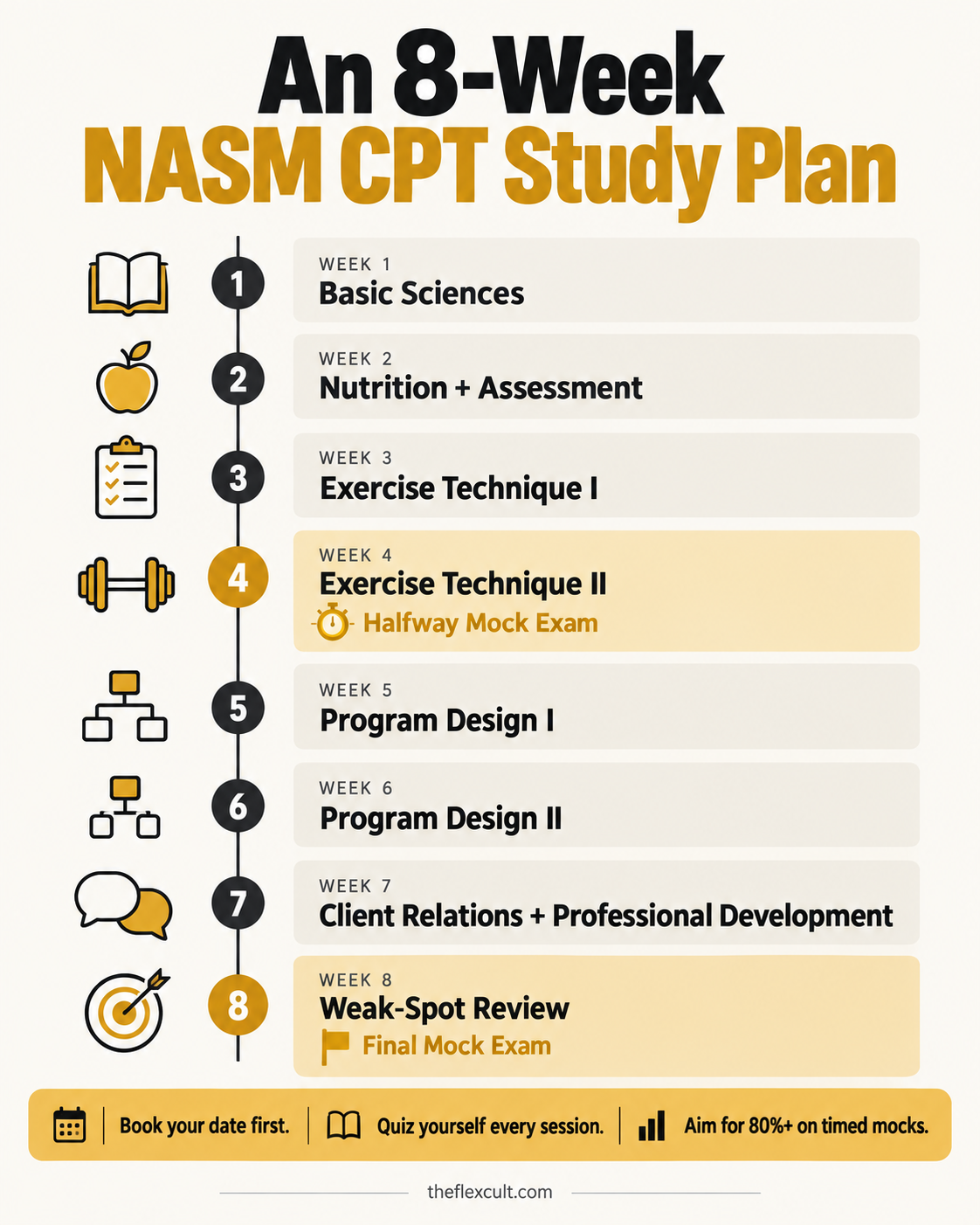
Put together, that gives you a simple weekly rhythm:
- Book your exam date before you start. A fixed deadline turns "studying for NASM" into an actual plan.
- Study by domain weight, not chapter order. Give Exercise Technique and Program Design the most hours.
- End every session with questions, not notes. Each lesson's knowledge-check quiz is your retrieval practice — do it even when you feel shaky.
- Revisit, don't just move on. Spend the first 10 minutes of each session quizzing yourself on something from one or two weeks earlier.
- Make a one-page "compensation sheet." Write out every overhead squat compensation with its overactive and underactive muscles from memory, then check it. Repeat until it's automatic.
- Take a full timed mock at the halfway point and again a week before the exam. Use the results to rebalance your remaining hours.
Short, focused blocks work better than long, distracted ones. The free Pomodoro Timer is a simple way to run 25-minute study sprints with built-in breaks, and the same tracking logic you'd use for training works for study hours too.
Are You Ready? A Pre-Exam Checklist
You're probably ready to sit the exam if you can tick all of these honestly:
- You score in the 80s on at least two full-length, timed practice exams — such as the free 120-question NASM-CPT mock exam.
- You can write every overhead squat compensation with its overactive and underactive muscles from memory.
- You can name all five OPT phases and their main acute variables without looking.
- You can give a progression and a regression for core, balance and plyometric exercises.
- No single domain is more than 10 points below your overall practice score.
- Your CPR/AED certification is current, your ID is valid, and you've tested your setup if you're taking it remotely.
If two or more of these are shaky, it's usually cheaper in time and money to move your exam date back a week or two than to risk a retest.
If You Don't Pass the First Time
Failing once is common enough that NASM has a clear process. You can retest after 1 week following a first failed attempt, after 30 days following a second, and after 1 year following a third or later.[2][3] A retest fee applies unless your package includes a free retest — check the current price on nasm.org.
Don't restart from page one. Look at your weakest domains on the score report, put about 70% of your remaining time into those, and keep doing timed practice tests. One extra week of focused review is usually enough to close the gap if you were close to passing.
Is It Worth the Effort?
For most people who want to coach general-population clients, yes. NASM is NCCA-accredited and widely recognised by gyms, and the exam's focus on assessment and corrective programming is useful on the gym floor, not just on test day.[3] The certificate itself doesn't make you a good trainer — your first clients will teach you more than any exam — but it's a credible starting point. If you're still deciding whether this career is for you, the free Become a Personal Trainer course covers pay, getting clients and specialisation options. Many trainers also add nutrition coaching later as a second income stream.
Final Thoughts
The NASM CPT exam isn't designed to catch you out. It's designed to check whether you can apply a specific model — NASM's OPT approach — to realistic client situations. That's why passive re-reading underperforms, and why a handful of topics (compensations, acute variables, progressions) decide so many results.
The exam isn't hard because the questions are tricky. It's hard for people who prepare by reading instead of testing themselves.
Book a date, weight your study by domain, quiz yourself every session, and don't sit the real thing until your timed practice scores give you a buffer. If you want a structured, free way to do all of that, the NASM-CPT study companion follows the real chapter structure and domain weighting, with a quiz at the end of every lesson and a full mock exam.
The Flex Cult is an independent study resource and is not affiliated with, endorsed by, or acting on behalf of the National Academy of Sports Medicine (NASM). Exam format, pass-rate figures, fees and policies are taken from NASM's published materials at the time of writing and can change — always confirm current details at nasm.org before registering.
Sources
[1] NASM-CPT Exam Data Statistics, reporting period Nov 1, 2022 – Nov 1, 2023. National Academy of Sports Medicine. Available at: nasm.org
[2] NASM FAQs — exam format, first-attempt pass rate, study time, retest policy and recertification. National Academy of Sports Medicine. Available at: nasm.org
[3] NASM Certified Personal Trainer — Exam Information. National Academy of Sports Medicine. Available at: nasm.org
[4] How to Pass the NASM CPT Exam: Top 10 Tips (Rick Richey, NASM Master Instructor). NASM Blog. Available at: blog.nasm.org
[5] NASM-CPT Exam Snapshot and domain weighting (blueprint verified July 2026). The Flex Cult. Available at: theflexcult.com/certifications/nasm-cpt
[6] Roediger HL, Karpicke JD. Test-enhanced learning: taking memory tests improves long-term retention. Psychological Science, 2006. Available at: pubmed.ncbi.nlm.nih.gov
[7] Cepeda NJ, Pashler H, Vul E, Wixted JT, Rohrer D. Distributed practice in verbal recall tasks: a review and quantitative synthesis. Psychological Bulletin, 2006. Available at: pubmed.ncbi.nlm.nih.gov